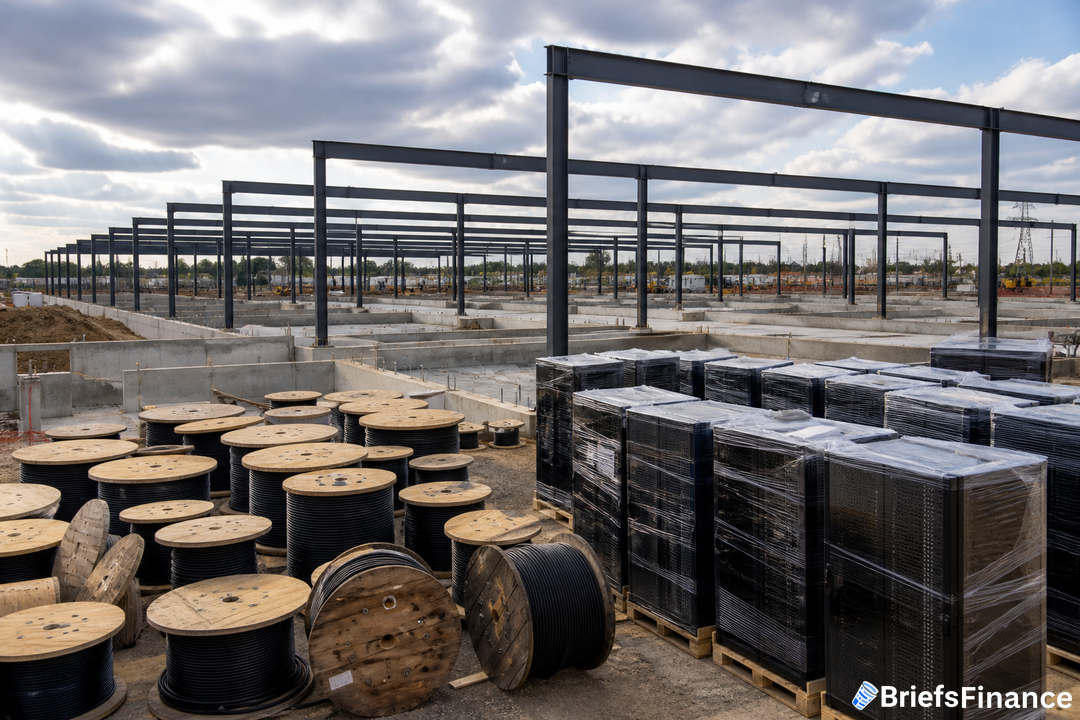
Why tech firms are borrowing at scale
For years, internet-era giants mostly recycled enormous profits back into their businesses, with bonds playing a background role. Starting in late 2025, that flipped as companies began issuing tens of billions in debt to rapidly expand AI capacity. Newer players like OpenAI and Anthropic have raised billions from venture backers, but the biggest names are increasingly turning to credit markets to stand up data centers and compute.
The totals are massive. Bloomberg's tally shows global AI infrastructure debt sales running around $450 billion so far in 2026. Separately, four leading U.S. tech companies said they expect to commit about $745 billion in total this year to AI expansion, spanning computing sites, network hardware, and associated infrastructure. Alphabet, for example, projected $180 billion to $190 billion in technical infrastructure spending for 2026, roughly twice last year's level, and expects that number to increase in 2027.
Concrete deals and who is borrowing what
The financing mix runs from plain-vanilla bonds to project loans and off-balance-sheet structures. In early October, Bloomberg reported that SpaceX was talking with banks and investors about borrowing $40 billion to buy Nvidia chips. SpaceX is the owner of xAI, which runs the Grok chatbot, as well as X, the social network. Around the same period, Broadcom Inc. pulled together a group of finance firms aiming to raise $60 billion to fund AI chips for Anthropic PBC, the Claude maker, and additional companies.
Debt taps are widespread. In March, Amazon.com Inc. tapped Europe's bond market for the first time, bringing in €14.5 billion ($16.2 billion), then issued over $60 billion in the U.S., and later in September added £4.25 billion ($5.62 billion) in the U.K. On April 30, Meta Platforms Inc. raised $25 billion through an investment-grade bond sale to help fund its AI expansion. Alphabet also issued a 100-year bond in early 2026, a rarity in tech since the late 1990s that appealed to investors like insurers and pensions.
Project finance is having a moment. Oracle Corp. has been lining up a mix of corporate borrowing and project loans to build data centers across the U.S. Many companies are using special-purpose vehicles to buy servers and related gear so the debt sits off the parent's balance sheet, easing ratings pressure. In late 2025, Musk's xAI considered as much as $20 billion in financing using entities set up to purchase the chips and then rent them to the company, and it struck deals with Apollo and additional partners, among them a $7 billion arrangement linked to access to Nvidia.
Investors got jittery in late 2025 when large tech companies raised nearly $100 billion within weeks to boost cloud and data center capacity. That burst came after roughly $30 billion was raised for a Meta data center in Louisiana via an SPV, with repayment to lenders structured under a long-term lease with Meta.
Funding AI with debt rather than cash flow changes who carries the risk. Market Briefs covers that shift free every weekday.
Costs, risks and where the money goes
Most of this capital is headed to AI hardware, services and real estate. Chips are only part of it. Power and people are big ticket items too.
In late 2025, Alphabet bought a clean energy developer to help feed its data centers as the U.S. grid strains to keep up. Meta has been spending millions to recruit skilled engineers. The profit engines funding the push are still humming: In the second quarter of 2026, Google reported revenue of more than $119 billion.
Not every company wants to lean on debt. Some private companies, including OpenAI and xAI, have brought in billions by selling equity, a route that dilutes current shareholders. OpenAI boosted its revolving loan to above $5 billion, and Anthropic increased its revolving credit facility to $15 billion in advance of its planned initial public offering.
Even with the borrowing burst, major data center operators are expected to keep total debt low relative to annual earnings. Still, the pace and size are striking, and they are coming from some of the most profitable, highly rated companies rather than the riskier borrowers that defined past booms. The flood of new deals, plus likely needs next year, has made some investors pickier. The surge of new tech deals could alter credit markets by soaking up investor demand.
There are credit implications. In July, S&P Global Ratings downgraded Oracle by one notch, citing rising AI-related spending. Some see echoes of the dot-com era's fiber buildout, when telecoms borrowed heavily for network capacity. The difference now is that today's largest issuers are more diversified and profitable.
What this means for your portfolio
Cheap it is not. The numbers are huge, timelines are long and rates are still elevated, yet the pressure to build is relentless. Keep an eye on three things: how effectively companies use SPVs to manage leverage, whether AI-driven cash flows materialize, and how welcoming bond buyers stay as the calendar flips.
If the payoffs show up, balance sheets can hold. If they don't, the risk is expensive data centers, fast-aging hardware and tighter credit profiles that could sap future growth.
The bond market is now central to how AI gets built. Join Market Briefs free and follow the issuance.