Free NewsletterPro Login
S&P 500 6,287 +0.42%
DOW 44,521 -0.18%
NASDAQ 21,103 +0.71%
S&P 500 +12.4%
Briefs Finance Fund +24.8%
JOIN THE FUND →

Supreme Court Justices Request $20.6 Million Budget Increase; Barrett Details Swatting and Bulletproof Vest

Published Jul 14, 2026
[tts_player]
Share:
Summary:
  • The Supreme Court is requesting $228.4 million for FY2027, a 10% increase from $207.8 million.
  • Justice Barrett disclosed a swatting incident at her home and receiving a bulletproof vest after the abortion opinion leak.
  • The hearing marked the first time any justice testified before Congress since 2019.

First Testimony Since 2019

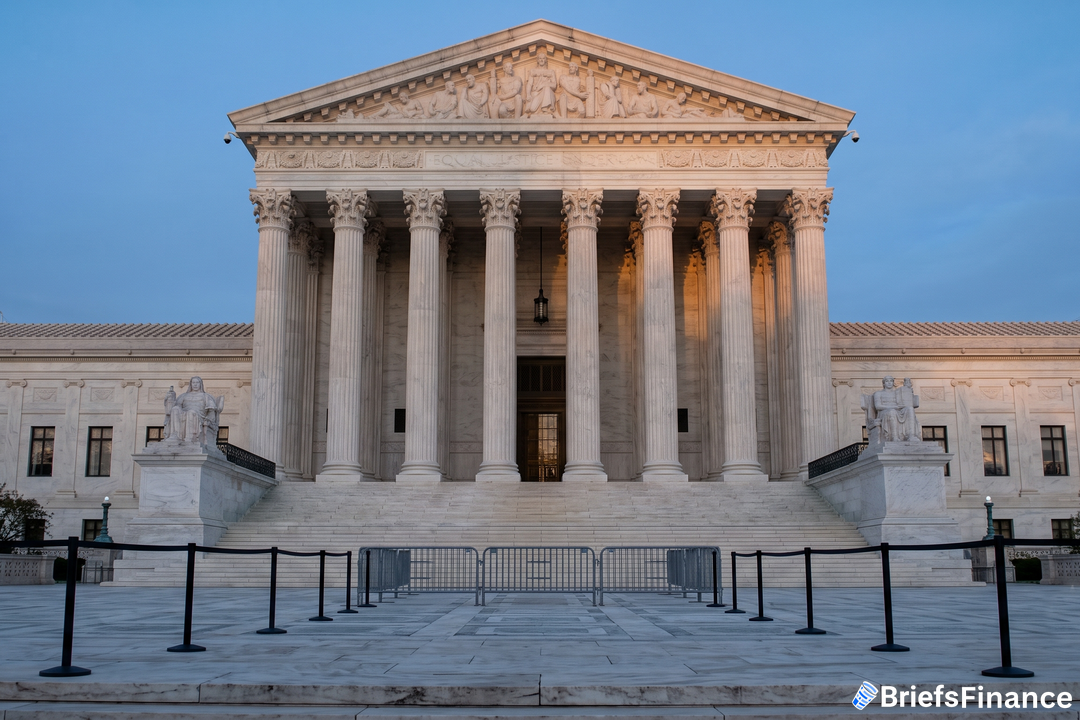
For the first time since 2019, two Supreme Court justices - Amy Coney Barrett and Elena Kagan - appeared before a House panel on July 14, 2026, specifically, the House panel responsible for financial services and general government appropriations, to discuss the court's budget.

The main reason was the court's budget request for the 2027 fiscal year.

Barrett told the subcommittee the situation is serious.

The Threat Level Is 'Really High'

Barrett did not sugarcoat it. "The threat level is really high," she said.

Get the market news that matters in a five-minute read with Market Briefs, our free daily newsletter

She gave a very personal account. A "swatting" incident happened at her home.

During a swatting incident, someone deceives law enforcement by reporting a false emergency - such as a shooting or loud arguments - at a person's residence.

Later, a draft opinion was leaked that overturned the Court's prior ruling establishing a constitutional protection for abortion. After that leak, Barrett stated, "I was given a bulletproof vest by my security."

"Those statistics sound abstract, but being on the receiving end of them is not," Barrett said.

What the Budget Request Means

The Supreme Court's security measures have faced heightened scrutiny after the controversial leak of the Dobbs draft opinion in 2022, which prompted protests outside justices' homes and led to an assassination attempt against Justice Brett Kavanaugh. The attempt featured an armed individual who drove to Kavanaugh's home carrying a handgun, ammunition, zip ties, and additional equipment, and later confessed to police that his plan was to assassinate the justice. The incident underscored the dangers justices face.

The elevated security risks have significantly altered the Court's daily operations. Following the Dobbs leak, the U.S. Marshals Service ramped up around-the-clock protection for all nine justices, and the Court implemented stricter screening of visitors and mail. Barrett's firsthand account of receiving a bulletproof vest and being targeted in a swatting call illustrates the personal toll of this ongoing security crisis - one that the requested $20.6 million increase aims to address through enhanced cybersecurity, building protections, and expanded personnel for justice safety.

This budget request comes amid ongoing concerns about the safety of federal judges across the country. In recent years, threats against judges have risen dramatically, prompting Congress to pass the Daniel Anderl Judicial Security Act in 2022, which expanded protection for judges and their families. The Supreme Court's own security measures have been upgraded multiple times since the Dobbs leak, including the installation of fencing around the building and increased screening of visitors. The requested funds would help sustain and enhance these protections.

The $228.4 million request for fiscal 2027 includes not only increased security for justices but also enhanced cybersecurity and building protections.

This story is still developing; check back later for the latest information.

Join Market Briefs, our free daily newsletter, for a quick daily rundown of the markets
Disclosure

Recent News

1 2 3 35

Get Market Briefs delivered to your inbox every morning for free!

No fluff. No noise. No politics. Just finance news you can read in 5 minutes.

Blogs

June 29, 2026
Portfolio Diversification: Why Putting All Your Eggs in One Basket Destroys Wealth
  • Real diversification means spreading investments across all 11 economic sectors plus bonds, alternatives, and cash so no single bet can sink the portfolio.
  • Different sectors perform at different times, so a diversified portfolio captures upswings while smoothing the brutal drawdowns that wipe out concentrated bets.
  • Total market index funds offer the simplest path to diversification, and annual rebalancing is what keeps the structure working over time.
Read More
June 29, 2026
Non Taxable Income: What It Is and Why It Matters
  • Non taxable income is money you receive that you don't owe income tax on.
  • The tax code treats workers, investors, and business owners very differently, and investors often come out ahead.
  • Learning how income is taxed is a quiet superpower for keeping more of what you earn.
Read More
June 29, 2026
Semiconductor Stocks: A Simple Guide for Investors
  • Semiconductor stocks are companies that design and make computer chips, the brains inside nearly every modern device.
  • The AI boom has turned chips into one of the market's most important and most watched groups.
  • They offer big growth potential, but come with high valuations and a notoriously cyclical history.
Read More
June 25, 2026
How Stocks Work: A Simple Guide for Beginners
  • A stock is a slice of ownership in a company - buy one, and you own a piece of the business.
  • You make money two ways: the share price rising over time, and dividends paid to shareholders.
  • The simplest path for most beginners is buying into the whole market through a low-cost index fund.
Read More
June 25, 2026
Stop Loss vs Stop Limit: What's the Difference?
  • A stop loss order sells your stock once it hits a trigger price, prioritizing getting you out.
  • A stop limit order only sells within a price range you set, prioritizing price over a guaranteed exit.
  • The trade-off: a stop loss almost always executes; a stop limit might not if the price moves too fast.
Read More
June 25, 2026
Energy Stocks: A Simple Guide for Investors
  • Energy stocks are companies that produce and supply the power the world runs on, from oil and gas to newer sources.
  • They make up one of the 11 sectors of the market and tend to move with energy prices and big-picture shifts.
  • Like any sector, the key is diversification and understanding the forces driving demand.
Read More
June 18, 2026
What Is a Stop Loss Order? A Simple Guide
  • A stop loss order automatically sells a stock once it falls to a price you set.
  • It's a tool to cap losses or lock in gains without watching the market all day.
  • It works best for active strategies, and can backfire if used carelessly on long-term holdings.
Read More
June 18, 2026
Best S&P 500 Index Fund: How to Choose One
  • The best S&P 500 index fund for most investors is simply the cheapest, most established one that tracks the index well.
  • Funds like VOO, IVV, and SPY all hold the same 500 companies, so the biggest difference is the fee.
  • Pick one, automate your buys, and let time do the heavy lifting.
Read More
June 17, 2026
What Are Penny Stocks? Risks and Rewards Explained
  • Penny stocks are very low-priced shares of very small companies, often trading for just a few dollars or less.
  • They promise huge gains but carry huge risks: low liquidity, high failure rates, and wild price swings.
  • Most investors are better served by quality companies and funds than by chasing cheap shares.
Read More
June 17, 2026
Best Stocks for Beginners With Little Money
  • The best stocks for beginners with little money usually aren't individual stocks at all - they're low-cost index funds.
  • You can start with $100 or less and use small, regular investments to build wealth over time.
  • Focus on diversification and consistency, not on picking the next big winner.
Read More
1 2 3 24
Share via
Copy link











