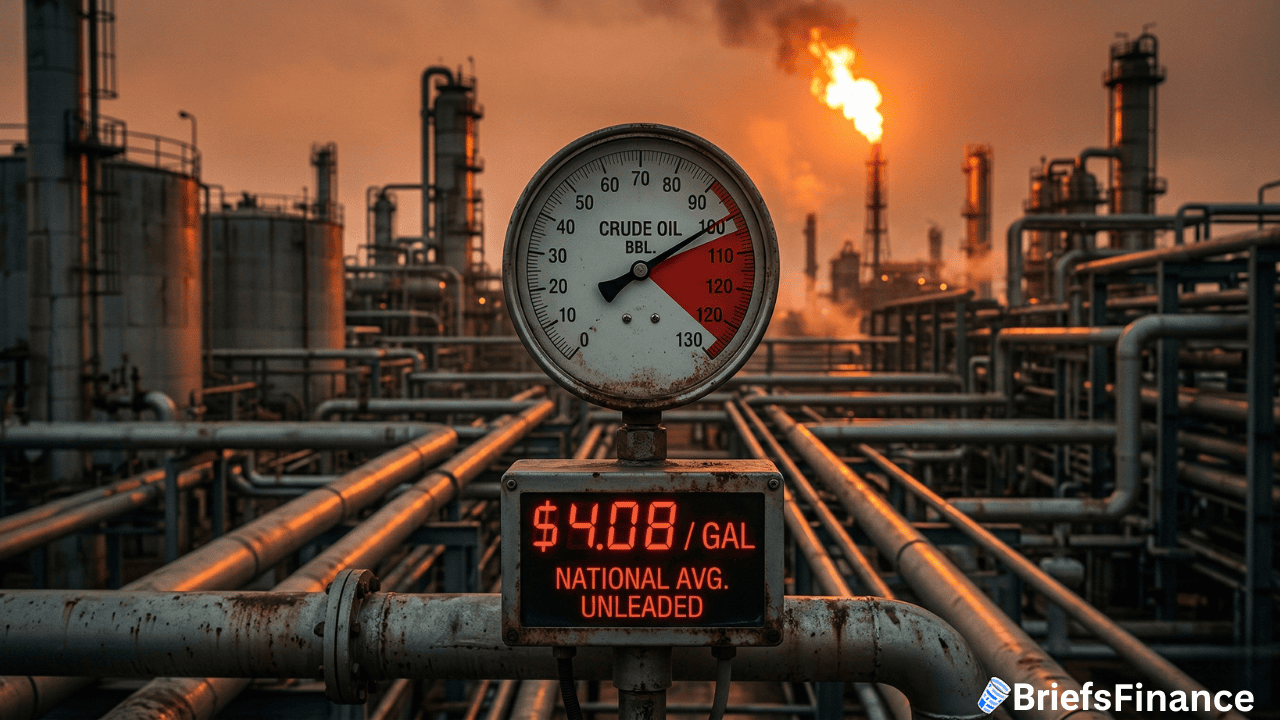
A gallon of gas costs $1.10 more today than it did before the first bombs dropped. Diesel cracked $5.51 a gallon.
That's the price of a war with no end date.
Trump Promised Speed. Markets Wanted a Plan.
President Trump went on national TV Wednesday night and said the fighting with Iran would be over "shortly." In the same breath, he promised additional strikes stretching out another two to three weeks.
What he didn't offer was a road map. No ceasefire framework. No plan for unlocking the Strait of Hormuz - the chokepoint where about 20% of the world's oil moves through.
His answer on the strait: it would "open up naturally."
Crude started running higher the moment Trump started talking and kept going through Thursday. By the afternoon, U.S. crude was up 12% and trading north of $112.
Brent crude - the price the rest of the world watches - tacked on 8% to push past $109.
One bright spot did surface midday. Iran's deputy foreign minister mentioned a possible "new navigation regime" for the strait after fighting wraps up.
That pushed U.S. stocks off their lows - the S&P 500 trimmed its drop to just 0.3% by early afternoon. Oil barely flinched at the comment.
The Damage Is Spreading
This isn't just an oil story anymore. It's showing up in borrowing costs.
A 30-year fixed mortgage is running 6.41% right now. The day before bombs started falling, that number was 5.99%.
Bond interest rates - what investors call yields - have climbed from around 3.96% in late February to roughly 4.30%. When yields rise, everything from car loans to credit cards gets more expensive.
Analysts at Bank of America put out a note saying the Fed's go-to inflation number - the PCE index - is on track to hit nearly 4% before summer. That reading was 2.8% back in January.
In Europe, prices jumped even faster. March inflation came in at 2.5%, way up from the 1.9% reading a month earlier.
What to Watch
U.S. markets are dark Friday for Good Friday - meaning Thursday was the last session before a three-day weekend. During stretches like this, investors tend to lighten up. Nobody wants to sit on a position while the ground shifts overseas.
Britain pulled 35 countries onto a call Thursday to talk about getting the strait back open. The U.S. wasn't on it.
The war is still setting the price of everything.