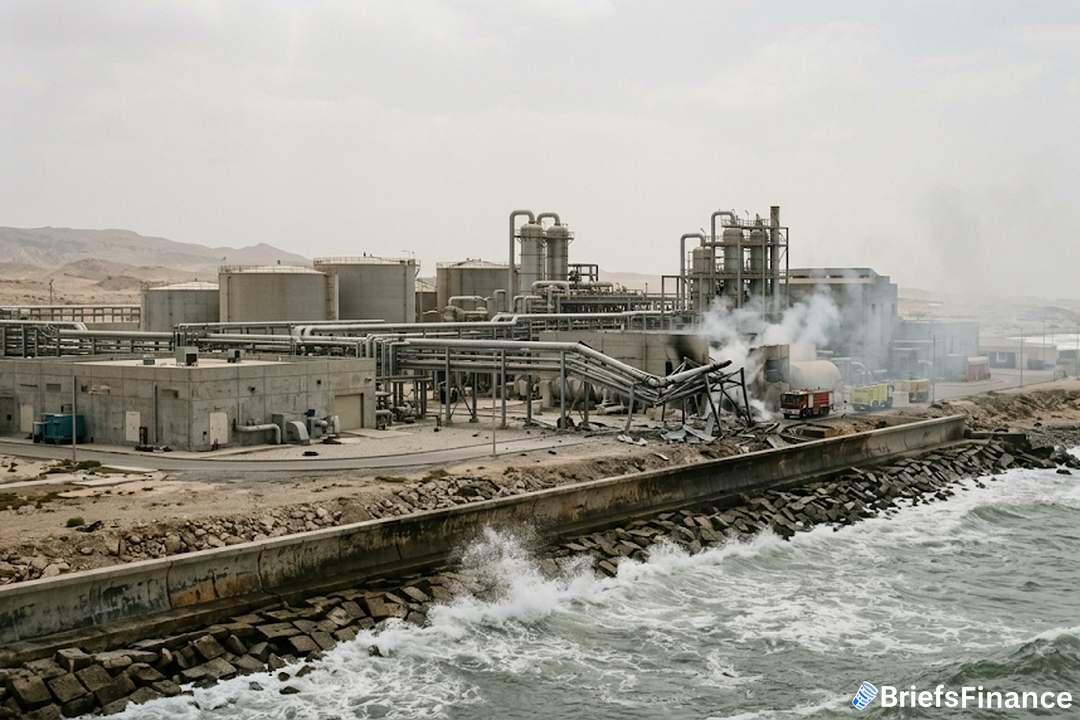
Damaged Plants Reveal a Hidden Weakness
It has shown just how fragile the Gulf's water supply really is.
Desalination plants - the facilities that turn seawater into drinking water - have been hit repeatedly. Iran's Foreign Minister Abbas Araghchi stated, "The US struck a desalination plant on Qeshm Island, cutting water to 30 villages." The United States denied it, saying it targeted military installations instead.
Bahrain stated that an Iranian drone struck a desalination facility in its territory, but the water supply remained unaffected. Kuwait was hit harder: the Doha West and Zour South plants were struck, and Zour South's power generation units were damaged.
This is not a new vulnerability. During the Gulf War of 1990‑1991, Iraqi forces destroyed Kuwaiti desalination capacity and spilled oil into the Persian Gulf. But the scale today is larger.
Get the market news that matters in a five-minute read with Market Briefs, our free daily newsletter
The region's desalination infrastructure has grown substantially in recent decades to support booming populations and industrial development, yet this heavy dependence on a single water source leaves Gulf states exposed. The current conflict has highlighted how quickly these critical facilities can be disrupted, as they are typically situated along coastlines and are difficult to defend against aerial or drone strikes.
The combined installed desalination capacity of the six Gulf Cooperation Council states represents approximately half of the global total. About 60 million people in those countries rely on it for their tap water.
Why This Matters More Than You Think
Gulf states have almost no natural freshwater to fall back on. They need desalination for drinking, industry, and food production. The numbers are staggering.
In its long-term water security blueprint, the UAE seeks to establish emergency reserves sufficient for more than six weeks of use in dire emergencies, yet it has not reached that level.
If more plants are knocked out, the result could be severe. Water rationing, restricted commercial use, handouts of bottled water, and even evacuations are all on the table. Iran's President Masoud Pezeshkian warned last year that Tehran itself might need to be evacuated because of water scarcity - and that was before the war started.
The Geneva Conventions' additional protocol calls desalination plants "indispensable to the survival of the civilian population." But in a conflict, that protection does not always hold.
The vulnerability extends beyond drinking water: these plants also supply water for agriculture and industrial cooling, meaning disruptions could compound food shortages and cripple refineries and power stations. With no backup aquifers or rivers, the region's entire water economy hangs on a handful of coastal facilities that remain exposed to any future strike.
Join Market Briefs, our free daily newsletter, for a quick daily rundown of the markets