Free NewsletterPro Login

Warning: Undefined variable $stocks in /var/www/briefs.co/htdocs/wp-content/plugins/oxygen/component-framework/components/classes/code-block.class.php(133) : eval()'d code on line 448

Warning: foreach() argument must be of type array|object, null given in /var/www/briefs.co/htdocs/wp-content/plugins/oxygen/component-framework/components/classes/code-block.class.php(133) : eval()'d code on line 448

Warning: Undefined variable $funds in /var/www/briefs.co/htdocs/wp-content/plugins/oxygen/component-framework/components/classes/code-block.class.php(133) : eval()'d code on line 472

Warning: foreach() argument must be of type array|object, null given in /var/www/briefs.co/htdocs/wp-content/plugins/oxygen/component-framework/components/classes/code-block.class.php(133) : eval()'d code on line 472
/* the link was here */

Data Center Buildout Is Giving Trucking a Boost

Published Sep 5, 2026
Share:
Summary:
  • AI data centers need tons of physical gear that mostly rides on trucks, and that is stabilizing parts of a freight market that has been banged up by tariffs and record diesel prices.
  • Flatbed and heavy haul have been the standout winners, with spot rates at multiyear highs this summer as construction-heavy markets tighten.
  • Smaller carriers are getting in on the action too, but upfront costs and taking on larger customers before getting paid can squeeze cash flow.

Why AI is suddenly a trucking story

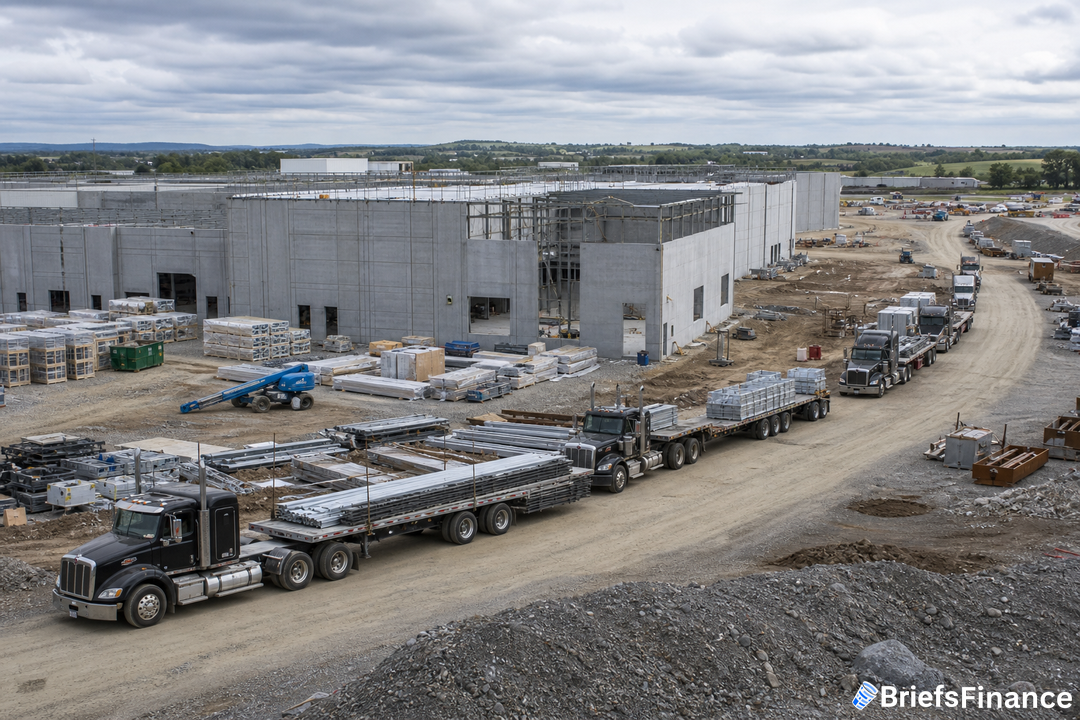
Those giant buildings full of servers do not teleport into place. HVAC units, piping, wiring, semiconductors, and all the other kit arrive by truck, or by rail and then a truck for the last leg. That matters in a freight market already hit by trade-war tariffs and a diesel price spike that, tied to the Iran war, climbed to a record $5.85 a gallon on Friday. Cox Fleet's senior vice president for fleet management solutions, Patrick Brennan, said, "Against that backdrop, AI and data center activity presents an opportunity for fleets."

Brennan said overall freight is still uneven, but the equipment-heavy push around data centers, defense, and chips is more likely to generate loads. He pointed to a clear pickup in production indicators and carrier commentary tied to data center materials, with load-to-truck ratios climbing as capacity tightens in that slice of the market.

Where the freight is flowing

Power availability and land costs help decide where these projects go, and that is redrawing trucking lanes into places that were not traditional freight hubs. "This reshapes routes as much as it adds volume," Brennan said. Georgia and Texas are experiencing clear increases in trucking linked to these projects, said Janelle Griffith, who leads the global logistics practice at Marsh. "A lot of it is rural," she said, citing research indicating that among planned data center developments, 67 percent will be located in rural areas, while 39 percent of planned facilities are designated for counties that currently have none.

One marquee job: a $16 billion data center in Saline, Michigan, developed by Related Digital for Oracle and Open AI. As construction ramps in these locations, demand spreads across the local economy, from fuel and building supplies to a need for more drivers, which pulls in additional trucking activity throughout the region.

Who is doing the hauling and hiring

"The effect shows up most in flatbed and heavy haul, where spot rates have hit multiyear highs this summer and capacity is tightest in construction-heavy markets," Brennan said. "Flatbed and heavy haul have been on an absolute tear since last year, and that's where demand from the buildout is most concentrated," he added.

Even when big components ride the rails, a truck usually still takes them from the terminal to the site. According to Kyle Roberts - vice chairman for industrial & logistics/capital markets at Newmark Mountain West - "A lot of things used to build data centers move via rail, truck takes it from destination to building, doesn't reduce demand, just reduced distance." This short final-mile leg has especially helped LTL, a part of the market that has struggled for an extended period, a weakness underscored by the 2024 bankruptcy of Yellow Trucking.

Even when industries shift, steady investing pays off over time, so download the free Always Be Buying E-Book.

Moving these projects also takes people beyond drivers. "These projects require moving heavy equipment, generators, transformers, cooling systems, construction materials, and supporting infrastructure, which increases demand for CDL drivers, diesel technicians, fleet maintenance professionals, and logistics personnel," Brennan said. The scramble from a shrinking talent pool is lengthening hiring timelines for specialized roles, ramping up recruiting, and pushing fleets to expand maintenance capacity as trucks run more and rack up miles. And more miles means more maintenance.

Boom today, leaner tomorrow

It is not just the big fleets cashing in. AltLINE's freight factoring operations manager, Jennifer Lockett, said, "Data center construction is creating new work for carriers, particularly those moving the massive transformers and generators needed to power these facilities, and large quantities of concrete and other construction materials." She noted the bigger, specialized loads can open doors to new customers and lanes. The catch: scaling up with additional trucks, more drivers, and extra equipment to manage the volume often requires fuel, labor, and maintenance spending before invoices are paid, especially when smaller carriers take on larger customers.

Carriers may need more working capital to keep growth moving. "Still, the bigger story is how much new freight activity these projects can generate for trucking businesses," Lockett said.

Industry voices say do not confuse the construction spike with permanent demand. Roberts warned of an "extraordinary drop off" in truck traffic once a site is live. By contrast, once operational, a data center handles only a sliver of the traffic you would see at a typical 200,000-square-foot warehouse or distribution center that has 80 dock doors and runs two turns per day. According to Kyre Lahtinen, who teaches finance as an associate teaching professor at Wake Forest University, "Unlike warehouses that support large retailers or other physical goods delivery, data centers required comparatively little logistics support after they have been built."

For now, the AI machine is busy enough that carriers can roll to the next project. "There is a massive ecosystem that sits around, all of those components have trucking demands," Roberts said. "It's a very positive impact," Roberts said. If you rely on freight to move your business, the takeaway is straightforward: the build phase is a real tailwind, but it is cyclical, and pricey fuel at $5.85 a gallon still eats into the win.

Disclosure

Recent News

1 2 3 … 98

Get Market Briefs delivered to your inbox every morning for free!

No fluff. No noise. No politics. Just finance news you can read in 5 minutes.

Blogs

October 5, 2026
What Is the Briefs Connector? A Simple Guide
  • The Briefs Connector lets your favorite AI read Briefs research, like Pro reports and the Briefs Score.
  • Without it, an AI asked about investing can give answers that sound right but aren't backed by that research.
  • It explains the research, but it won't tell you what to buy or sell.
Read More
October 5, 2026
Is a Recession Coming? What the Last Five Rate Hiking Cycles Say
  • The Fed has started raising rates again, and in the last five hiking cycles going back to 1994, a recession never started while the hikes were underway.
  • The pain showed up where there was a bubble to pop - housing in 2008, dot-coms in 2000, the pandemic money-printing boom in 2022 - and usually after the hikes ended.
  • Private equity and private credit are feeling this cycle first, and how far the pain spreads depends on how high rates go and how long they stay there.
Read More
October 2, 2026
Fed Interest Rates May Rise Again in 2026 - and the Newest Culprit Is AI
  • Fed Governor Barr told a meeting our head of investing research attended that higher rates are likely in 2026, lower inflation may not come soon, and AI is now pushing prices up.
  • The same week, President Trump asked the biggest AI companies to police themselves under an accord that's morally but not legally binding, because the White House sees AI as a race with China.
  • Higher rates put downward pressure on asset prices and squeeze borrowers, but the way through hasn't changed: own investments, buy on a schedule, and treat downturns as discounts.
Read More
October 1, 2026
Housing Market 2026: Why Office Buildings Are Cracking Before Houses Do
  • Office buildings are selling for 80% to 95% off because their five-year loans are resetting at much higher rates while half-empty floors have gutted the income those buildings are valued on.
  • Housing is under pressure, not cracking: a $400,000 mortgage costs $975 more a month than at 3%, but six of every seven mortgages are still under 6% and those owners are staying put.
  • Whether pressure turns into cracks is a race between unaffordability and the economy, and either way Jaspreet's rule is to treat your house as a liability and buy only what you can afford.
Read More
September 30, 2026
Dividend Investing vs. Growth Investing: Why the Slower Portfolio Can End Up Bigger
  • "What stock should I buy?" is the wrong first question. Growth, income, or wealth preservation comes first, and the goal changes which stocks even make sense.
  • At $500 a month for 30 years, 13% growth builds about $1.75 million. 10% growth plus a reinvested 4% dividend builds a little more than $2.2 million and pays a little more than $80,000 a year.
  • Income investors have US dividend ETFs, REITs, and international dividend funds to study. Growth investors have the Nasdaq 100, AI and chip funds, and small caps. None of it is a recommendation.
Read More
September 29, 2026
Why Is Gold Going Down? A 5.2% Treasury Yield Just Took Its Job
  • President Trump rejected Iran's deal to reopen the Strait of Hormuz, oil prices jumped back up, and gold fell instead of rising.
  • Treasury yields hit their highest level in more than 20 years, so investors sold gold and bought Treasuries that pay interest.
  • Higher Treasury yields make the national debt, mortgages, car loans, and credit cards more expensive, with the Fed's next rate decision due October 28.
Read More
September 28, 2026
The Strategic Bitcoin Reserve: Why the Government Wants Bitcoin to Explode
  • The US government holds about 328,000 Bitcoin, worth roughly $25 billion, and since a 2025 executive order it keeps seized coins instead of selling them.
  • Washington wants a bigger pile of assets so its $40 trillion national debt looks smaller next to them, which lets it keep borrowing and spending.
  • Bitcoin's wild price swings, and a government holding a coin built to escape governments, are the two risks investors need to watch.
Read More
September 25, 2026
BRIEFS EXCLUSIVE: 43% Of Respondents Say Bills Outran Their Income Over Past Two Years
  • 43% of the 494 Market Briefs readers surveyed said their bills grew faster than their income over the past two years, even though 79% could cover a surprise $5,000 expense tomorrow.
  • Half of readers own gold or crypto, the two classic bets against a weaker dollar, and only 13% bought nothing at all in the last 12 months.
  • The median reader says it takes $150,000 a year to feel financially secure, about $62,000 above the U.S. median household income.
Read More
September 25, 2026
The Economy Is Booming. So Why Did Stocks and Bonds Fall Together?
  • S&P Global says the US economy is growing at its fastest rate since 2021, with corporate profits up 28.9% in a year, almost four times the historical average.
  • Stocks and bonds fell at the same time, which is not how the two markets normally behave, because Treasury yields above 5% now compete with stocks for investors' money.
  • Jaspreet Singh lays out three ways to invest through a shift like this: always be buying, buy the crash, or follow the money before it hits the headlines.
Read More
September 24, 2026
The 2026 Economic Reset Is Starting: Are We in a Recession, or Is the Pain Still Ahead?
  • The Federal Reserve has flipped from stimulating the economy to fighting inflation with higher interest rates, while the White House still wants growth at almost any cost.
  • The national debt tops $40 trillion, has outgrown the entire U.S. economy, and its interest payments are now the government's fastest-growing expense.
  • Higher rates bring pain for private equity, private credit, and speculative assets, but they open opportunities for investors holding cash, treasuries, and value assets.
Read More
1 2 3 … 28
Share via
Copy link