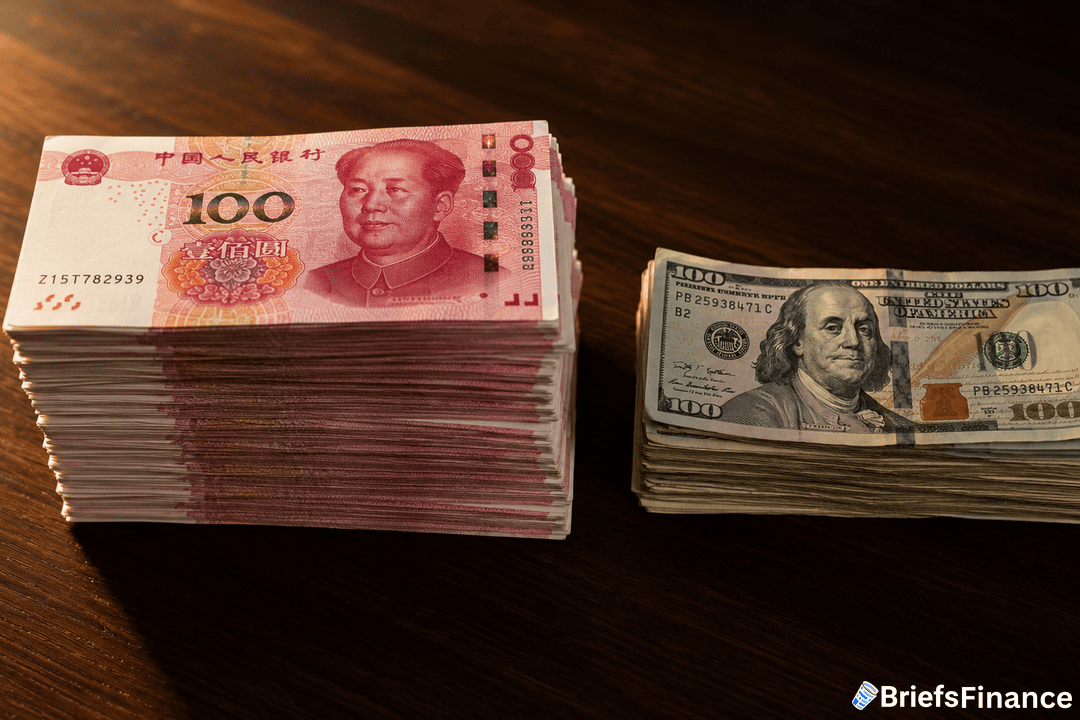
China ran a record trade surplus for most of the past four years, and yet its currency still fell. Macquarie just laid out why - and what could send it sharply the other way.
In a report quoted by Bloomberg, the bank said the yuan could rise as far as 5 per US dollar if companies inside China start unwinding the massive dollar pile they've built up since 2022.
That would be one of the biggest currency moves in years.
How $800 Billion Quietly Piled Up
Since 2022, Chinese firms have run a carry trade at scale, borrowing in their own currency at low rates and swapping the cash for US dollars to park in higher-yielding assets abroad.
Macquarie pegs the total stash at more than $800 billion, which is the money that kept the yuan weak even as China kept selling more goods abroad than it bought.
A carry trade is when an investor borrows in a low-rate currency to buy a higher-rate one, with the goal of pocketing the gap. When that trade unwinds, the borrowed currency tends to snap back hard.
We break down moves like this in plain English every morning in Market Briefs - delivered in five minutes, with a free 45-minute investing masterclass when you sign up.
What Could Flip The Trade
Macquarie isn't calling the unwind today, but its team laid out three things that have to line up first: corporate confidence has to come back, the gap between US and Chinese rates has to narrow, and Beijing's stimulus push has to actually move domestic demand.
Larry Hu, the bank's chief China economist, put it this way: "the yuan carry trade will unwind once China's domestic demand turns around."
He added that "it then depends on when policy stimulus could become decisive enough."
In English: when Chinese consumers and companies start spending again, those parked dollars come home.
Why It Matters For Investors
If that unwind happens at scale, Macquarie says the yuan would stop trading mostly on what the dollar is doing and start trading on what China's own economy is doing.
That's a big deal for anyone with exposure to Chinese stocks, US tech that sells into China, or commodities priced in dollars.
What To Watch
The trigger Macquarie is pointing to is domestic demand - not Fed policy, not tariffs, not the trade balance. If China's spending data starts to turn, watch the yuan.
The dollar pile took four years to build, and it could come off a lot faster than that.
If you want this kind of read every weekday morning, join the 350,000+ investors who read Market Briefs - you also get a free 45-minute investing course as a bonus.