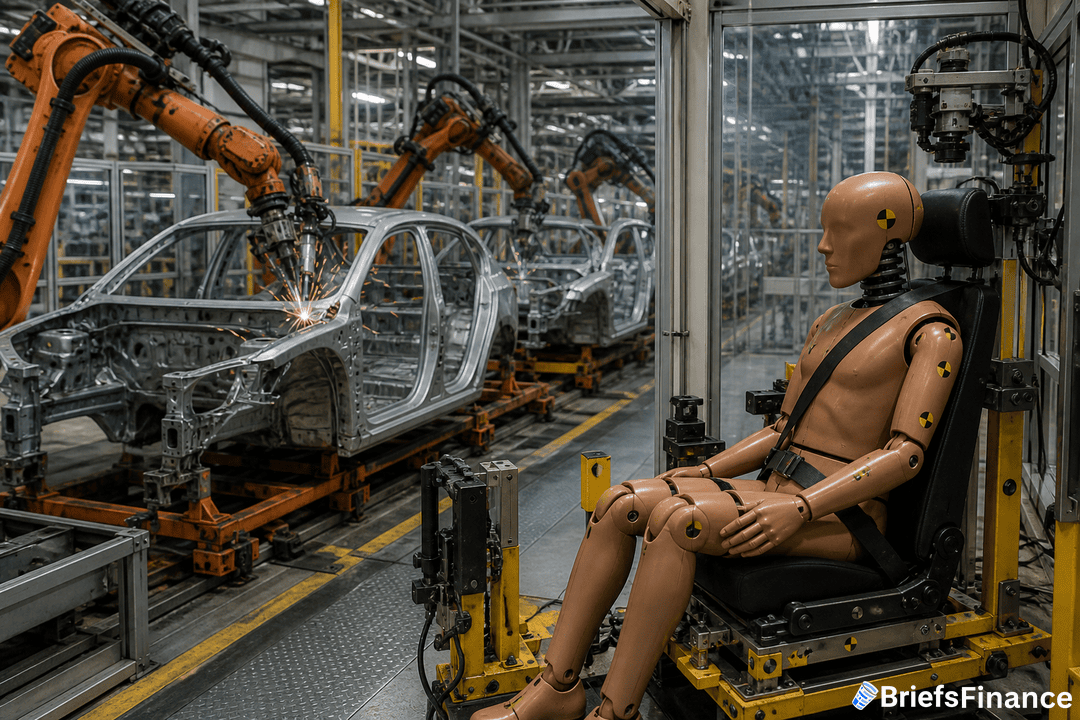
A faster clock meets tougher oversight
China's carmakers are trying to squeeze even more time out of development cycles just as regulators step up scrutiny of safety and testing. With artificial intelligence accelerating everything from design reviews to digital validation, IAT Automobile Technology and the China Association of Automobile Manufacturers estimate a fresh model could be ready in 18 months, down from roughly two years in China and well ahead of the multi-year timelines common among established foreign brands.
But the "China speed" that set a global benchmark is stoking concern that rapid iterations are straining quality control and oversight. Industry leaders are debating whether compressed schedules risk hurting brand credibility - especially in export markets such as Europe - or instead highlight a superior ability to compete. The market's hyperactive churn - marked by a torrent of new nameplates and updates in the first half of the year and swift integration of AI across the supply chain - underscores how deeply speed is embedded in the operating model.
Inside the safety push
Authorities have launched a yearlong enforcement drive featuring unannounced inspections at automakers to curb quality slippage in the chase for faster rollouts. The clampdown follows several high-profile fatal accidents and is part of a broader reset that has already tightened rules on batteries, advanced driver-assistance features and door-handle designs.
China is also carrying out its biggest vehicle recall to date, with Tesla Inc. and eight other manufacturers required to address door-related safety requirements on more than 4.27 million electric vehicles. Regulators, meanwhile, proposed that on-road trials for new-energy vehicles should span at least 30,000 kilometers (18,640 miles), aiming to reassure the public that faster development does not compromise safety.
Two executives at a Chinese automaker said that the Ministry of Industry and Information Technology is closely tracking consumer complaints that appear online; the pair sought anonymity because they weren't authorized to speak publicly. The people added that after some of the company's models attracted defect-related complaints, the ministry reached out to ask how the issue would be fixed even before replacement parts and dealer coordination were ready. A formal recall followed about a month after the issue emerged.
In a departure from past practice, the ministry is now naming the companies it checks shortly after onsite visits. At least five leading carmakers were inspected in July. A visit to Guangzhou Automobile Group Co.'s Aion came within days of reports that some batteries failed after vehicles hit 150,000 kilometers; the brand said it is repairing or replacing the batteries at no cost.
The best financial decisions come from understanding the whole picture. Join Market Briefs free and get the full brief each morning.
What's changing in the rulebook
A slate of standards is rolling out over the next two years that will lift the bar for safety and validation:
- February 2025: Stronger rules for intelligent connected vehicles covering product approvals, recalls and software over-the-air updates, making it harder to rely on OTAs to remedy issues that should have been resolved pre-sale.
- March 2025 release, effective July 2026: Updated EV battery norms stipulating that in a thermal runaway event, batteries must not burn, explode or emit smoke for at least two hours.
- December 2025 release, effective July 2026: Specifications for steer-by-wire EVs that replace traditional hydraulic components with sensors, control units and electric actuators.
- December 2025 release, effective July 2026: EV safety provisions including the ability to instantly shut off the vehicle's high-voltage system via a physical mechanism such as a button.
- January 2026 release, effective January 2027: New door-handle safety requirements that ban the hidden-style layouts made famous by Tesla.
- July 2026 release, effective July 2027: Requirements for advanced driver-assistance systems that define where and when features can be used, mandate driver attention, and set guidance for training and data practices.
- July 2026 release, effective July 2027: Safety rules for higher levels of autonomous driving where vehicles operate with limited human input.
Industry response: pushback, pragmatism and pressure
Some executives warn that compressing schedules pushes validation onto end users. Leaders at Zhejiang Geely Holding Group, Great Wall Motor Co. and Chery Automobile Co. have cautioned that faster turnarounds risk turning customers into real-world testers. "Cars aren't fast-moving consumer goods. "There are simply some development timelines we cannot afford to shortcut."
Others say speed isn't inherently unsafe if testing is completed. Lu Fang, who chairs Dongfeng Motor Corp.'s luxury Voyah marque, argues that a rapidly developed model that clears all mandatory validation simply shows efficiency. Bill Russo, founder of Shanghai consultancy Automobility Ltd., observed that fast model churn is now ingrained in the market and that the inspection campaign may push companies to be more selective about which stages they speed up. Software and digital features can move quickly and be proven via simulation, he said, but safety-critical hardware and new technologies need more rigorous checks before reaching customers.
This ask might be too hard.
Meeting tougher standards will also raise costs, potentially widening the gap between smaller, speed-focused players and larger manufacturers with deeper capital and mature systems, according to Russo.
Global rivals try to catch up
While scrutiny intensifies, Chinese companies may still hold an edge thanks to their embrace of technologies like AI, said IAT Chief Executive Officer Xuan Qiwu. Foreign brands are hustling to narrow the gap. Volkswagen AG has built a fully owned R&D base in Anhui - its first outside Germany capable of independently designing and testing vehicles. The ID.UNYX 08, an electric SUV co-developed with Xpeng Inc., was completed in 24 months and relied on AI and virtual reality for digital validation. Renault SA finished the Twingo E-Tech in China in 21 months, the fastest timeline the company has achieved. Meanwhile, Toyota Motor Corp. is working to accelerate a process that typically spans three to five years for model updates by developing a new platform and vehicles in parallel rather than one after the other, according to an NHK documentary aired in July.