Free NewsletterPro Login

Bob Iger Is Out. The Theme Park Guy Is In.

A stylized illustration of a cylindrical cup with blue arrows and lines indicating a swirling or rotational motion inside the cup.
Published Mar 18, 2026
Share:
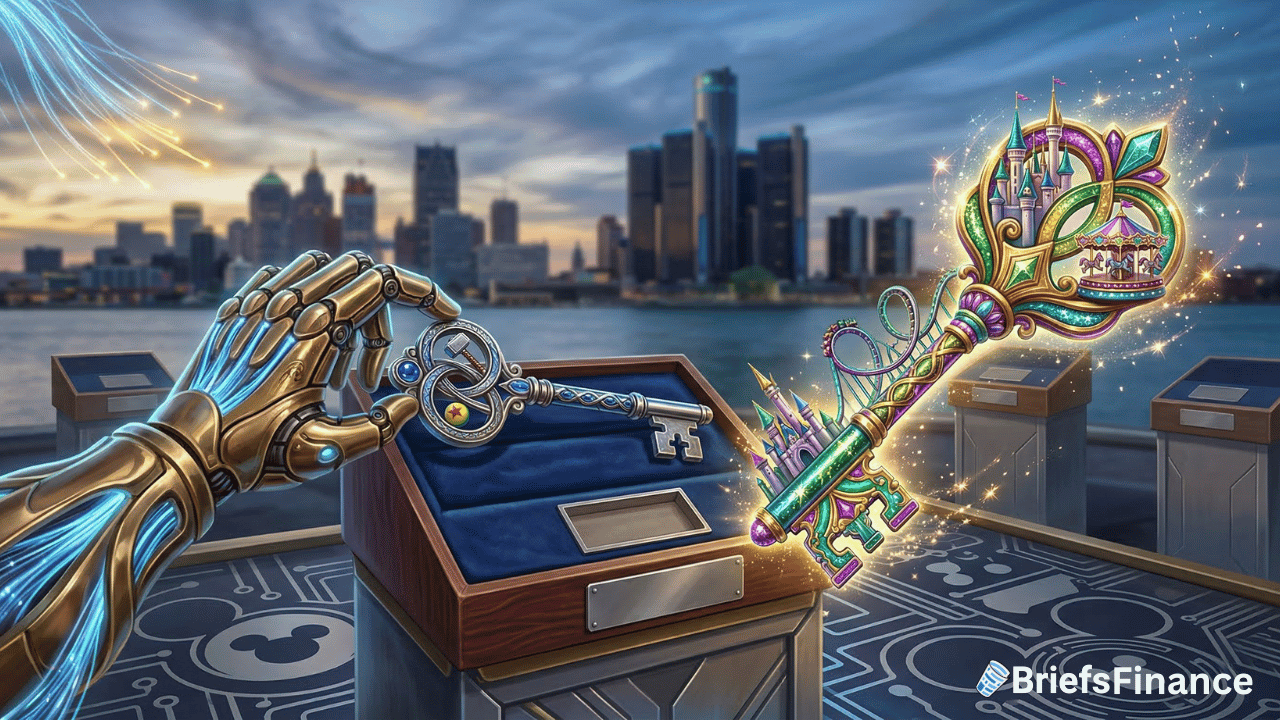
A robot hand exchanges a plain key for a colorful, ornate theme park key with amusement park imagery, set against a city skyline and river. The "BriefsFinance" logo appears in the corner.
Summary:

  • Josh D'Amaro officially became Disney's CEO on Wednesday, succeeding Bob Iger after nearly 20 years at the top.
  • D'Amaro, 55, spent six years running Disney Experiences — the parks, cruises, and resorts division that now accounts for 57% of the company's annual profit.
  • Disney's board paired him with Dana Walden as president and chief creative officer to cover the Hollywood side D'Amaro doesn't know as well.

The magic kingdom has a new king.

Who D'Amaro Is

D'Amaro has been at Disney for 28 years, starting at Disneyland in 1998. He became chairman of Disney Experiences in 2020 and since then has run a business with $36 billion in annual revenue, 12 theme parks, 57 resort hotels, and a cruise fleet that's doubling in size by 2031. He's also greenlit a new park in Abu Dhabi.

In 2023, he committed to a $60 billion parks investment over 10 years — the most ambitious expansion in the division's history. Disney's parks business has been the company's most reliable profit engine throughout the streaming wars, and D'Amaro built it into that position.

He's also unusually popular. Variety reported he "is constantly accosted by guests who want to hug him and take pictures with him" at Disneyland, and that he's obsessed with operational details down to the color of trash cans.

The Risk Everyone Is Talking About

The last person who ran Disney's parks and then got promoted to CEO was Bob Chapek. That didn't go well. Chapek lasted less than three years and was ousted in 2022 amid declining morale and a high-profile political fight with Florida that damaged the company's brand.

Disney's board appears to have learned from that. Walden's appointment as chief creative officer — a newly created role — pairs D'Amaro's operational strength with someone who spent decades in Hollywood running ABC and Hulu's content operations. TD Cowen analyst Doug Creutz called the pairing critical: the two will need to forge a strong working partnership to make it work.

What He Inherits

D'Amaro takes over a company with profitable streaming, a $17.5 billion annual profit base, and five films topping $1 billion at the global box office over the past two years. He also inherits a TV business in decline, Marvel and Star Wars showing box office fatigue, and growing uncertainty about what the AI era does to content economics.

Iger will stay on as a senior advisor and board member through December 31.
Disclosure

Get Market Briefs delivered to your inbox every morning for free!

No fluff. No noise. No politics. Just finance news you can read in 5 minutes.

Blogs

May 30, 2026
Financial Literacy Books That Actually Build Wealth
  • The best financial literacy books don't just teach budgeting, they shift how you think about money.
  • Two classics stand out: The Intelligent Investor for valuing investments, and Rich Dad Poor Dad for the owner's mindset.
  • Reading is only step one. The real wealth comes from acting on what you learn.
Read More
May 30, 2026
What Is a Roth Conversion? A Simple Guide
  • A Roth conversion moves money from a traditional retirement account into a Roth account.
  • You pay taxes on the money now, in exchange for tax-free growth and withdrawals later.
  • It can pay off if you expect higher taxes or more income in the future, but the timing and tax hit matter a lot.
Read More
May 30, 2026
Trailing Stop Loss: How to Protect Your Gains
  • A trailing stop loss is an order that automatically sells a stock if it falls a set percentage from its recent high.
  • As the stock rises, the sell point rises with it, locking in gains while capping losses.
  • It's most useful for active strategies like momentum investing, not for long-term buy-and-hold.
Read More
May 30, 2026
5 Types of Wealth: Why Money Is Only One of Them
  • Real wealth is more than a bank balance. It spans your finances, health, mind, purpose, and freedom.
  • Money is powerful, but it amplifies the life you already have rather than fixing a broken one.
  • True financial wealth means your cash flow covers your expenses, so your money works while you live.
Read More
May 30, 2026
How to Invest in Private Equity: A Beginner's Guide
  • Private equity means investing in companies that aren't listed on the stock market.
  • Traditional private equity is built for experienced, high-net-worth investors with large amounts to invest.
  • New rules have opened more accessible paths, like startup crowdfunding and real estate deals, often starting around $100.
Read More
May 30, 2026
What Is a Call Option? A Simple Guide With Examples
  • A call option gives you the right to buy a stock at a set price by a set date.
  • Investors buy calls when they expect a stock to rise, using less money than buying the shares outright.
  • The most you can lose buying a call is the premium, but time works against you, so it's an advanced tool.
Read More
May 30, 2026
EBITDA Formula: How to Calculate It Step by Step
  • EBITDA stands for Earnings Before Interest, Taxes, Depreciation, and Amortization, a measure of a company's core profit.
  • The formula adds those four items back to net income to show what the underlying business earns.
  • Investors use EBITDA to compare companies and to judge how many times earnings a stock is selling for.
Read More
May 30, 2026
What Is a Stock Option? A Plain-English Guide
  • A stock option is a contract giving you the right, but not the obligation, to buy or sell a stock at a set price by a set date.
  • There are two types: calls (the right to buy) and puts (the right to sell).
  • Options are powerful but risky, so they suit investors who already have the basics down.
Read More
May 30, 2026
Put Option: What It Is and How It Works
  • A put option gives you the right to sell a stock at a set price by a set date.
  • Investors use puts to bet a stock will fall, or as insurance to protect shares they own.
  • The most you can lose buying a put is the premium you paid, which makes it a defined-risk tool.
Read More
May 30, 2026
Operating Margin: What It Is and How to Calculate It
  • Operating margin shows how much profit a company keeps from its core business after paying its running costs.
  • The formula is operating income divided by revenue, shown as a percent.
  • A strong, steady operating margin signals a well-run business that controls its costs.
Read More
1 2 3 22
Share via
Copy link











