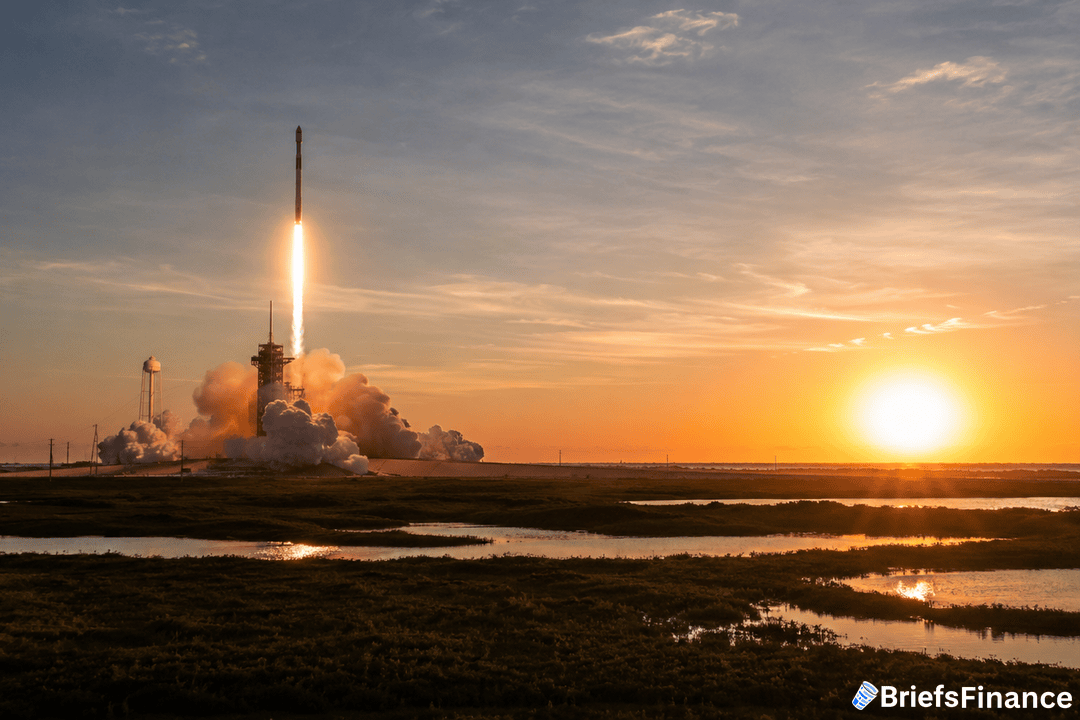
Four trading days is not a lot of time to become one of the biggest companies on Earth. That's exactly how long SpaceX took. The stock ran up 58% in four sessions since its IPO last Friday, and on Wednesday it briefly leapfrogged Amazon and edged past Microsoft to land as the fifth most valuable public company in the world.
A Record IPO That Keeps Climbing
SpaceX priced its IPO on June 12 at $135 a share, a $75 billion deal that was reportedly oversubscribed by about 4x. By the time it started trading, traders were already lining up for the next day's session.
Then it kept going. Shares rose as much as 6% intraday on Wednesday, briefly pushing past $214 and adding more than half a trillion dollars of market value in four sessions.
The momentum even spilled into leveraged ETFs tied to SpaceX, which crossed $1 billion in trading volume on their first day. For context: this is a company that posted $18.7 billion in 2025 revenue and a $4.9 billion net loss, so at the IPO price the stock was trading at about 94x trailing sales.
In plain English, that's $94 of stock for every dollar SpaceX brought in last year.
If you want a 5-minute read on the trades Wall Street is actually watching, Market Briefs lands in your inbox every weekday morning, plus you get a free investing masterclass as a sign-up bonus.
Why Anyone Is Paying Up
The bull case is mostly about what SpaceX has become outside of rockets.
The company runs the Colossus data center in Memphis, where 220,000 Nvidia GPUs deliver more than 300 megawatts of AI compute. Google is renting about $920 million of capacity a month, and Anthropic signed a $1.25 billion-a-month deal that runs through May 2029 - worth more than $40 billion in total.
Wedbush analyst Dan Ives, a longtime Tesla bull, wrote in a note that he sees better than an 80% chance SpaceX and Tesla eventually merge into what he called a Musk "holy grail" AI conglomerate. That call isn't coming out of nowhere - Tesla already has a stake in SpaceX after its $2 billion xAI investment got converted into SpaceX shares in February.
Add Starlink's 9 million-plus satellite internet subscribers on top of all that, and the pitch starts to look less like a rocket company and more like a vertically stacked AI platform.
The Other Side Of The Trade
Not everyone is convinced. Morningstar analyst Nicolas Owens put SpaceX's fair value at $63 a share, which is 53% below the IPO price.
His math: investors are paying roughly $72 per share for the right to bet on long-shot projects like orbital data centers and Mars, and he puts the odds those orbital data centers never work at 43%.
There's also an unusual lockup wrinkle worth knowing. In most IPOs, insiders can't sell for 180 days, but SpaceX is letting some early shareholders, not including Musk, start selling within weeks, with more chunks unlocking periodically through December.
For space stocks more broadly, that lockup schedule could mean steady supply on the market all year.
What To Watch
The trade after a big IPO is rarely the same on day five as it was on day four. SpaceX closed Wednesday down about 5% after a hawkish Fed signal hit the broader market, ending the four-day rally and pulling the stock back below Amazon.
Still, the stock is sitting more than 42% above its offer price four days in - which is a long way from "the trade is over."
The first leg is done. Now SpaceX has to convince investors it deserves what they just paid - and the next test comes when more insiders are allowed to sell.
Join 350,000+ investors reading Market Briefs to keep up with moves like this one, and grab a 45-minute investing course thrown in for free when you sign up.