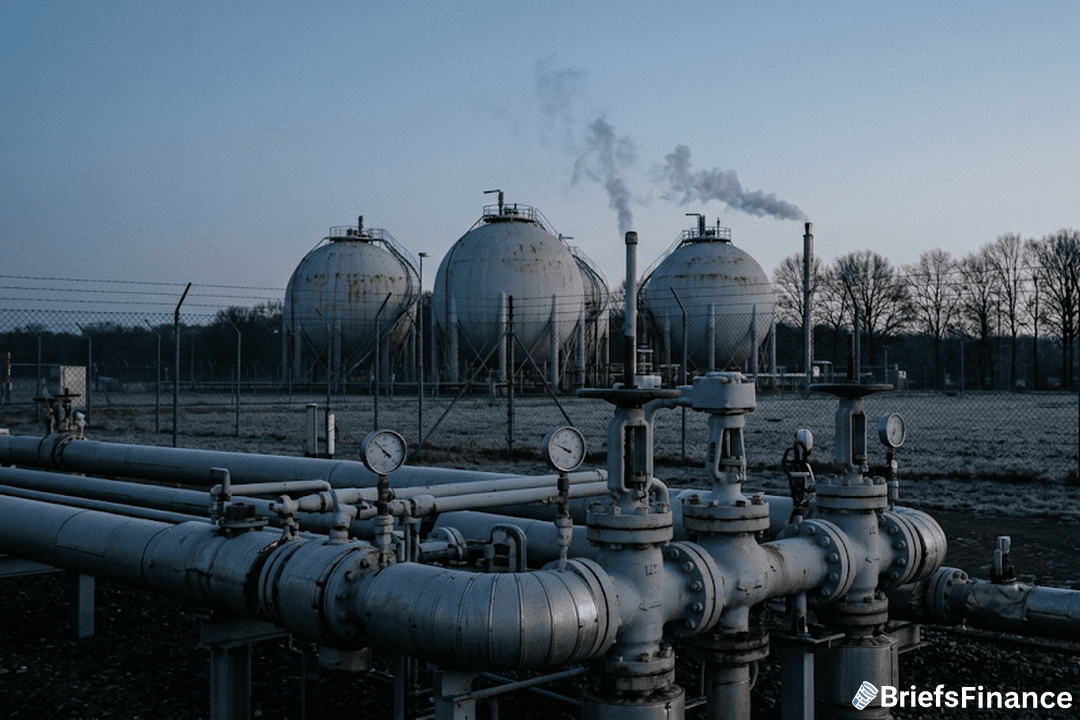
Europe's Gas Tanks Are Emptier Than Usual
Europe's gas tanks are running low, and the calendar is not helping. Storage is the fuel gauge for winter.
The gauge is not empty, but it is a lot lower than usual. That matters because summer is when Europe normally refills the tanks, and the Iran war disrupted that job by driving up energy prices.
The result is a shortfall heading into the cold months. The EU plans to cover it with liquefied natural gas, or LNG, which is natural gas chilled into a liquid so it can travel by ship.
Those shipments will be a test of shipping routes and import terminals. Not every supplier is reachable by pipeline, which is why LNG has become Europe's backup plan.
The real question is whether the gas is there to buy at a price Europe is willing to pay.
The Plan: More Imports, with an 80% Target
The European Commission says the plan is solid. "The EU can count on significant spare LNG import capacity allowing additional imports during the winter months," a spokesperson said.
That spare capacity comes from a sharp building effort. Europe has raised its LNG import capacity a lot in recent years, and many of those terminals have room for extra cargoes.
Get the free Always Be Buying eBook and learn the simple system for building wealth on any income
The Commission also set a clear marker. The spokesperson called the 80% goal "technically achievable."
An EU body called the Gas Coordination Group met in July and found no immediate concern about gas supplies, according to a readout. The group meets next in September, and the Commission says it "is ready to convene a meeting on short notice when necessary."
The calm readout is worth noting. The EU is treating winter as a manageable problem, not an emergency.
The Catch: A Crowded Market With Less to Go Around
The plan runs into a crowded global market. Asian buyers are taking much of what remains.
Europe will need more gas in winter, not less, and the extra capacity only helps if cargoes are actually available to fill the terminals.
Few market participants expect physical shortages. The bigger risk is price: if global supplies stay tight and winter demand spikes, Europe could face higher prices as it lines up behind Asia for the same cargoes.
That puts extra weight on the winter months. Europe is shopping at a moment when sellers have less to offer.
On August 4, 2026, the natural gas contract closest to delivery, known as the front-month future, traded at 2.68, a change of 3.56%.
What This Means for Your Portfolio
Europe probably has enough gas to get through winter. The open question is what it costs, and that question reaches beyond Europe's borders.
If global supplies stay tight and winter demand spikes, prices could jump. Energy is a global market, and a price spike in one region does not stay in that one region.
For investors, this is a price story before it is a gas story. Higher energy prices flow into heating bills and into the costs of companies that rely on gas, and those costs tend to find their way into your portfolio.
The same forces that move Europe's gas bills also move energy investments. Storage levels, buying patterns, and the competition for LNG cargoes are the numbers to watch as the season unfolds.
Download the free Always Be Buying eBook and start putting your money to work today