Free NewsletterPro Login
S&P 500 6,287 +0.42%
DOW 44,521 -0.18%
NASDAQ 21,103 +0.71%
S&P 500 +12.4%
Briefs Finance Fund +24.8%
JOIN THE FUND →

Bitcoin Depot Just Filed Chapter 11 And Shut Down Its 9,000 ATMs

Published May 18, 2026
[tts_player]
Share:
Summary:
  • Nasdaq-listed Bitcoin Depot filed Chapter 11 in Texas on Monday, the company behind the biggest US bitcoin ATM network.
  • More than 9,000 kiosks across the US, Canada, and Australia have been switched off as the firm winds down.
  • Q1 revenue dropped 49% year over year and the company flipped from a $12 million profit to a $9.5 million loss.

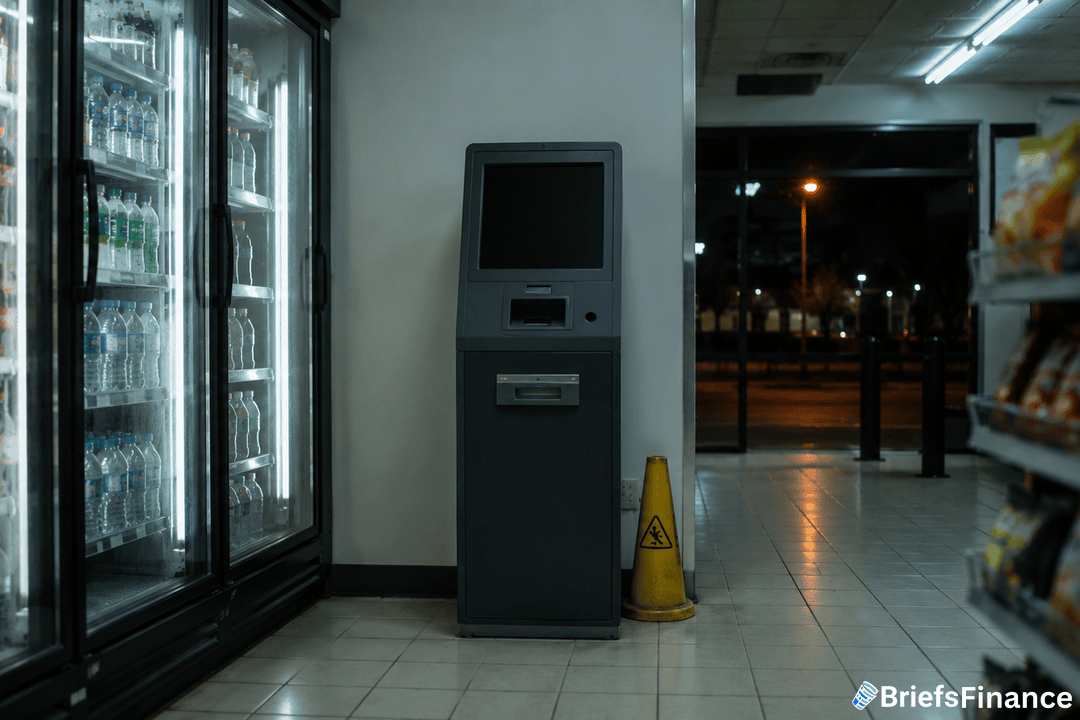
The biggest bitcoin ATM network in North America just went completely offline. Bitcoin Depot filed for Chapter 11 bankruptcy in Texas on Monday and unplugged its entire fleet of more than 9,000 kiosks across the US, Canada, and Australia.

The company ran roughly 28% of the US crypto ATM market at its peak.

Regulations, Lawsuits, And A Wallet Breach Stacked Up

Bitcoin Depot's CEO, Alex Holmes, said the regulatory environment made the business "no longer viable."

State regulators have been tightening rules on crypto ATMs for two years, lowering transaction limits, raising compliance costs, and in some places banning the machines outright.

Connecticut suspended Bitcoin Depot's money transmitter license in March after finding the company charged fees above the state's 15% cap and failed to fully refund fraud victims.

Then came the lawsuits, with attorneys general in Massachusetts and Iowa leading legal action over claims that the kiosks helped facilitate crypto scams.

Bitcoin Depot also disclosed a $3.7 million crypto wallet breach earlier this year and warned investors of weaknesses in how the company handled and counted cash.

The financials told the rest of the story, with Q1 revenue coming in at roughly $83.5 million, down 49% from a year earlier.

The company posted a $9.5 million loss versus a $12.2 million profit the year before, and gross profit fell 85%.

Bitcoin Depot hired Vinson & Elkins as its bankruptcy counsel and Portage Point Partners as restructuring adviser, and the company filed standard first-day motions to keep the wind-down orderly.

For more on the regulatory wave reshaping crypto investing, Market Briefs breaks it down every morning - and you get a free investing masterclass when you sign up.

The Crypto-ATM Model Was Already Breaking

The crypto ATM was always a strange middle ground, with most retail crypto investors having moved to apps like Coinbase or Cash App years ago.

The kiosks ended up serving a much smaller customer base, and that base attracted heavier scrutiny from state regulators worried about scams targeting older and less tech-savvy users.

The math stopped working as compliance costs went up, transaction limits went down, lawsuits piled in, and revenue collapsed. Bitcoin Depot was the biggest operator in a US crypto-ATM industry that has been shrinking for two years under regulatory pressure.

Founded in 2016 and headquartered in Atlanta, the company at its peak had cash-to-bitcoin terminals in retail locations across 47 US states plus Canada and Australia. That entire footprint is now offline.

What To Watch

The Chapter 11 process will fold in Bitcoin Depot's Canadian business, with formal restructuring proceedings there expected to follow shortly.

Smaller US operators that have been holding on through the same regulatory squeeze are now operating in a market without its biggest player.

Roughly 28% market share in the US is now in play, but the rules that broke Bitcoin Depot apply to every competitor still standing.

For investors holding the stock, a meaningful recovery looks unlikely given the net loss, the wallet breach, and the ongoing lawsuits.

The 9,000-plus kiosks are now offline as the company winds down.

If you want to see where regulation is actually hitting crypto next, join 350,000+ investors at Market Briefs - the daily newsletter comes with a 45-minute investing course as a bonus.

Disclosure

Recent News

1 2 3 37

Get Market Briefs delivered to your inbox every morning for free!

No fluff. No noise. No politics. Just finance news you can read in 5 minutes.

Blogs

June 29, 2026
Portfolio Diversification: Why Putting All Your Eggs in One Basket Destroys Wealth
  • Real diversification means spreading investments across all 11 economic sectors plus bonds, alternatives, and cash so no single bet can sink the portfolio.
  • Different sectors perform at different times, so a diversified portfolio captures upswings while smoothing the brutal drawdowns that wipe out concentrated bets.
  • Total market index funds offer the simplest path to diversification, and annual rebalancing is what keeps the structure working over time.
Read More
June 29, 2026
Non Taxable Income: What It Is and Why It Matters
  • Non taxable income is money you receive that you don't owe income tax on.
  • The tax code treats workers, investors, and business owners very differently, and investors often come out ahead.
  • Learning how income is taxed is a quiet superpower for keeping more of what you earn.
Read More
June 29, 2026
Semiconductor Stocks: A Simple Guide for Investors
  • Semiconductor stocks are companies that design and make computer chips, the brains inside nearly every modern device.
  • The AI boom has turned chips into one of the market's most important and most watched groups.
  • They offer big growth potential, but come with high valuations and a notoriously cyclical history.
Read More
June 25, 2026
How Stocks Work: A Simple Guide for Beginners
  • A stock is a slice of ownership in a company - buy one, and you own a piece of the business.
  • You make money two ways: the share price rising over time, and dividends paid to shareholders.
  • The simplest path for most beginners is buying into the whole market through a low-cost index fund.
Read More
June 25, 2026
Stop Loss vs Stop Limit: What's the Difference?
  • A stop loss order sells your stock once it hits a trigger price, prioritizing getting you out.
  • A stop limit order only sells within a price range you set, prioritizing price over a guaranteed exit.
  • The trade-off: a stop loss almost always executes; a stop limit might not if the price moves too fast.
Read More
June 25, 2026
Energy Stocks: A Simple Guide for Investors
  • Energy stocks are companies that produce and supply the power the world runs on, from oil and gas to newer sources.
  • They make up one of the 11 sectors of the market and tend to move with energy prices and big-picture shifts.
  • Like any sector, the key is diversification and understanding the forces driving demand.
Read More
June 18, 2026
What Is a Stop Loss Order? A Simple Guide
  • A stop loss order automatically sells a stock once it falls to a price you set.
  • It's a tool to cap losses or lock in gains without watching the market all day.
  • It works best for active strategies, and can backfire if used carelessly on long-term holdings.
Read More
June 18, 2026
Best S&P 500 Index Fund: How to Choose One
  • The best S&P 500 index fund for most investors is simply the cheapest, most established one that tracks the index well.
  • Funds like VOO, IVV, and SPY all hold the same 500 companies, so the biggest difference is the fee.
  • Pick one, automate your buys, and let time do the heavy lifting.
Read More
June 17, 2026
What Are Penny Stocks? Risks and Rewards Explained
  • Penny stocks are very low-priced shares of very small companies, often trading for just a few dollars or less.
  • They promise huge gains but carry huge risks: low liquidity, high failure rates, and wild price swings.
  • Most investors are better served by quality companies and funds than by chasing cheap shares.
Read More
June 17, 2026
Best Stocks for Beginners With Little Money
  • The best stocks for beginners with little money usually aren't individual stocks at all - they're low-cost index funds.
  • You can start with $100 or less and use small, regular investments to build wealth over time.
  • Focus on diversification and consistency, not on picking the next big winner.
Read More
1 2 3 24
Share via
Copy link










