Free NewsletterPro Login

Warning: Undefined variable $stocks in /var/www/briefs.co/htdocs/wp-content/plugins/oxygen/component-framework/components/classes/code-block.class.php(133) : eval()'d code on line 448

Warning: foreach() argument must be of type array|object, null given in /var/www/briefs.co/htdocs/wp-content/plugins/oxygen/component-framework/components/classes/code-block.class.php(133) : eval()'d code on line 448

Warning: Undefined variable $funds in /var/www/briefs.co/htdocs/wp-content/plugins/oxygen/component-framework/components/classes/code-block.class.php(133) : eval()'d code on line 472

Warning: foreach() argument must be of type array|object, null given in /var/www/briefs.co/htdocs/wp-content/plugins/oxygen/component-framework/components/classes/code-block.class.php(133) : eval()'d code on line 472
/* the link was here */

Convenience stores double down on hot food to poach pizza-night dollars

Published Oct 26, 2026
Share:
Summary:
  • Big c-store names are upgrading kitchens and menus to win meals from Domino's and Pizza Hut.
  • Casey's is debuting a pan pizza and aims to price its pies $1 to $2 below national rivals, while planning about $800 million in capital spending this fiscal year.
  • Prepared food and drinks rose to 29% of industry sales excluding fuel last year, up from 12% two decades ago, with 2025 sales up 3.9%.

The new menu at the gas pump

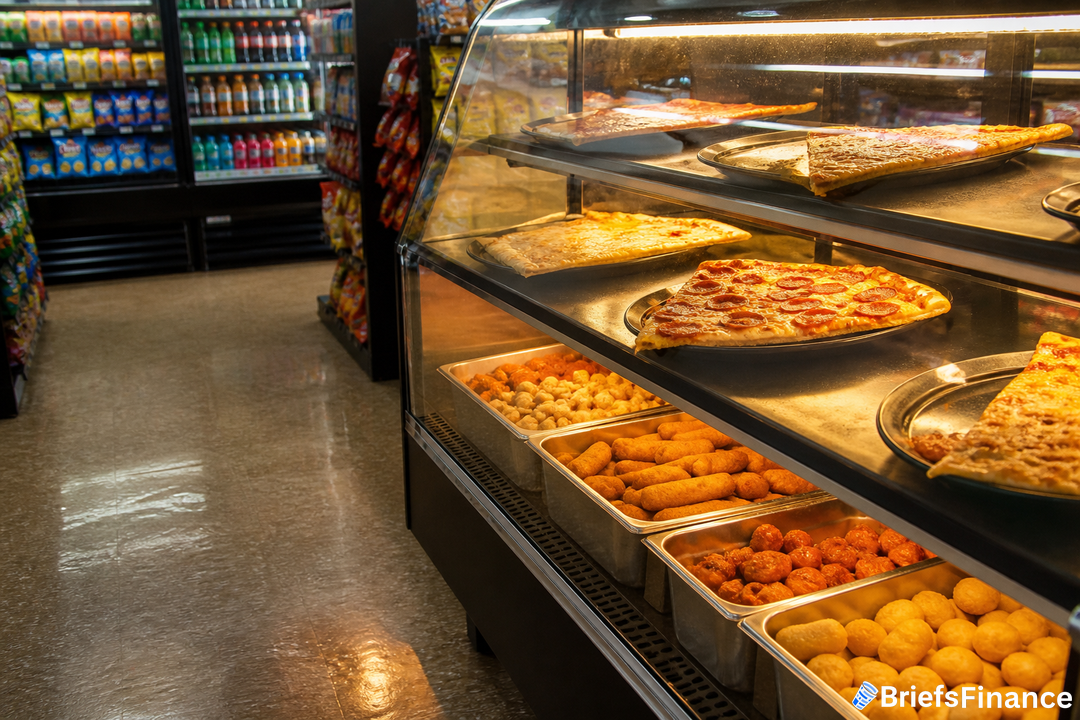
Convenience stores are widening their food play to look more like quick-service restaurants. Casey's General Stores, the country's third-largest convenience-store chain, is rolling out a pan pizza with a fluffy interior, a crisp base and cheese all the way to the edge. The pitch is simple: show that a pie from a gas station can go toe to toe with a sit-down or delivery spot, especially at dinner.

Casey's says it plans to set pizza prices $1 to $2 below national competitors. "Good pizza is good pizza," said Andrew Kintigh, the company's culinary director. With about 3,000 U.S. stores, Casey's is also counted as the nation's fifth-largest pizza chain.

Others are pushing too. 7-Eleven plans to put more of its restaurant brands into stores, and QuikTrip is doubling kitchen footprints to expand made-to-order meals. Texas based Buc-ee's has built foodie buzz around its barbecued meats.

Why the pivot now

Two old standbys for convenience stores are fading: cigarettes and gas. According to the National Association of Convenience Stores, prepared food and beverages made up 29% of industry sales excluding fuel last year, compared with 12% twenty years prior.

Gas use is slipping as well. The US Energy Information Administration reports that, by 2025, gasoline use in the U.S. was 4% lower than in 2019. Meanwhile, higher gas prices are nudging diners toward cheaper meals. Research from Technomic finds that brands with restaurant-like offerings - including Casey's, Wawa and Sheetz - account for nearly two-thirds of the sector's food sales even though they represent only about one-quarter of locations.

When consumer habits shift, staying informed helps you make smarter choices, so sign up for the free Market Briefs newsletter

Technomic also notes that, at convenience stores, sales of prepared food and drinks increased 3.9% in 2025, while fast-food pizza chains recorded a 0.3% decline last year. "Convenience stores are increasingly in the consumer consideration set" as food quality improves, said Donna Hood Crecca, a senior principal at Technomic.

Casey's playbook and the investor angle

At Casey's, revenue from prepared foods and dispensed beverages climbed about 22% over two years, hitting nearly $1.8 billion for the fiscal year that ended April 30. Roughly 71% of its locations are in communities with fewer than 20,000 residents, where restaurant rivals are often scarce.

The company plans to devote about $800 million to property and equipment during this fiscal year, and about three-quarters of that is slated for opening additional locations and refurbishing existing sites, with kitchen improvements in the mix. Wings, now available in fewer than one-third of stores, are set to be rolled out across the chain. Casey's has trained more than 30,000 employees on pizza-making, and it is betting the new pan pizza will pull in more customers, particularly for dinner.

There is a catch. The updated strategy projects profit growth to decelerate compared with the prior three years, and last quarter's same-store sales missed expectations. Through Oct. 23, shares were up nearly 27% this year, but they have fallen almost 24% since their June peak.

What it means for your portfolio

Food is becoming the traffic driver, not the side attraction. That puts metrics like prepared-food revenue, kitchen capex and same-store sales at the center of the story for c-store names. As chains try to undercut restaurant prices and broaden dinner options, operators with restaurant-like menus could keep pulling ahead of fuel-and-cigarette-heavy models.

Bottom line: watch whether menu investments translate into repeat visits and steadier comps. As Tom Brennan, Casey's chief merchandising officer, put it, "We view ourselves as a restaurant that happens to sell gas." And the bet is clear: "We expect food to deliver outsize growth versus the rest of the business."

With more options competing for your attention, get quick clarity each morning with the free Market Briefs

Disclosure

Recent News

1 2 3 … 110

Get Market Briefs delivered to your inbox every morning for free!

No fluff. No noise. No politics. Just finance news you can read in 5 minutes.

Blogs

October 23, 2026
Are We in a Recession? 5 Threats to the Economy and Where the Money Is Moving
  • The S&P 500 is up about 13% this year, but without AI it's in a bear market, with nearly 40% of its companies down more than 20% for four months or longer.
  • Jackson, Briefs Finance's head of investing research, sees five threats: rising interest rates, sticky inflation, an economy propped up by AI, a struggling UK, and high oil prices.
  • The opportunities he's watching mostly sit outside the dollar: rising economies like Brazil and Indonesia, US-backed emerging market bonds paying 7% to 9%, and the shifts that fear creates.
Read More
October 16, 2026
How Boring Math Makes You Rich: The Briefs Money Spreadsheet, Explained
  • Briefs Money shows you what to do with every paycheck, and in what order: how much to spend, save, and invest, when to build an emergency fund, and which debt to pay off first.
  • The Climb to Wealth course walks you through the system step by step, and the Personal Finance Spreadsheet is where you track your own numbers.
  • Investing is one piece of building wealth. The system that gets money to your investments, and keeps it there, decides the outcome.
Read More
October 16, 2026
Common Investing Mistakes: Why a Stock Grade Is One Tool, Not the Whole Toolkit
  • The Briefs Score shows growth, income, and wealth preservation investors how well a stock fits their goal, with a separate letter grade for each one.
  • The most common mistake is treating the letter as an instruction. An A tells you a stock scores well for one goal, not that you should buy today.
  • Research works best as one input in a process you own. The grade shows how a stock stacks up. You supply the goal, the timeline, and the rules for being wrong.
Read More
October 16, 2026
How to Read a Company's Numbers Without a Finance Degree (Using Briefs Terminal)
  • Briefs Terminal lets you size up any public company in about ten minutes: what the stock costs, what it earns, how fast sales are growing, and what it pays you, all on one page.
  • It lines those numbers up against the company's closest competitors for you, so you can tell if a number is impressive or just average.
  • Below that are the income statement, balance sheet, and cash flow statement from the company's SEC filings, the latest news, and transcripts of its earnings calls.
Read More
October 16, 2026
What Type of Investor Am I? The Three Investor Archetypes, Explained
  • Briefs sorts its stock grades and monthly reports by three investor goals: growth, income, and wealth preservation. Pick yours and you know which report and which grade to read first.
  • Growth investors want stocks that beat the S&P 500. Income investors want to get paid in cash. Wealth preservation investors want stocks that hold up when the market drops.
  • The same stock can score an A- for one goal and a D- for another, so picking your goal comes before picking any stock.
Read More
October 16, 2026
How to Build a Stock Watchlist That Isn't Just Stocks You Heard About
  • A watchlist on Briefs Terminal lets you group stocks by the idea you're tracking and follow each one's price, one-day move, and 52-week high and low in one place.
  • Each list has its own name and description, so you always know why a stock is on it, and you can make as many lists as you have ideas.
  • The monthly growth, income, and wealth preservation reports under the Briefs Research tab hand you new themes to track that you didn't hear about online.
Read More
October 16, 2026
How to Choose an ETF That Matches Your Idea (Using the ETF Planning Tool)
  • The ETF planning tool takes an idea like "I want to invest in fast food companies," asks what you mean, and finds the ETFs that match, with the reasons, the holdings, and the sources.
  • Build a Plan then shows what your money could grow to in those ETFs over the years you choose, with conservative, expected, and optimistic estimates next to the S&P 500.
  • It gets you from an idea to an actual plan without researching dozens of companies one at a time.
Read More
October 16, 2026
Is This Stock a Good Buy? How to Use the Briefs Score to Tell If a Stock Fits the Way You Invest
  • The Briefs Score shows growth, income, and wealth preservation investors how well a stock fits their goal, with a separate letter grade for each one.
  • One stock can score very differently for each. Nvidia showed an A- for growth and a D- for income, because it grows fast and pays almost no dividend.
  • Seven sub scores under each grade show what earned the letter, so you can see exactly where a stock is strong or weak for your goal.
Read More
October 16, 2026
How to Tell an Asset From a Liability: The One Question to Ask Before You Buy Anything
  • The typical American household earned more in 2025 than in any year on record, yet only 30% of Americans say they could pay a surprise $1,000 bill from savings, so the problem isn't income but what the income gets spent on.
  • An asset puts money in your pocket and a liability takes money out, and the wealthy buy assets first, then let the assets pay for the fun stuff.
  • Before you buy anything, ask one question: does this put money in my pocket, or take money out of my pocket? Then you need a plan for the money you keep.
Read More
October 16, 2026
How to Build Your First $2,000 Emergency Fund and Wipe Out Every Debt Over 10%
  • Your first money goal isn't investing, it's $2,000 in its own account named Do Not Touch, built by moving 10% of every paycheck into it automatically.
  • More than a third of American adults couldn't cover a $400 surprise bill with cash or savings, according to the Federal Reserve, and that's how one bad day turns into years of credit card payments.
  • Once the $2,000 is there, attack every debt charging more than 10% interest, highest rate first, because you can't out-invest a 22% credit card so paying it off is the investment.
Read More
1 2 3 … 29
Share via
Copy link










