What happened
CEO Taavi Madiberk said the October deal pushed Skeleton past the $1 billion mark. The company said the check was north of $100 million but did not give a precise figure. Founded 17 years ago, Skeleton is eyeing a US listing next year, per a Bloomberg report from March.
The deal and rollout
As part of the tie-up, Siemens won sole selling rights for Skeleton's high power energy storage technology to data center customers, according to management board member Peter Koerte, who also leads Siemens's Smart Infrastructure division. "Our idea, of course, is to provide our customers with an end-to-end solution for data centers," he said, noting strong demand from hyperscalers pushed Siemens to lean further into the partnership. "If things really go well, then we'll also have the opportunity to expand this significantly further."
Storage technology is the missing piece in most renewable plans. Market Briefs covers that build-out free every morning.
Tech, customers, and capacity
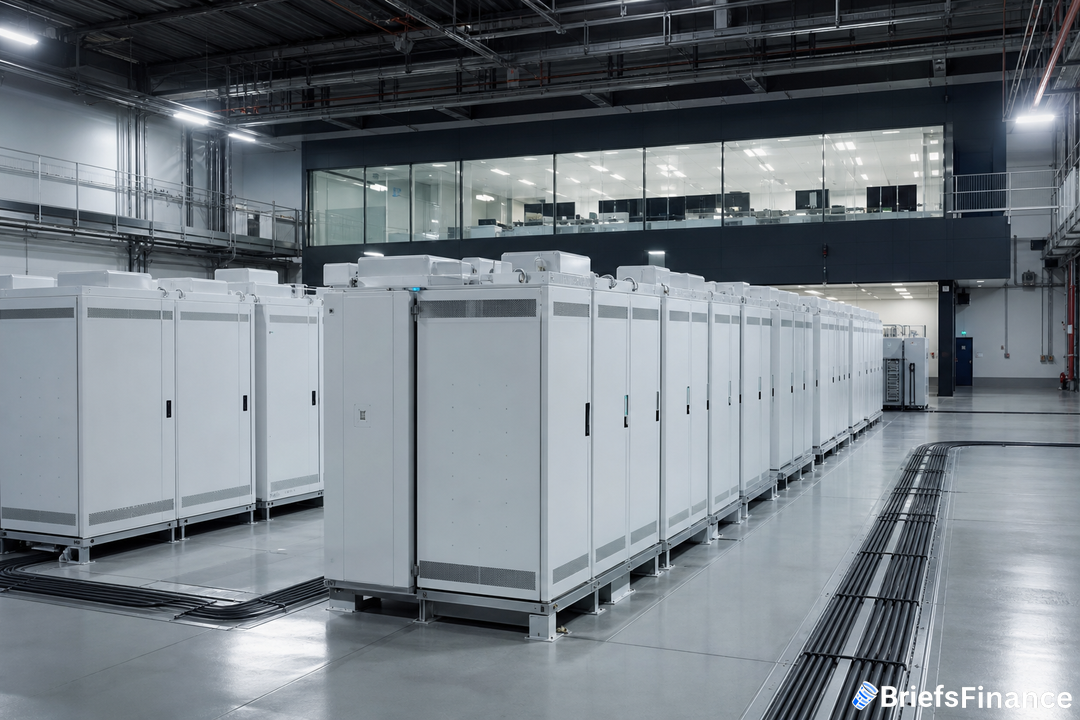
Skeleton's hardware helps data centers smooth power volatility and cut energy use. Madiberk said the company is working with "all major hyperscalers" in the US, and that the firm expects to roll out its technology to cover a gigawatt of data center capacity in the near future. He added, "What we see is that also up to 40% more compute can be had on the chips if the power management is done right and the energy is not burned off."
Manufacturing roots and Europe's role
The partners previously joined forces on Skeleton's €220 million ($246 million) facility outside Leipzig in eastern Germany, with Siemens aiding the launch of an automated line and the integration of digital tools into production. Koerte said Europe needs heavier investment in AI infrastructure to keep pace with the US. "We don't need the next OpenAI right now, what we need is the next generation of AI, which will primarily operate at the application level," he said. "We need to further expand the infrastructure."
European suppliers are deeply wired into data center electrification, with Siemens, France's Schneider Electric SE, and Switzerland's ABB Ltd. among the major players. Koerte flagged memory chips as Europe's biggest vulnerability in data centers, while stressing no region is truly independent given that US firms dominate design and much of the manufacturing sits in Asia.
Why this matters for your portfolio
Madiberk said, "We will invest over $200 million to US expansion and US manufacturing, so keeping the European technology at the heart." Siemens, among Germany's most highly valued companies at about €216 billion in market capitalization, provides power and electrical equipment to data centers and employs its industrial software to simulate how those sites are designed and operated. Estonia also prides itself on producing unicorns at a high rate for its size, with more than 10 startups valued above $1 billion in a country of 1.3 million people. And the neighborhood is busy too: Bloomberg reported Tuesday that Lithuania's newest unicorn is also zeroing in on the AI market. For regular investors, the takeaway is simple enough: AI infrastructure is not just chips, it is the power and plumbing behind them, and that is where new money is flowing.
Who solves grid storage captures an enormous market. Get the free Market Briefs daily newsletter and follow it.