Free NewsletterPro Login

Free Live Investors Workshop

Seats limited

Tue, Sep 29.

The dollar is losing value.

Here’s how investors can still profit.

Hosted By

Jaspreet Singh

Founder, Briefs Finance

X

Warning: Undefined variable $stocks in /var/www/briefs.co/htdocs/wp-content/plugins/oxygen/component-framework/components/classes/code-block.class.php(133) : eval()'d code on line 448

Warning: foreach() argument must be of type array|object, null given in /var/www/briefs.co/htdocs/wp-content/plugins/oxygen/component-framework/components/classes/code-block.class.php(133) : eval()'d code on line 448

Warning: Undefined variable $funds in /var/www/briefs.co/htdocs/wp-content/plugins/oxygen/component-framework/components/classes/code-block.class.php(133) : eval()'d code on line 472

Warning: foreach() argument must be of type array|object, null given in /var/www/briefs.co/htdocs/wp-content/plugins/oxygen/component-framework/components/classes/code-block.class.php(133) : eval()'d code on line 472
/* the link was here */

Saudis Close East-West Pipeline After Attacks, Lifting Oil Prices

Published Sep 13, 2026
[tts_player]
Share:
Summary:
  • Saudi Arabia halted the East-West crude pipeline as a precaution after attacks, with no timeline for restarting flows.
  • Brent jumped as much as 3.6% above $108 and WTI traded near $103 as supply risks flared.
  • Stockpiles at Yanbu can backstop exports for only days, analysts say, making a longer outage a potential catalyst for output cuts and higher prices.

What happened

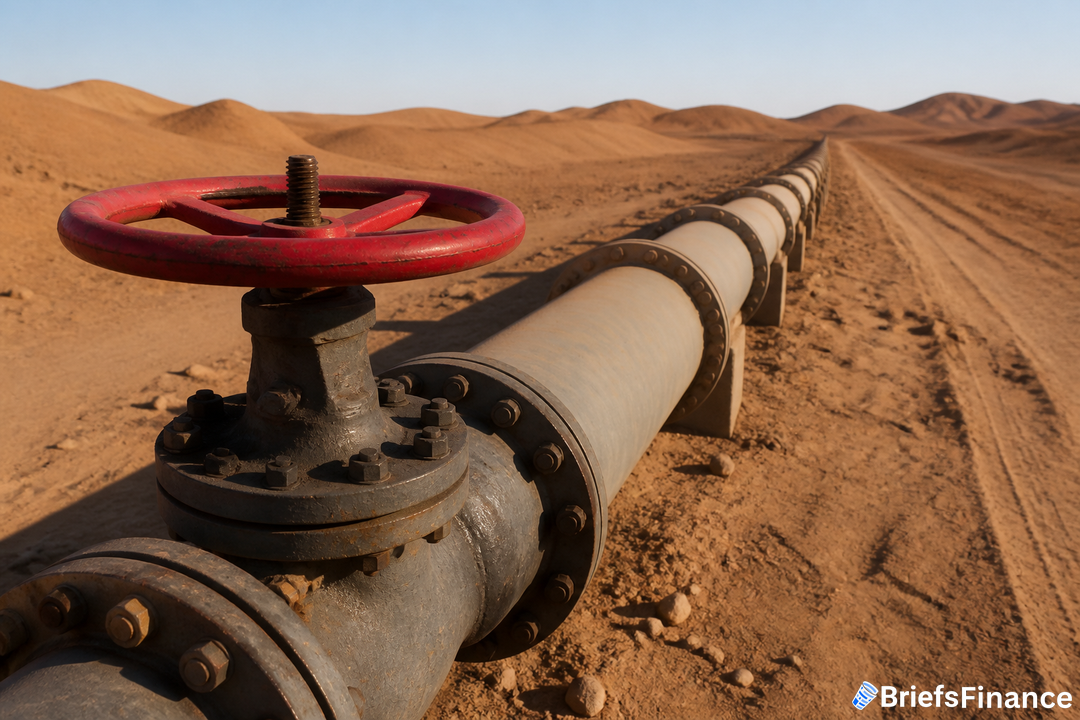
Saudi Arabia temporarily shut the East-West pipeline late Friday following attacks a day earlier, sidelining a key route that has helped sidestep the Strait of Hormuz amid the US-Iran war. Officials have not given any indication of when operations will restart. The attacks were reported on Sept. 10, and separate satellite imagery shows damage from a Sept. 13 drone strike at pipeline facilities.

Iraq moved quickly to address spillover risk: on Saturday, Prime Minister Ali Al-Zaidi instructed officials to begin an investigation after concluding the strikes came from a site in a region adjacent to Iran. With capacity around 7 million barrels a day, the line is central to regional flows at a moment when the global energy backdrop is already tight.

Market moves and immediate supply signals

Oil rallied on the headlines, then eased off peak gains. Brent climbed as much as 3.6% to top $108, and by 7:56 a.m. in Singapore the November contract was up 2.9% at $107.64. WTI hovered near $103, with October futures up 2.5% to $102.56.

Under the surface, pricing signaled tighter near-term supply. Brent's prompt spread widened to $5.39 a barrel in backwardation from $3.84 a week earlier, a sign of stronger demand for barrels now versus later. The move extends a year in which crude has risen by more than three-quarters as the US-Iran conflict has rippled across the region, hobbling exports and shipping, while a recent pickup in Chinese purchases added support.

How long this could last and what analysts say

"It all boils down to the duration," said June Goh, a senior oil market analyst with Sparta Commodities SA. A swift resumption would likely limit the fallout since stocks held at Yanbu, at the pipeline's western terminus, are available to draw. If the halt stretches, she said it could lead to production cuts.

Yanbu storage could sustain exports for about five to seven days, Suvro Sarkar, who heads energy research at DBS Bank Ltd., noted, after which the impact would be "huge." With repair details still unclear, he said the near-term setup points toward a potential test of $120 a barrel.

When uncertainty touches energy supplies, steady planning helps protect your financial future. Join Briefs Finance CEO Jaspreet Singh on September 29th for a FREE live investor workshop, How to Profit From A Dollar That's Losing its Value, where he shows how we're spotting investment opportunities as the dollar falls. Save your spot.

Diplomacy, security risks and the inflation tie-in

Oman's foreign minister, Badr Albusaidi, said the meeting that had been scheduled for later Monday with Iran and several Gulf states to set up a temporary Hormuz shipping corridor was postponed. Earlier, Bahrain announced it would skip the talks, citing in part the attack on the East-West pipeline, and Axios said Riyadh, too, had misgivings about the proposal.

Traders are also watching Yemen's Red Sea coast, where Iranian-backed Houthi advances could give the group more sway over traffic through the Bab el-Mandeb, another crucial chokepoint. The broader Middle East crisis has pushed up prices for crude, natural gas, and refined fuels like diesel. After US data showed inflation picked up in August, investors widely expect the Federal Reserve to raise rates this week.

Last week, US Treasury Secretary Scott Bessent said he intended to announce on Monday sanctions aimed at a major bank to pressure Tehran. At the same time, a blockade of Iran's ports is being enforced by the US Navy to constrict its energy exports.

What this means for your money: a key oil artery is offline with no restart signal, Yanbu stocks likely buy only a few days, and chokepoint risks are stacking up. That is why crude popped today - and why the path gets bumpier if repairs take time.

Staying calm and reviewing your portfolio regularly can help grow and safeguard savings. Our CEO Jaspreet Singh is hosting a FREE live investor workshop, How to Profit From A Dollar That's Losing its Value, on September 29th. Sign up free to join him live.

Disclosure

Recent News

1 2 3 75

Get Market Briefs delivered to your inbox every morning for free!

No fluff. No noise. No politics. Just finance news you can read in 5 minutes.

Blogs

September 11, 2026
How Is the Economy Doing? Washington Says It's Fixed, but the Numbers Don't Agree
  • Treasury Secretary Scott Bessent says the economy is fixed because lower earners' incomes are now rising faster than top earners'.
  • The Atlanta Fed and Bank of America show different numbers, and Hilton, Marriott, and McDonald's can't agree on what they're seeing either.
  • Whichever side is right, the economy is built to make investors rich, and inflation is how it does it.
Read More
September 10, 2026
US National Debt Hits $40 Trillion: Why the Economy Hasn't Collapsed Yet
  • The US national debt crossed $40 trillion in 2026 and is growing faster than the economy. The debt to GDP ratio now sits at 125%, the highest outside the pandemic and higher than World War II.
  • On September 9, 2026, Treasury Secretary Scott Bessent rolled out an emergency plan for the government to lend money to itself. Ray Dalio now says the dollar has roughly three years before real pain.
  • Empires rarely default. They debase. Since 1971, median household income grew about 8x while houses grew 17x and the S&P 500 grew 360x, so investors got richer while workers fell behind.
Read More
September 9, 2026
Your 401k Is Fueling the AI Bubble
  • About $10 trillion of 401k money sits in a $77 trillion stock market, mostly through target date funds and S&P 500 funds. Roughly 30% of every S&P 500 dollar lands in five AI-heavy tech stocks.
  • Four bubble signals run hotter today than before the 2000 crash: top-ten concentration, tech's share of the index, the Buffett Indicator, and how much of the market index funds own.
  • You only lock in an AI bubble loss if you sell. The 2022, 2020, 2008, and 2000 crashes were all buying windows for long-term investors, and the US-China AI race means government money could keep flowing in.
Read More
September 9, 2026
What Is Wealth Preservation? How To Protect Your Money From Anything
  • Wealth preservation is an investing strategy built around keeping the money you've already made instead of chasing growth.
  • It leans on assets that hold steady when markets fall - gold, Treasury bonds, and companies that keep earning through wars, crashes, and pandemics.
  • The tradeoff is real: you give up some upside, and the two key numbers to check are maximum drawdown and correlation to the market.
Read More
September 8, 2026
Why Is Everything So Expensive? Why Prices May Never Come Back Down
  • Official inflation is 3.4% and prices are up 32% since 2020, but rent (41%), gas (47%), car insurance (64%) and ground beef (79%) all outran the 28% median wage.
  • The Federal Reserve targets 2% inflation on purpose. Rising prices push extra dollars to investors and shrink the real cost of a $40 trillion national debt.
  • Investors who simply owned the S&P 500 gained about 150% over the same six years, and the Fed's September 16 decision will show whether it protects the dollar or the economy first.
Read More
September 7, 2026
The U.S. Housing Market Just Flipped: Renting a Home Now Beats Buying One
  • The US is in a buyer's market in 41 of the 50 largest metro areas, but prices sit near record highs and mortgage rates are close to 7%.
  • The same median house costs 27% more than it did in 2021 while the monthly payment costs 90% more, and incomes rose a little more than 10%.
  • A 2008-style crash is not showing up in the data, so the pressure is landing on buyers instead of prices.
Read More
September 4, 2026
An Interest Rate Hike in 2026? The Fed Just Broke Its Own Script
  • The Federal Reserve spent a year signaling cheaper money, and its new chairman just warned that an interest rate hike may be coming instead.
  • The Fed is stuck between high inflation and a weak job market, and fixing one makes the other worse.
  • Higher rates also reprice roughly a third of America's $40 trillion national debt this year, which is why Washington wants cuts so badly.
Read More
September 3, 2026
5 Passive Income Ideas That Pay You Whether You Work or Not
  • School teaches one formula: work, earn, spend. Stop working and the money stops, so the wheel never ends.
  • Five assets pay you without your labor - dividends, rent, interest, royalties, and the things you already own.
  • $80,000 a year of cash flow takes about $1 million invested at 8%, or roughly 20 years of $1,000 a month.
Read More
September 2, 2026
The Best Way to Invest 10k: Three Options To Transform 10K into 10 Million
  • Passive investing in stocks or real estate targets around 10% a year, and time in the market matters more than the price you get in at.
  • Active investing means putting your time in alongside your money, which raises the target to roughly 20% a year and raises the risk of losing it all.
  • Investing in yourself has no ceiling, because a new skill can create a new income that no market return can match.
Read More
September 1, 2026
The Tax Write Offs the Rich Are Using in 2026 While the IRS Shrinks
  • The 2026 tax brackets landed lower than they were headed, and the standard deduction jumped from a planned $8,350 to $16,100 for single filers.
  • New write offs for overtime, tips, seniors and car loan interest are live now, and most of them are written to expire in 2028.
  • About a third of IRS auditors have been fired, and four assets do most of the work for people who want income without a matching tax bill.
Read More
1 2 3 26
Share via
Copy link