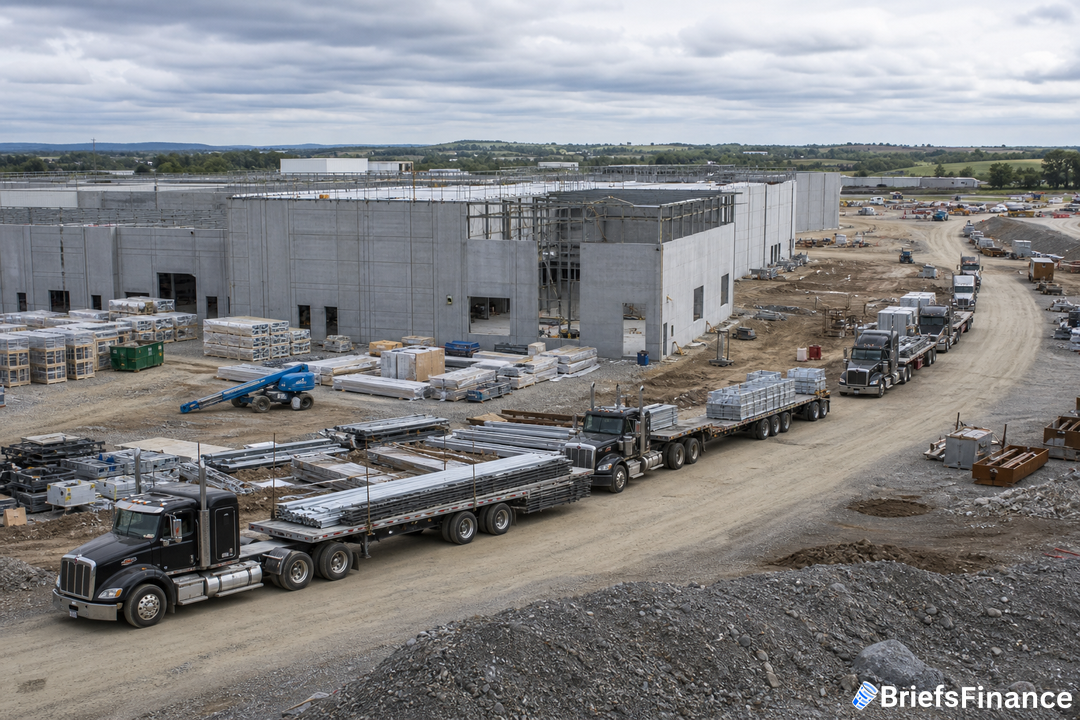
Why AI is suddenly a trucking story
Those giant buildings full of servers do not teleport into place. HVAC units, piping, wiring, semiconductors, and all the other kit arrive by truck, or by rail and then a truck for the last leg. That matters in a freight market already hit by trade-war tariffs and a diesel price spike that, tied to the Iran war, climbed to a record $5.85 a gallon on Friday. Cox Fleet's senior vice president for fleet management solutions, Patrick Brennan, said, "Against that backdrop, AI and data center activity presents an opportunity for fleets."
Brennan said overall freight is still uneven, but the equipment-heavy push around data centers, defense, and chips is more likely to generate loads. He pointed to a clear pickup in production indicators and carrier commentary tied to data center materials, with load-to-truck ratios climbing as capacity tightens in that slice of the market.
Where the freight is flowing
Power availability and land costs help decide where these projects go, and that is redrawing trucking lanes into places that were not traditional freight hubs. "This reshapes routes as much as it adds volume," Brennan said. Georgia and Texas are experiencing clear increases in trucking linked to these projects, said Janelle Griffith, who leads the global logistics practice at Marsh. "A lot of it is rural," she said, citing research indicating that among planned data center developments, 67 percent will be located in rural areas, while 39 percent of planned facilities are designated for counties that currently have none.
One marquee job: a $16 billion data center in Saline, Michigan, developed by Related Digital for Oracle and Open AI. As construction ramps in these locations, demand spreads across the local economy, from fuel and building supplies to a need for more drivers, which pulls in additional trucking activity throughout the region.
Who is doing the hauling and hiring
"The effect shows up most in flatbed and heavy haul, where spot rates have hit multiyear highs this summer and capacity is tightest in construction-heavy markets," Brennan said. "Flatbed and heavy haul have been on an absolute tear since last year, and that's where demand from the buildout is most concentrated," he added.
Even when big components ride the rails, a truck usually still takes them from the terminal to the site. According to Kyle Roberts - vice chairman for industrial & logistics/capital markets at Newmark Mountain West - "A lot of things used to build data centers move via rail, truck takes it from destination to building, doesn't reduce demand, just reduced distance." This short final-mile leg has especially helped LTL, a part of the market that has struggled for an extended period, a weakness underscored by the 2024 bankruptcy of Yellow Trucking.
Markets move every day, and most of it never reaches you in time. Get the free Market Briefs daily newsletter and stay ahead of it.
Moving these projects also takes people beyond drivers. "These projects require moving heavy equipment, generators, transformers, cooling systems, construction materials, and supporting infrastructure, which increases demand for CDL drivers, diesel technicians, fleet maintenance professionals, and logistics personnel," Brennan said. The scramble from a shrinking talent pool is lengthening hiring timelines for specialized roles, ramping up recruiting, and pushing fleets to expand maintenance capacity as trucks run more and rack up miles. And more miles means more maintenance.
Boom today, leaner tomorrow
It is not just the big fleets cashing in. AltLINE's freight factoring operations manager, Jennifer Lockett, said, "Data center construction is creating new work for carriers, particularly those moving the massive transformers and generators needed to power these facilities, and large quantities of concrete and other construction materials." She noted the bigger, specialized loads can open doors to new customers and lanes. The catch: scaling up with additional trucks, more drivers, and extra equipment to manage the volume often requires fuel, labor, and maintenance spending before invoices are paid, especially when smaller carriers take on larger customers.
Carriers may need more working capital to keep growth moving. "Still, the bigger story is how much new freight activity these projects can generate for trucking businesses," Lockett said.
Industry voices say do not confuse the construction spike with permanent demand. Roberts warned of an "extraordinary drop off" in truck traffic once a site is live. By contrast, once operational, a data center handles only a sliver of the traffic you would see at a typical 200,000-square-foot warehouse or distribution center that has 80 dock doors and runs two turns per day. According to Kyre Lahtinen, who teaches finance as an associate teaching professor at Wake Forest University, "Unlike warehouses that support large retailers or other physical goods delivery, data centers required comparatively little logistics support after they have been built."
For now, the AI machine is busy enough that carriers can roll to the next project. "There is a massive ecosystem that sits around, all of those components have trucking demands," Roberts said. "It's a very positive impact," Roberts said. If you rely on freight to move your business, the takeaway is straightforward: the build phase is a real tailwind, but it is cyclical, and pricey fuel at $5.85 a gallon still eats into the win.