Free NewsletterPro Login

Warning: Undefined variable $stocks in /var/www/briefs.co/htdocs/wp-content/plugins/oxygen/component-framework/components/classes/code-block.class.php(133) : eval()'d code on line 448

Warning: foreach() argument must be of type array|object, null given in /var/www/briefs.co/htdocs/wp-content/plugins/oxygen/component-framework/components/classes/code-block.class.php(133) : eval()'d code on line 448

Warning: Undefined variable $funds in /var/www/briefs.co/htdocs/wp-content/plugins/oxygen/component-framework/components/classes/code-block.class.php(133) : eval()'d code on line 472

Warning: foreach() argument must be of type array|object, null given in /var/www/briefs.co/htdocs/wp-content/plugins/oxygen/component-framework/components/classes/code-block.class.php(133) : eval()'d code on line 472
/* the link was here */

Why Physical AI Is Following the ChatGPT Playbook

Published Aug 26, 2026
[tts_player]
Share:
Summary:
  • Physical AI startups are raising huge sums of money, including a $105 million seed round for Genesis AI.
  • The technology needs far more data and computing power before robots can handle everyday tasks reliably.
  • Most successful robots today do narrow jobs like vacuuming floors or digging ditches, not complex general-purpose work.

Everyone knows AI is getting smart. The harder question is whether it can learn to work with its hands.

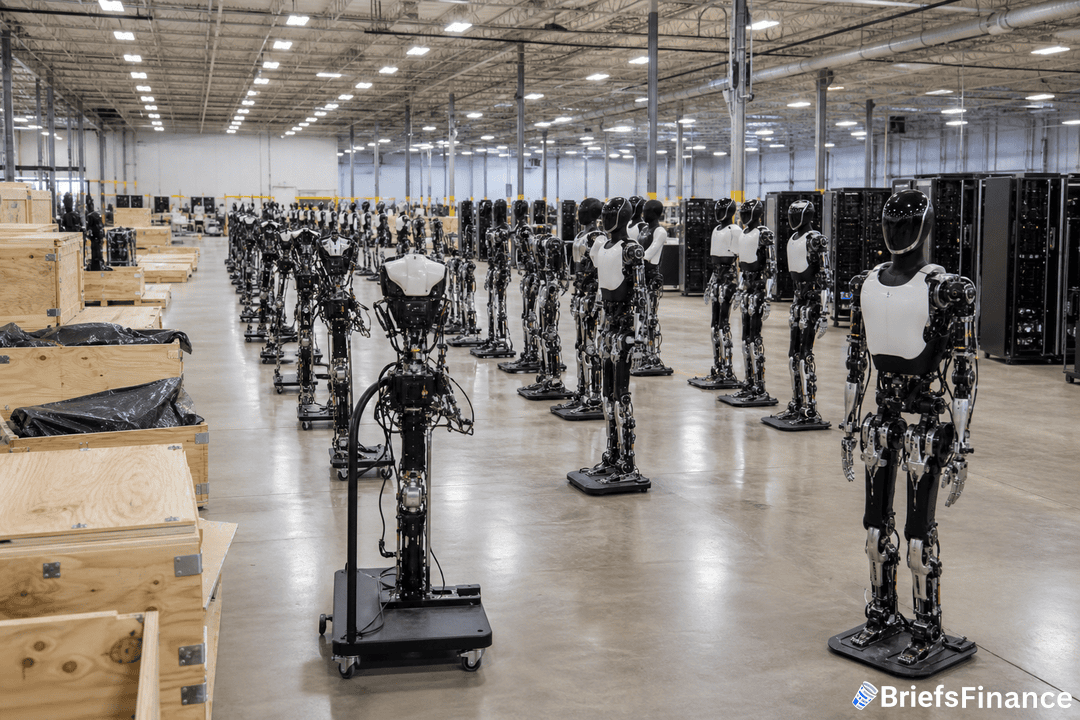
That question is driving billions into "physical AI" - software that lets machines move, grab, and build things in the real world. But the companies chasing it admit the technology is still in its early days.

One founder compares this moment to the early stages of ChatGPT. The pieces are there. The data is not.

Big Money, Early Days

Théophile Gervet, the founder of Genesis AI, compares physical AI to where OpenAI was with its GPT-2 model. The tech showed promise, but it needed far more data and computing power before it became something the world actually used.

"No customer cares about the general-purpose robot that works at 80%," Gervet said.

That is the central problem. A robot that gets it right four out of five times fails a real job. A warehouse manager cannot risk a robot dropping their shipment. A hospital cannot trust a robot that occasionally fumbles.

Gervet's comparison to GPT-2 is telling. That model was a breakthrough when it launched, but it was still too limited for real-world use. It took years of additional training data and computing power before the technology reached the point where it could power products like ChatGPT. Physical AI is in a similar position now - the fundamental approach works, but the scale of data needed to make robots reliable in unpredictable environments is still out of reach.

So the startups taking in huge checks are picking their battles. Agility deploys robots in industrial settings. Gritt builds solar farms. Bedrock started with autonomous excavators because digging is simpler than picking up a glass of water.

Building wealth takes consistency, so grab the free Always Be Buying E-Book to start.

The Race to Gather Smarter Data

Autonomous vehicles are further along because they had a head start. They can pull data from millions of miles of human-driven cars, and their job is mostly avoiding obstacles. They do not have to manipulate things or squeeze through tight spaces.

That data advantage is why Wayve and Uber both launched robotics labs focused on humanoid robots. And it is why Tesla keeps pushing its Optimus project forward.

Foxglove, a tooling company started by former Cruise employees, just launched a feature that lets engineers search through sensor data using plain language. Instead of digging through logs, they can ask questions like "show me every time a car cut us off" and the system finds it.

The idea is to make debugging faster. Teams spend enormous time finding why a robot did something wrong, and any tool that speeds that up is valuable.

What Comes Next

Sam Altman, the man behind ChatGPT, says a physical AI breakthrough is only a few years away.

For your portfolio, this is not a story about one hot stock. It is a story about a broad shift in how machines learn to work alongside people.

That shift touches everything from the construction sites that use autonomous excavators to the factories renting robots for repetitive tasks. The winners will likely be the companies that solve the boring problems first, not the ones promising a robot for every home.

The technology is coming. But as anyone who has watched a robot try to fold laundry knows, it will arrive one narrow task at a time.

Disclosure

Recent News

1 2 3 62

Get Market Briefs delivered to your inbox every morning for free!

No fluff. No noise. No politics. Just finance news you can read in 5 minutes.

Blogs

August 23, 2026
How to Get the Most From Your Guideline 401k
  • Guideline is a company that provides low-cost 401k plans, popular with small businesses and their employees.
  • A "Guideline 401k" follows the same core rules as any 401k: tax-advantaged growth, contribution limits, and often an employer match.
  • The biggest results come from capturing the full match, choosing low-cost funds, and picking Roth or traditional to fit your situation.
Read More
August 23, 2026
Principal 401k: What to Know About Your Plan
  • Principal is one of many companies that manage workplace 401k plans, so a "Principal 401k" is simply a 401k where Principal is the provider.
  • The rules of a 401k are the same no matter who runs it: pre-tax or Roth contributions, tax-advantaged growth, and often an employer match.
  • The biggest wins come from grabbing the full match, picking low-cost funds, and knowing whether Roth or traditional fits you.
Read More
August 23, 2026
What a Tariff Dividend Means for Your Money
  • A "tariff dividend" is the idea of taking money the government collects from tariffs and paying some of it back to citizens.
  • To judge the idea, you first need to know what a tariff is: a tax on imported goods, usually paid by the companies bringing them in.
  • Tariffs ripple through prices, businesses, and your investments, so the smart move is understanding those ripples, not just the headline.
Read More
August 23, 2026
No Tax on Overtime: How Overtime Pay Is Taxed
  • "No tax on overtime" refers to a tax break that lets certain workers deduct some overtime pay, lowering the income they get taxed on.
  • A deduction does not mean overtime is truly tax-free. It means part of that pay is subtracted before your tax is figured.
  • The bigger money lesson: how you earn money changes how it is taxed, and investors often get the friendliest treatment of all.
Read More
August 23, 2026
Reading the Silver Price Forecast for 2026
  • Nobody can honestly promise a specific silver price for 2026. Any exact number is a guess, so treat forecasts as opinions, not facts.
  • Silver is unusual because it is both a precious metal and an industrial metal, so its price answers to two very different forces.
  • Instead of chasing a forecast, learn the drivers - inflation, interest rates, recession fear, and industrial demand - so you can judge any prediction yourself.
Read More
August 23, 2026
What to Do When Reddit Stocks Go Viral
  • "Reddit stocks" usually means stocks getting hyped in online communities, where crowds can send a price soaring or crashing fast.
  • These tips can be entertaining and sometimes useful, but they are opinions, not research, and often come loaded with hype.
  • The safe move is to treat every online tip as a starting point, then do your own homework before risking a dollar.
Read More
August 23, 2026
Why Is Bitcoin Dropping Right Now?
  • Bitcoin drops for a mix of reasons: interest rates, big-picture money policy, regulation news, and simple shifts in how much risk investors want to take.
  • Bitcoin has a fixed supply and no earnings, so its price runs almost entirely on supply, demand, and sentiment.
  • Sharp drops are normal for bitcoin. Understanding the drivers matters more than reacting to any single day.
Read More
August 23, 2026
The Fidelity 500 Index Fund, Made Simple for Beginners
  • The Fidelity 500 Index Fund is a low-cost fund that tracks the S&P 500, an index of 500 large U.S. companies.
  • Buying it means owning a tiny slice of 500 businesses at once, which spreads your risk in a single purchase.
  • Index funds like this win over time mostly by keeping fees low and letting compounding do the work.
Read More
August 23, 2026
USA Penny Stocks: Risks and Rewards Explained
  • USA penny stocks are very low-priced shares of very small companies, often trading under $5 and sometimes under $1.
  • They dangle the dream of huge, fast gains, but carry brutal risks: low liquidity, wild swings, and high failure rates.
  • Most investors build wealth faster with quality companies and funds than by chasing cheap shares.
Read More
August 23, 2026
Finding Cheap Stocks to Buy Now Without Getting Burned
  • A low share price does not mean a stock is cheap. Real value compares the price to what the business is actually worth.
  • The best cheap stocks to buy now are quality companies trading below their true value, not the tiniest, riskiest shares on the market.
  • For most beginners, a low-cost index fund is the simplest "cheap" way to own great companies at once.
Read More
1 2 3 25
Share via
Copy link










