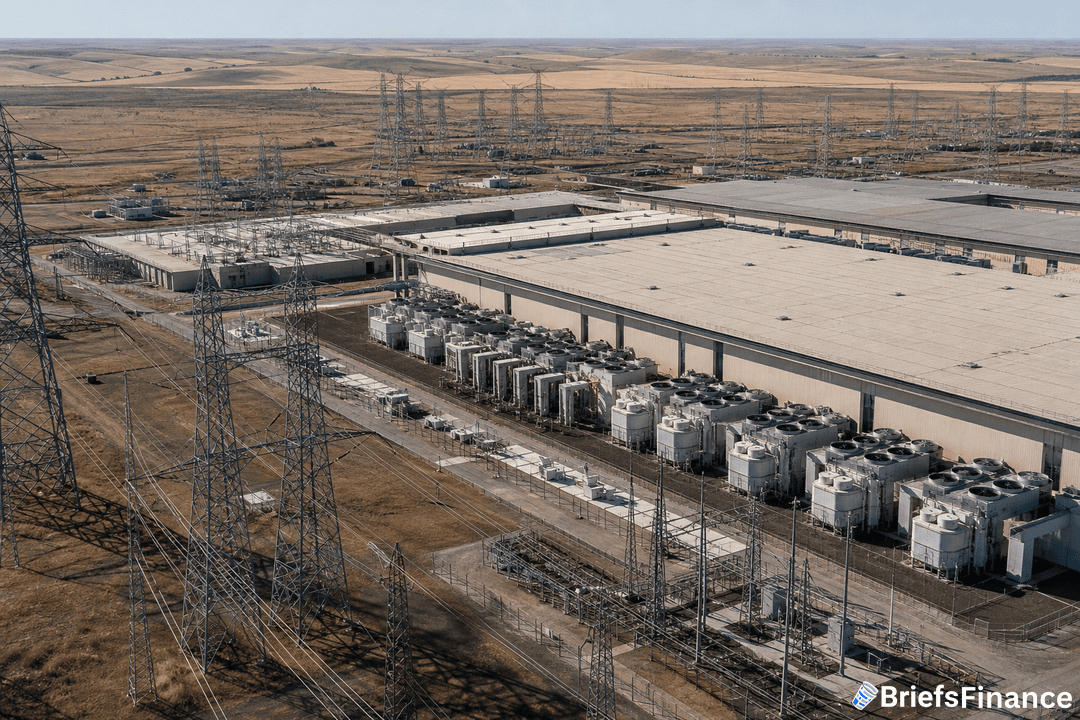
Data Centers as a Growing Load
Data centers never sleep. Like giant factories, they run around the clock, so they put steady pressure on a grid that has to keep supply and demand matched every second.
A terawatt-hour is a measure of electricity on a national scale, so 34 terawatt-hours is not a small jump.
That is already almost seven times today's demand.
Data centers are a tricky load because they do not ease off at night or over weekends. They run consistently across seasons, much like a large industrial plant.
That puts pressure on the grid when overall demand is lowest.
New Demand Meets an Aging Grid
The timing is the hard part. Data centers can plug in faster than the grid can build the power lines and plants needed to serve them.
That can create bottlenecks, push up consumer prices, and force a heavier reliance on coal while new supply catches up.
A few minutes a day is enough to stay genuinely informed about your money. Join Market Briefs free and start tomorrow.
The government wants new data centers to run on renewable power, including solar, although some regional administrators are pushing back.
AEMO chief executive Daniel Westerman says the early 2030s should be manageable. "A significant amount of new capacity is expected to be delivered between now and the early 2030s," he said.
Then he pointed further out: "Beyond 2030, the next wave of investment is critical."
Power plants are also being retired at the same time. Within 10 years, 13 gigawatts of coal and gas generation are expected to retire. That includes 2 gigawatts of capacity expected to retire in the same window.
Not every data center project will make it either.
The money is still huge. CBA estimates the data-center build-out could be worth A$150 billion by 2030.
That is the kind of scale that makes a $1 billion project look small.
What happens next depends on whether those investments land before the older plants leave. The race is between new supply and new demand.
What This Means for Your Money
There is good news in the supply numbers.
AEMO says the new capacity has already improved the reliability outlook. That matters because reliability keeps prices from spiking when demand is high.
For investors, the more interesting story is the wave of electricity projects needed to keep up. Generation, batteries, and grid upgrades are all part of that picture.
For households and businesses, the risk is more direct. A grid stretched to serve giant power users can pass those costs along, especially during low-demand periods when data centers are doing most of the heavy lifting.
The bottom line: Data centers are coming either way. The question is whether the power system can scale fast enough to handle them without making electricity a lot more expensive for everyone else.
Rates, prices and policy all end up in your budget eventually. Get the free Market Briefs daily newsletter and see it coming.