Free NewsletterPro Login
S&P 500 6,287 +0.42%
DOW 44,521 -0.18%
NASDAQ 21,103 +0.71%

Warning: Undefined variable $funds in /var/www/briefs.co/htdocs/wp-content/plugins/oxygen/component-framework/components/classes/code-block.class.php(133) : eval()'d code on line 491

Warning: foreach() argument must be of type array|object, null given in /var/www/briefs.co/htdocs/wp-content/plugins/oxygen/component-framework/components/classes/code-block.class.php(133) : eval()'d code on line 491
/* the link was here */

US Interceptor Stockpiles Dangerously Low After Iran Conflict, Analysis Says

Published Aug 11, 2026
[tts_player]
Share:
Summary:
  • A Bloomberg Economics analysis dated August 11, 2026 cautions that American inventories of certain Iran-war munitions are "dangerously low."
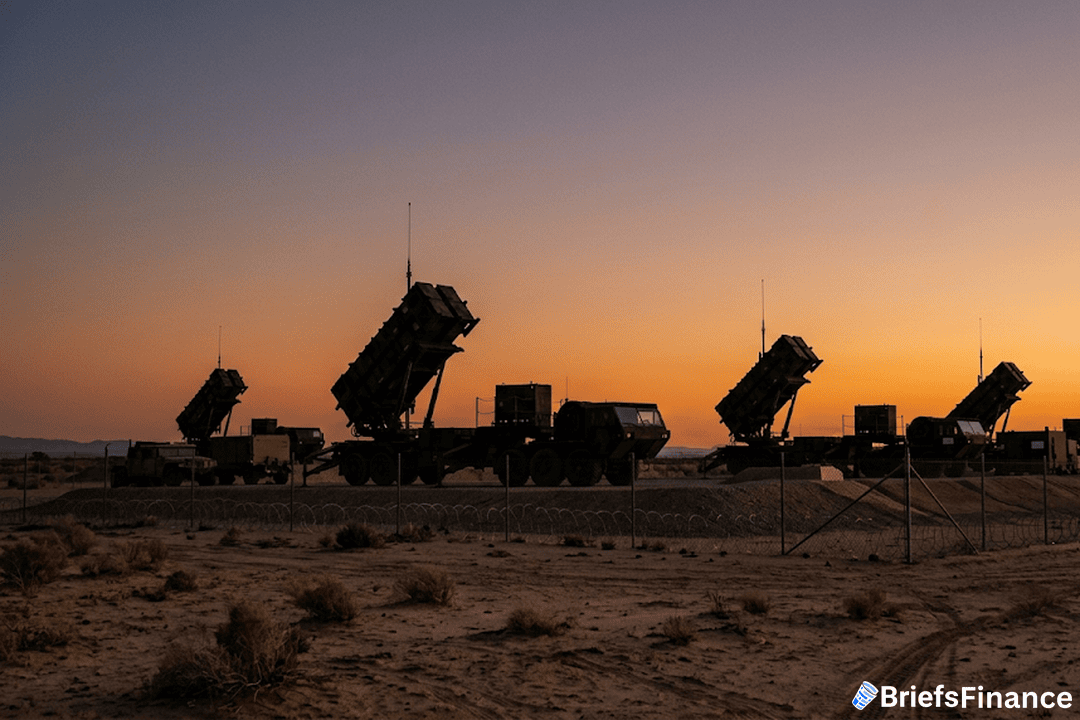
  • The US likely expended more than half of its top-tier PAC-3 MSE Patriot interceptors and roughly 40% of its THAAD interceptors.
  • The Pentagon is seeking $18.2 billion for munitions in a $67 billion emergency package, and rebuilding stocks will take years.

The US military fired a lot of hardware during the conflict with Iran. Pentagon officials say American forces struck more than 13,000 targets. Now comes the bill, and it is not just about money.

A Bloomberg Economics analysis released Tuesday warns that the US is sitting on "dangerously low" stocks of the weapons that matter most. The Pentagon's supply of air-defense interceptors - the missiles that shoot down incoming threats - is "critically low," while long-range missile supplies are "under pressure."

The analysts drew on Pentagon budget documents and public reporting about stockpile levels. As of Tuesday, the Defense Department had not answered a request for comment.

According to the analysis, US forces probably expended more than 50 percent of the most sophisticated Patriot version, the PAC-3 MSE, and close to 40 percent of Terminal High Altitude Area Defense interceptors while defending against Iranian retaliation. At the start of the conflict, commanders worked to keep US personnel out of combat zones, and the inventory of Precision Strike Missiles may now be gone; other standoff weapons also ran down quickly.

The Cost of Rebuilding

In testimony to Congress, Defense Secretary Pete Hegseth put the cost of the Iran war at roughly $37.5 billion, although analysts think the final number may exceed that.

Get the free Always Be Buying eBook and learn the simple system for building wealth on any income

For the current fiscal year, the Pentagon has asked for an emergency package of $67 billion, including $18.2 billion for munitions that saw heavy use against Iran. According to the report, rebuilding these inventories is a years-long effort that will require billions.

"The war has consumed important weapons faster than they can be bought and built," wrote analysts Becca Wasser and Courtney McBride. "That is creating a generational gap in US stockpiles of air defense interceptors and exquisite long-range munitions that cannot be quickly overcome."

The intensity of the fighting is underscored by the Pentagon's estimate that US forces hit more than 13,000 targets. With air-defense systems operating at high tempo and factories unable to match wartime consumption, the report says the result is a gap in stocks that will not close quickly.

What the Officials Are Saying

President Trump and Hegseth have generally pushed back against claims of shortfalls, insisting American troops have sufficient supplies. In the Oval Office the other day, President Trump told journalists the US possesses an almost inexhaustible inventory of "certain types of munitions that are very powerful," while acknowledging, "we have others where it's a little bit tighter, and we're getting them in on a daily basis."

Such inventory pressures now appear to be shaping US operational choices.

The choices ahead are all tradeoffs, as the Bloomberg Economics analysts put it. "The US isn't out of missiles, but it is running low on the right ones," Wasser and McBride wrote. "And the choices that remain all come at a cost."

Bottom Line

Adversaries like China are watching closely. "Munitions availability will increasingly shape which operations the US can undertake at an acceptable level of risk," the analysts wrote.

Download the free Always Be Buying eBook and start putting your money to work today
Disclosure

Recent News

1 2 3 53

Get Market Briefs delivered to your inbox every morning for free!

No fluff. No noise. No politics. Just finance news you can read in 5 minutes.

Blogs

June 29, 2026
Portfolio Diversification: Why Putting All Your Eggs in One Basket Destroys Wealth
  • Real diversification means spreading investments across all 11 economic sectors plus bonds, alternatives, and cash so no single bet can sink the portfolio.
  • Different sectors perform at different times, so a diversified portfolio captures upswings while smoothing the brutal drawdowns that wipe out concentrated bets.
  • Total market index funds offer the simplest path to diversification, and annual rebalancing is what keeps the structure working over time.
Read More
June 29, 2026
Non Taxable Income: What It Is and Why It Matters
  • Non taxable income is money you receive that you don't owe income tax on.
  • The tax code treats workers, investors, and business owners very differently, and investors often come out ahead.
  • Learning how income is taxed is a quiet superpower for keeping more of what you earn.
Read More
June 29, 2026
Semiconductor Stocks: A Simple Guide for Investors
  • Semiconductor stocks are companies that design and make computer chips, the brains inside nearly every modern device.
  • The AI boom has turned chips into one of the market's most important and most watched groups.
  • They offer big growth potential, but come with high valuations and a notoriously cyclical history.
Read More
June 25, 2026
How Stocks Work: A Simple Guide for Beginners
  • A stock is a slice of ownership in a company - buy one, and you own a piece of the business.
  • You make money two ways: the share price rising over time, and dividends paid to shareholders.
  • The simplest path for most beginners is buying into the whole market through a low-cost index fund.
Read More
June 25, 2026
Stop Loss vs Stop Limit: What's the Difference?
  • A stop loss order sells your stock once it hits a trigger price, prioritizing getting you out.
  • A stop limit order only sells within a price range you set, prioritizing price over a guaranteed exit.
  • The trade-off: a stop loss almost always executes; a stop limit might not if the price moves too fast.
Read More
June 25, 2026
Energy Stocks: A Simple Guide for Investors
  • Energy stocks are companies that produce and supply the power the world runs on, from oil and gas to newer sources.
  • They make up one of the 11 sectors of the market and tend to move with energy prices and big-picture shifts.
  • Like any sector, the key is diversification and understanding the forces driving demand.
Read More
June 18, 2026
What Is a Stop Loss Order? A Simple Guide
  • A stop loss order automatically sells a stock once it falls to a price you set.
  • It's a tool to cap losses or lock in gains without watching the market all day.
  • It works best for active strategies, and can backfire if used carelessly on long-term holdings.
Read More
June 18, 2026
Best S&P 500 Index Fund: How to Choose One
  • The best S&P 500 index fund for most investors is simply the cheapest, most established one that tracks the index well.
  • Funds like VOO, IVV, and SPY all hold the same 500 companies, so the biggest difference is the fee.
  • Pick one, automate your buys, and let time do the heavy lifting.
Read More
June 17, 2026
What Are Penny Stocks? Risks and Rewards Explained
  • Penny stocks are very low-priced shares of very small companies, often trading for just a few dollars or less.
  • They promise huge gains but carry huge risks: low liquidity, high failure rates, and wild price swings.
  • Most investors are better served by quality companies and funds than by chasing cheap shares.
Read More
June 17, 2026
Best Stocks for Beginners With Little Money
  • The best stocks for beginners with little money usually aren't individual stocks at all - they're low-cost index funds.
  • You can start with $100 or less and use small, regular investments to build wealth over time.
  • Focus on diversification and consistency, not on picking the next big winner.
Read More
1 2 3 24
Share via
Copy link











