Four financial institutions completed a debt facility supporting SoftBank Group Corp.'s $5.4 billion robotics acquisition, after expanding the dollar-denominated portion.
The debt facility, equivalent to $1.75 billion and consisting of both dollar and euro term loans, was priced with a 4.25 percentage-point margin above the applicable benchmarks, at the high end of initial discussions, said a person with knowledge of the matter. The debt was sold at a price of 98.5 cents per dollar, reflecting a discount.
Previously, the banks increased the dollar component of the transaction by $200 million, bringing it to $800 million, while the euro portion of the loan was set at €825 million, equivalent to about $940 million, indicating greater appetite from US leveraged loan investors.
Get the market news that matters in a five-minute read with Market Briefs, our free daily newsletter
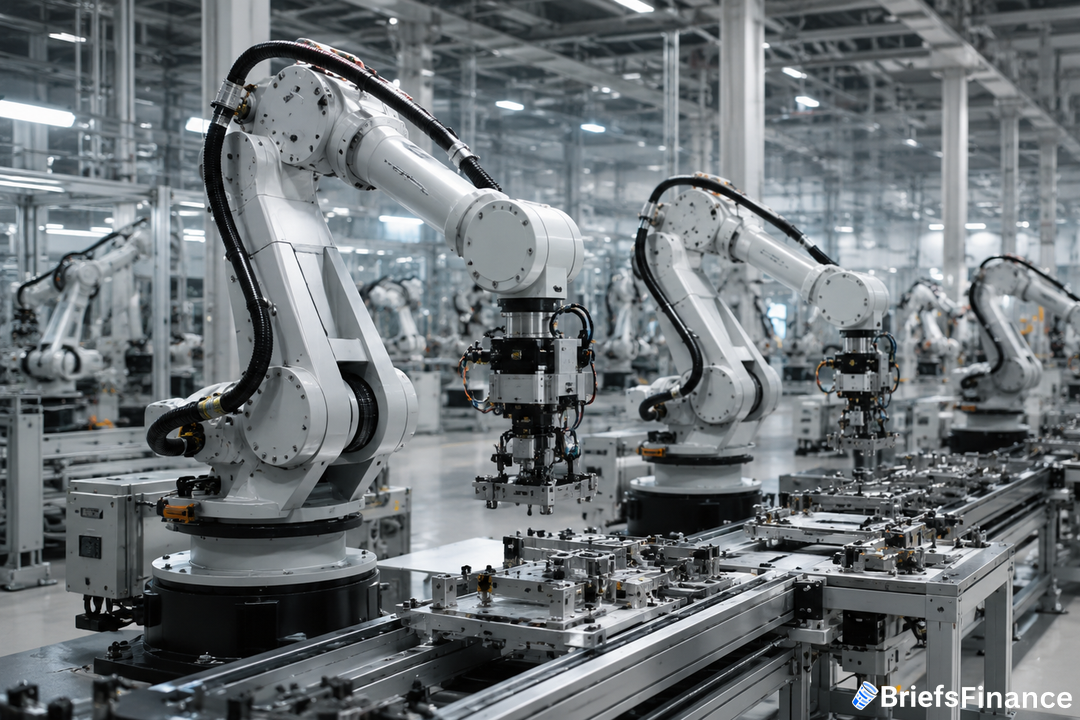
The deal proceeds are intended to finance SoftBank Group's purchase of ABB Ltd's industrial robotics division. ABB, the Swiss industrial group, had planned to spin off the business but has now decided to concentrate on sectors like electrification, which is experiencing a boom as companies such as OpenAI and Meta Platforms Inc. pour trillions into data centers.
The loan was put together by a syndicate of four banks: BNP Paribas, Goldman Sachs, HSBC Holdings, and Mizuho Financial.
This acquisition marks a major push by SoftBank into industrial automation, as the Japanese conglomerate continues to bet on robotics amid rising labor costs and supply chain reshoring. ABB's robotics division is a leader in manufacturing automation, and the deal aligns with SoftBank's portfolio of technology investments. The leveraged loan market, meanwhile, has seen robust demand as institutional investors seek higher yields, allowing the banks to upsize the dollar tranche.
This transaction also reflects broader trends in the global leveraged loan market, where yield-hungry investors have fueled strong appetite for riskier debt. SoftBank's move into industrial robotics builds on its history of large bets in technology, from semiconductor design to artificial intelligence, and positions the company to capitalize on the growing automation needs of manufacturers reshoring production. The involvement of four major global banks underscores the complexity and scale of the financing, while the pricing at the high end of initial discussions indicates that lenders demanded a premium for the debt given the current interest rate environment and SoftBank's own leverage profile.
Background and Strategic Context
SoftBank's foray into industrial robotics represents a deliberate shift from its earlier emphasis on software and internet companies. The Japanese group has long placed large, speculative wagers - backing Arm Holdings before selling a stake, funding the Vision Fund's high-profile bets on WeWork and Uber, and more recently investing in artificial intelligence infrastructure. But acquiring a physical manufacturing unit from ABB, a century-old Swiss engineering firm, signals a deeper commitment to automation hardware.
Rising labor costs in developed economies and the reshoring of supply chains from China have created surging demand for industrial robots. The euro tranche, though smaller, also drew solid interest.
Join Market Briefs, our free daily newsletter, for a quick daily rundown of the markets