Free NewsletterPro Login

Warning: Undefined variable $stocks in /var/www/briefs.co/htdocs/wp-content/plugins/oxygen/component-framework/components/classes/code-block.class.php(133) : eval()'d code on line 448

Warning: foreach() argument must be of type array|object, null given in /var/www/briefs.co/htdocs/wp-content/plugins/oxygen/component-framework/components/classes/code-block.class.php(133) : eval()'d code on line 448

Warning: Undefined variable $funds in /var/www/briefs.co/htdocs/wp-content/plugins/oxygen/component-framework/components/classes/code-block.class.php(133) : eval()'d code on line 472

Warning: foreach() argument must be of type array|object, null given in /var/www/briefs.co/htdocs/wp-content/plugins/oxygen/component-framework/components/classes/code-block.class.php(133) : eval()'d code on line 472
/* the link was here */

Central Bank Warns Debt-Fueled AI Infrastructure Boom Could Trigger Market Collapse

Published Jul 14, 2026
[tts_player]
Share:
Summary:
  • The Bank for International Settlements warns that debt-fueled AI infrastructure spending could cause severe market disruptions if expected productivity gains fail to materialize.
  • AI-related expenditures may total nearly $6 trillion by 2030, with a large portion funded through borrowing and complex financing arrangements between tech firms and cloud providers.
  • The current AI buildout is growing faster than previous booms in canals, railways, and the dotcom era, outpacing them within just three years.

The folks who run the Bank for International Settlements, or BIS, are not exactly party poopers by nature. They are the central bank for central banks, the group that keeps an eye on the global financial system. So when they say a boom could turn into a bust, it is worth listening.

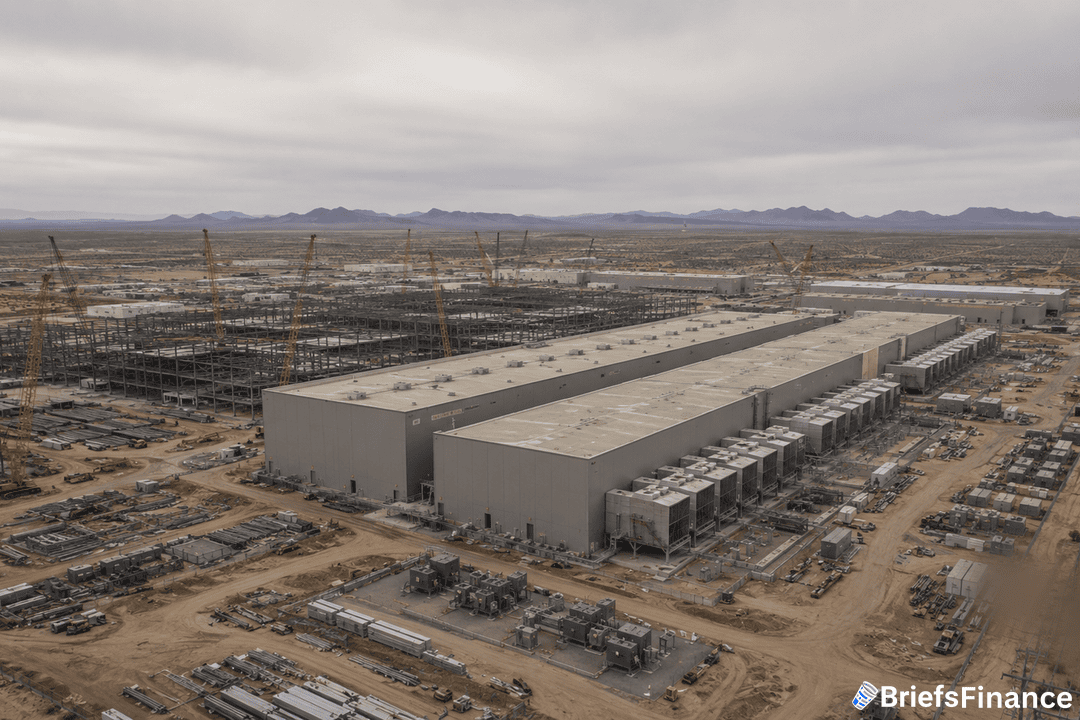
The BIS just published a study cautioning that the current AI infrastructure building spree will surpass all historical precedents - canals, railways, and the dotcom bubble - within three years.

The economist who wrote the study, Phurichai Rungcharoenkitkul, put it plainly: "The more capacity the sector builds, the higher the productivity bar it must clear to sustain the boom, so a larger boom is both more likely to disappoint and more damaging when it does."

How Debt Makes a Bad Situation Worse

The numbers here are not small. Projections from JPMorgan Chase and Goldman Sachs indicate that AI-related expenditures might reach nearly $6 trillion by 2030, largely funded through borrowing.

Get the market news that matters in a five-minute read with Market Briefs, our free daily newsletter

Here is the tricky part. In the AI industry, a market structure that favors a few dominant players means that while broad investment fuels advancement, the financial gains go mainly to a small set of winners. This situation pushes companies to overinvest, which makes the entire expansion more vulnerable.

Companies are also using complex financing. For instance, financing arrangements sometimes turn circular: firms that build cloud systems acquire equity in AI startups in return for promises to buy computing power.

The BIS study made a sharp point about this. "Rising leverage and more complex financing structures have raised questions about the financial stability risks of the current AI boom," wrote Rungcharoenkitkul. "The competition that over-builds the boom is also what selects the fragile financing that turns it into a bust."

Now, a warning from a central bank group does not mean the AI boom is over tomorrow. As Rungcharoenkitkul noted, "The potential demand for AI services is clearly vast and could justify a substantial expansion in computational power." Yet he added: "relative to its pre-boom trough, the current buildout is on track to outgrow every previous episode only three years in."

The study's author emphasized that the combination of high leverage, circular financing, and concentration of gains among a few players mirrors dynamics that preceded previous financial crises.

The BIS, as the central bankers' central bank, has historically flagged risks in rapid infrastructure booms. Its analysis draws on patterns from past bubbles - canals, railways, and the dotcom era - where heavy borrowing led to overcapacity and eventual crashes. The current AI buildout, with its reliance on debt and circular financing, echoes these earlier episodes, raising the stakes for global financial stability.

Join Market Briefs, our free daily newsletter, for a quick daily rundown of the markets
Disclosure

Recent News

1 2 3 63

Get Market Briefs delivered to your inbox every morning for free!

No fluff. No noise. No politics. Just finance news you can read in 5 minutes.

Blogs

August 23, 2026
How to Get the Most From Your Guideline 401k
  • Guideline is a company that provides low-cost 401k plans, popular with small businesses and their employees.
  • A "Guideline 401k" follows the same core rules as any 401k: tax-advantaged growth, contribution limits, and often an employer match.
  • The biggest results come from capturing the full match, choosing low-cost funds, and picking Roth or traditional to fit your situation.
Read More
August 23, 2026
Principal 401k: What to Know About Your Plan
  • Principal is one of many companies that manage workplace 401k plans, so a "Principal 401k" is simply a 401k where Principal is the provider.
  • The rules of a 401k are the same no matter who runs it: pre-tax or Roth contributions, tax-advantaged growth, and often an employer match.
  • The biggest wins come from grabbing the full match, picking low-cost funds, and knowing whether Roth or traditional fits you.
Read More
August 23, 2026
What a Tariff Dividend Means for Your Money
  • A "tariff dividend" is the idea of taking money the government collects from tariffs and paying some of it back to citizens.
  • To judge the idea, you first need to know what a tariff is: a tax on imported goods, usually paid by the companies bringing them in.
  • Tariffs ripple through prices, businesses, and your investments, so the smart move is understanding those ripples, not just the headline.
Read More
August 23, 2026
No Tax on Overtime: How Overtime Pay Is Taxed
  • "No tax on overtime" refers to a tax break that lets certain workers deduct some overtime pay, lowering the income they get taxed on.
  • A deduction does not mean overtime is truly tax-free. It means part of that pay is subtracted before your tax is figured.
  • The bigger money lesson: how you earn money changes how it is taxed, and investors often get the friendliest treatment of all.
Read More
August 23, 2026
Reading the Silver Price Forecast for 2026
  • Nobody can honestly promise a specific silver price for 2026. Any exact number is a guess, so treat forecasts as opinions, not facts.
  • Silver is unusual because it is both a precious metal and an industrial metal, so its price answers to two very different forces.
  • Instead of chasing a forecast, learn the drivers - inflation, interest rates, recession fear, and industrial demand - so you can judge any prediction yourself.
Read More
August 23, 2026
What to Do When Reddit Stocks Go Viral
  • "Reddit stocks" usually means stocks getting hyped in online communities, where crowds can send a price soaring or crashing fast.
  • These tips can be entertaining and sometimes useful, but they are opinions, not research, and often come loaded with hype.
  • The safe move is to treat every online tip as a starting point, then do your own homework before risking a dollar.
Read More
August 23, 2026
Why Is Bitcoin Dropping Right Now?
  • Bitcoin drops for a mix of reasons: interest rates, big-picture money policy, regulation news, and simple shifts in how much risk investors want to take.
  • Bitcoin has a fixed supply and no earnings, so its price runs almost entirely on supply, demand, and sentiment.
  • Sharp drops are normal for bitcoin. Understanding the drivers matters more than reacting to any single day.
Read More
August 23, 2026
The Fidelity 500 Index Fund, Made Simple for Beginners
  • The Fidelity 500 Index Fund is a low-cost fund that tracks the S&P 500, an index of 500 large U.S. companies.
  • Buying it means owning a tiny slice of 500 businesses at once, which spreads your risk in a single purchase.
  • Index funds like this win over time mostly by keeping fees low and letting compounding do the work.
Read More
August 23, 2026
USA Penny Stocks: Risks and Rewards Explained
  • USA penny stocks are very low-priced shares of very small companies, often trading under $5 and sometimes under $1.
  • They dangle the dream of huge, fast gains, but carry brutal risks: low liquidity, wild swings, and high failure rates.
  • Most investors build wealth faster with quality companies and funds than by chasing cheap shares.
Read More
August 23, 2026
Finding Cheap Stocks to Buy Now Without Getting Burned
  • A low share price does not mean a stock is cheap. Real value compares the price to what the business is actually worth.
  • The best cheap stocks to buy now are quality companies trading below their true value, not the tiniest, riskiest shares on the market.
  • For most beginners, a low-cost index fund is the simplest "cheap" way to own great companies at once.
Read More
1 2 3 25
Share via
Copy link











