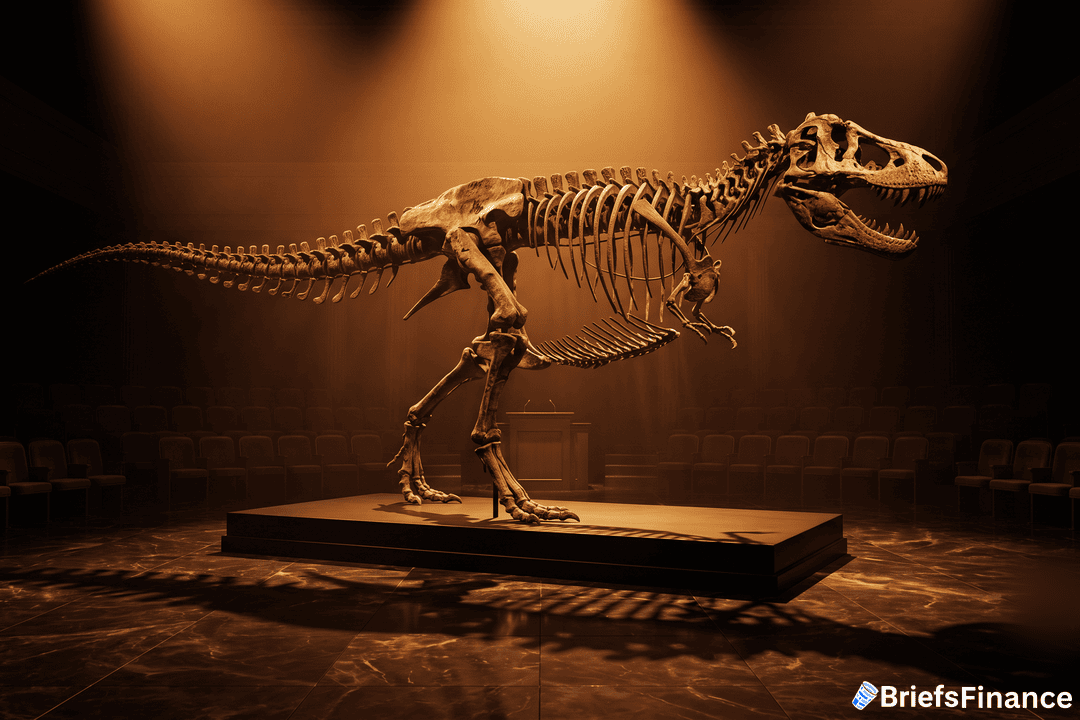
A 10-Minute Auction That Made History
The previous record was set in 2022, when financier Ken Griffin paid $44.6 million for a stegosaurus named Apex. Before that, the top price for a T. Rex was $31.8 million for a specimen called Stan in 2020.
Sotheby's stated that Gus is one of the biggest and most wholly preserved dinosaur skeletons ever found. By bone count, the skeleton is 61% complete, and by bone mass, it reaches up to 80%. For comparison, Stan was roughly 65% complete based on bone count.
In a press release, Cassandra Hatton, who oversees Sotheby's science and natural history department, said, "Tyrannosaurus Rex is the most iconic pre-historic species in the fossil record, and Gus stands firmly among the greatest examples ever found."
Why Wealthy Collectors Are Racing for Dinosaurs
Over the past few years, wealthy collectors have shown growing fascination with dinosaur fossils, viewing them as unique investments that combine emotional appeal with the chance for substantial financial gains.
Get the market news that matters in a five-minute read with Market Briefs, our free daily newsletter
The buyer of Gus was not immediately clear. But the pattern is clear. Private collectors are willing to spend tens of millions for a skeleton. Some of them find ways to share their fossils with the public.
As an example, Todd Graves, the founder of the Raising Cane's Chicken Fingers fast-food chain, loaned a triceratops skull he owned to the Louisiana Art & Science Museum. Separately, Ken Griffin's dinosaur specimen Apex, a stegosaurus, is currently housed at New York's American Museum of Natural History under a loan agreement.
These loan arrangements let wealthy investors own a piece of natural history while keeping it where people can see it. But not everyone is happy about that compromise.
The Scientists vs. the Private Owners
Ahead of Tuesday's sale, the Society of Vertebrate Paleontology issued a statement reaffirming its stance that fossils of scientific importance ought to remain in the custody of public research institutions. "While spectacular dinosaur fossils capture the imaginations of people around the world, SVP emphasizes that specimens of this scientific importance represent far more than rare collectibles," the statement read.
That position has not slowed the market.
Gus's record-breaking price reflects a broader surge in the market for high-end fossils. With every new auction, the price threshold climbs, drawing greater interest from both billionaires and museums.
The auction's outcome further highlights the persistent tension between private ownership and scientific access. Many researchers worry that wealthy buyers may restrict access to important specimens for study and public education, even as some owners agree to loan their fossils to institutions.
The bottom line: The record sale shows that for the ultra-wealthy, the kind of rarity represented by a T. Rex like Gus is hard to beat.
Join Market Briefs, our free daily newsletter, for a quick daily rundown of the markets