Free NewsletterPro Login

Warning: Undefined variable $stocks in /var/www/briefs.co/htdocs/wp-content/plugins/oxygen/component-framework/components/classes/code-block.class.php(133) : eval()'d code on line 448

Warning: foreach() argument must be of type array|object, null given in /var/www/briefs.co/htdocs/wp-content/plugins/oxygen/component-framework/components/classes/code-block.class.php(133) : eval()'d code on line 448

Warning: Undefined variable $funds in /var/www/briefs.co/htdocs/wp-content/plugins/oxygen/component-framework/components/classes/code-block.class.php(133) : eval()'d code on line 472

Warning: foreach() argument must be of type array|object, null given in /var/www/briefs.co/htdocs/wp-content/plugins/oxygen/component-framework/components/classes/code-block.class.php(133) : eval()'d code on line 472
/* the link was here */

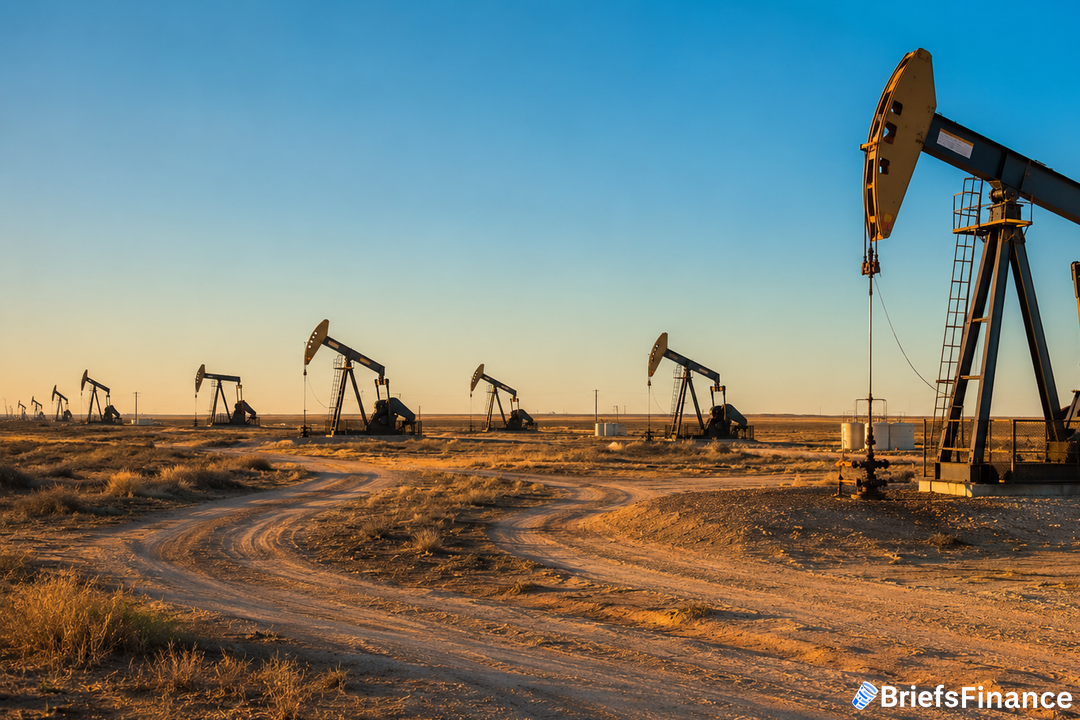
U.S. Oil Drillers Keep Rig Count Rising for 12th Straight Week, Longest Stretch Since 2022

Published Jul 17, 2026
[tts_player]
Share:
Summary:
  • The U.S. oil rig count has gone 12 consecutive weeks without a decline, the longest such stretch since January 2022.
  • Baker Hughes Co reported a net increase of seven rigs last week, bringing the national total to 452.
  • Higher oil prices, partly fueled by the Iran war, have encouraged shale drillers to reverse earlier cuts and add rigs back.

The Streak That Keeps Going

Oil drillers in the United States are doing something they have not done in more than four years. They have gone 12 weeks in a row without shutting down a single rig.

Baker Hughes Co, the company that tracks this data every week, says the total count actually went up by seven rigs last week. That puts the national number at 452 active rigs. Before this, the industry had not achieved such a sustained period without a decline since January 2022.

Why the Rigs Are Back

After months of cuts in 2025 prompted by worries over a shale downturn, drillers are now adding rigs back, reversing that earlier decline. The new drilling activity reflects a stronger reaction by shale producers to consistently rising oil prices. Higher prices have been driven by the Iran war.

Get the market news that matters in a five-minute read with Market Briefs, our free daily newsletter

What This Streak Means for the Industry

This 12-week period of stability is a marked change from early 2025, when rig numbers declined as fears grew that the shale boom might be fading. The seven-rig increase last week, while modest, signals that producers are gaining confidence in current price levels. Sustained gains in crude - partly fueled by geopolitical risk in the Middle East - have made it economical to bring back rigs that were previously idled.

"The streak also underscores the industry's cautious approach: instead of a rapid ramp-up, operators are adding rigs gradually, testing whether prices will hold," noted a market analyst. This measured pace contrasts with the aggressive expansions seen in past cycles, when a price rally would trigger a much faster buildup. With 452 active rigs, the U.S. is still well below the levels that supported record oil output a few years ago, but the reversal of the earlier downtrend suggests that the worst of the 2025 pullback may be over.

For context, the U.S. rig count peaked at nearly 800 in 2019 before a prolonged decline due to pandemic-era demand shocks and subsequent supply discipline. The current level of 452, while still low, represents a stabilization after the sharp cuts earlier in 2025. Shale producers have learned from past boom-bust cycles and are now prioritizing capital discipline, which explains the measured pace of additions.

Investor focus will now turn to whether the rig count can continue rising in the coming weeks, especially if oil prices remain elevated.

This 12-week streak reflects a significant shift in sentiment among shale producers, who had been reducing activity earlier in 2025 amid fears of oversupply and declining demand. The cautious but steady addition of rigs suggests that operators are now more comfortable with current oil prices, which have been supported by supply concerns stemming from the ongoing conflict in the Middle East. While the total rig count remains far below the peak of nearly 800 seen in 2019, the sustained increase indicates that the industry is stabilizing after the sharp pullback earlier this year.

Join Market Briefs, our free daily newsletter, for a quick daily rundown of the markets
Disclosure

Recent News

1 2 3 68

Get Market Briefs delivered to your inbox every morning for free!

No fluff. No noise. No politics. Just finance news you can read in 5 minutes.

Blogs

September 4, 2026
An Interest Rate Hike in 2026? The Fed Just Broke Its Own Script
  • The Federal Reserve spent a year signaling cheaper money, and its new chairman just warned that an interest rate hike may be coming instead.
  • The Fed is stuck between high inflation and a weak job market, and fixing one makes the other worse.
  • Higher rates also reprice roughly a third of America's $40 trillion national debt this year, which is why Washington wants cuts so badly.
Read More
September 3, 2026
5 Passive Income Ideas That Pay You Whether You Work or Not
  • School teaches one formula: work, earn, spend. Stop working and the money stops, so the wheel never ends.
  • Five assets pay you without your labor - dividends, rent, interest, royalties, and the things you already own.
  • $80,000 a year of cash flow takes about $1 million invested at 8%, or roughly 20 years of $1,000 a month.
Read More
September 2, 2026
The Best Way to Invest 10k: Three Options To Transform 10K into 10 Million
  • Passive investing in stocks or real estate targets around 10% a year, and time in the market matters more than the price you get in at.
  • Active investing means putting your time in alongside your money, which raises the target to roughly 20% a year and raises the risk of losing it all.
  • Investing in yourself has no ceiling, because a new skill can create a new income that no market return can match.
Read More
September 1, 2026
The Tax Write Offs the Rich Are Using in 2026 While the IRS Shrinks
  • The 2026 tax brackets landed lower than they were headed, and the standard deduction jumped from a planned $8,350 to $16,100 for single filers.
  • New write offs for overtime, tips, seniors and car loan interest are live now, and most of them are written to expire in 2028.
  • About a third of IRS auditors have been fired, and four assets do most of the work for people who want income without a matching tax bill.
Read More
August 31, 2026
America Is Running Out of Debt Buyers. Treasury Bills Are the Government's Fix
  • The government took in about $5 trillion in taxes in 2025 and spent about $7 trillion, and the national debt is now over $40 trillion.
  • Investors, banks, and foreign countries are all lending less to the U.S., so starting September 9 the government plans to sell more short-term treasury bills and use that cash to buy back its long-term debt.
  • Government interest rates set the floor for your mortgage, your car loan, and your credit card, and short-term Treasury ETFs like SGOV are one way investors are playing it.
Read More
August 23, 2026
How to Get the Most From Your Guideline 401k
  • Guideline is a company that provides low-cost 401k plans, popular with small businesses and their employees.
  • A "Guideline 401k" follows the same core rules as any 401k: tax-advantaged growth, contribution limits, and often an employer match.
  • The biggest results come from capturing the full match, choosing low-cost funds, and picking Roth or traditional to fit your situation.
Read More
August 23, 2026
Principal 401k: What to Know About Your Plan
  • Principal is one of many companies that manage workplace 401k plans, so a "Principal 401k" is simply a 401k where Principal is the provider.
  • The rules of a 401k are the same no matter who runs it: pre-tax or Roth contributions, tax-advantaged growth, and often an employer match.
  • The biggest wins come from grabbing the full match, picking low-cost funds, and knowing whether Roth or traditional fits you.
Read More
August 23, 2026
What a Tariff Dividend Means for Your Money
  • A "tariff dividend" is the idea of taking money the government collects from tariffs and paying some of it back to citizens.
  • To judge the idea, you first need to know what a tariff is: a tax on imported goods, usually paid by the companies bringing them in.
  • Tariffs ripple through prices, businesses, and your investments, so the smart move is understanding those ripples, not just the headline.
Read More
August 23, 2026
No Tax on Overtime: How Overtime Pay Is Taxed
  • "No tax on overtime" refers to a tax break that lets certain workers deduct some overtime pay, lowering the income they get taxed on.
  • A deduction does not mean overtime is truly tax-free. It means part of that pay is subtracted before your tax is figured.
  • The bigger money lesson: how you earn money changes how it is taxed, and investors often get the friendliest treatment of all.
Read More
August 23, 2026
Reading the Silver Price Forecast for 2026
  • Nobody can honestly promise a specific silver price for 2026. Any exact number is a guess, so treat forecasts as opinions, not facts.
  • Silver is unusual because it is both a precious metal and an industrial metal, so its price answers to two very different forces.
  • Instead of chasing a forecast, learn the drivers - inflation, interest rates, recession fear, and industrial demand - so you can judge any prediction yourself.
Read More
1 2 3 26
Share via
Copy link











