Free NewsletterPro Login

Free Live Investors Workshop

Seats limited

Tue, Sep 29

The dollar is losing value.

Here’s how investors can still profit.

Hosted By

Jaspreet Singh

Founder, Briefs Finance

X

Warning: Undefined variable $stocks in /var/www/briefs.co/htdocs/wp-content/plugins/oxygen/component-framework/components/classes/code-block.class.php(133) : eval()'d code on line 448

Warning: foreach() argument must be of type array|object, null given in /var/www/briefs.co/htdocs/wp-content/plugins/oxygen/component-framework/components/classes/code-block.class.php(133) : eval()'d code on line 448

Warning: Undefined variable $funds in /var/www/briefs.co/htdocs/wp-content/plugins/oxygen/component-framework/components/classes/code-block.class.php(133) : eval()'d code on line 472

Warning: foreach() argument must be of type array|object, null given in /var/www/briefs.co/htdocs/wp-content/plugins/oxygen/component-framework/components/classes/code-block.class.php(133) : eval()'d code on line 472
/* the link was here */

The Nasdaq And S&P 500 Just Had Their Worst Day Of The Year

Published Jun 7, 2026
[tts_player]
Share:
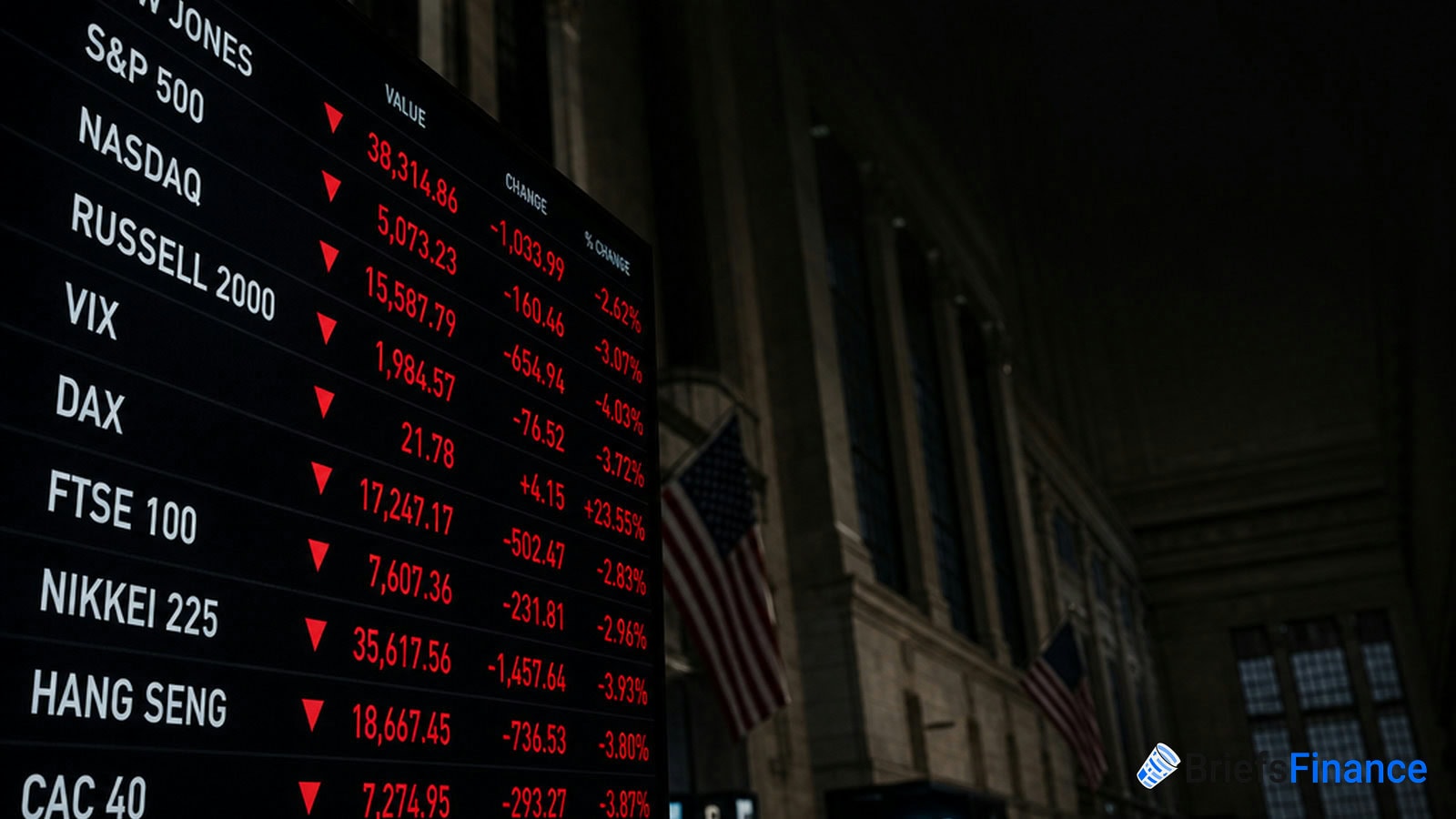
Electronic board displaying major stock indices with red downward values, set inside a building with American flags visible in the background.

AI stocks have done most of the heavy lifting for this market all year. Friday, they did the opposite.

The Nasdaq and S&P 500 both posted their worst day of the year, with the same trade that pushed stocks to record highs now pulling them down.

How The Selloff Unfolded

The selling started in the AI names and spread fast, with the Nasdaq closing down 4.18% and the S&P 500 down 2.64% - the Nasdaq's worst day since April 2025 and the S&P 500's worst day since October.

Chip stocks took the heaviest hit, dragging hyperscalers and AI software names down with them as traders rushed to lock in this year's gains.

The S&P 500 also snapped a nine-week winning streak, erasing a meaningful chunk of the run that started after its first record high on April 15.

The Dow, which has less exposure to tech, fell 695 points, or 1.35% - its worst day in about three months. Wall Street's fear gauge, the VIX, surged 40% to its highest level in two months.

When the market moves like this, the why matters more than the what. Market Briefs breaks down what's actually driving days like this every morning in five minutes - plus a free investing masterclass when you sign up.

Fed Rate Cut Hopes Reversed

At the same time stocks were sliding, traders started pricing in something new: a real chance the Fed raises rates instead of cutting them.

For most of the year, the question was how many cuts were coming and when. Now the question is whether cuts are coming at all.

Traders now see a 43% chance the Fed hikes its benchmark rate in December, up from 26% a month ago, according to CME FedWatch. Stronger-than-expected economic data - the economy added 172,000 jobs in May, smashing expectations - and inflation readings that have been heating up have pushed the rate cut timeline further out than markets had priced in for months.

Higher rates make borrowing more expensive for companies and make safer bets like bonds look better next to stocks - which is why fewer cuts, or a hike, takes air out of the rally. The 10-year Treasury yield jumped to 4.54% on Friday, adding more pressure on stocks.

That math hits AI stocks hardest because their sky-high valuations price in years of future growth, and those future earnings shrink in value when rates stay high.

Why AI Stocks Hit So Hard

A handful of names tied to chips, data centers, and AI software have done most of the work behind this year's gains. When that group sells off, the whole market feels it.

Meta dropped 5.5% on reports it is seeking to raise equity to fund its AI buildout, accelerating the afternoon selloff in tech.

The Magnificent 7 - the group of mega-cap tech names that includes the biggest AI winners - now makes up roughly a third of the S&P 500's total value, which means the index essentially moves on a few earnings reports each quarter.

The flip side: that concentration cuts both ways, sending the market up faster when AI is winning and down faster when it's losing.

What To Watch

The next read on inflation will tell traders whether the Fed has reason to hold steady or hike. Until then, every AI earnings report and every chip stock move will set the tone.

Volatility is also likely to stay elevated until earnings season clarifies whether AI spending is still accelerating or starting to cool, and that decides where the next leg of this market goes.

Want the moves that matter delivered every weekday morning? Join 350,000+ investors reading Market Briefs and grab a free 45-minute investing masterclass while you're at it.

Disclosure

Recent News

1 2 3 72

Get Market Briefs delivered to your inbox every morning for free!

No fluff. No noise. No politics. Just finance news you can read in 5 minutes.

Blogs

September 9, 2026
Your 401k Is Fueling the AI Bubble
  • About $10 trillion of 401k money sits in a $77 trillion stock market, mostly through target date funds and S&P 500 funds. Roughly 30% of every S&P 500 dollar lands in five AI-heavy tech stocks.
  • Four bubble signals run hotter today than before the 2000 crash: top-ten concentration, tech's share of the index, the Buffett Indicator, and how much of the market index funds own.
  • You only lock in an AI bubble loss if you sell. The 2022, 2020, 2008, and 2000 crashes were all buying windows for long-term investors, and the US-China AI race means government money could keep flowing in.
Read More
September 9, 2026
What Is Wealth Preservation? How To Protect Your Money From Anything
  • Wealth preservation is an investing strategy built around keeping the money you've already made instead of chasing growth.
  • It leans on assets that hold steady when markets fall - gold, Treasury bonds, and companies that keep earning through wars, crashes, and pandemics.
  • The tradeoff is real: you give up some upside, and the two key numbers to check are maximum drawdown and correlation to the market.
Read More
September 8, 2026
Why Is Everything So Expensive? Why Prices May Never Come Back Down
  • Official inflation is 3.4% and prices are up 32% since 2020, but rent (41%), gas (47%), car insurance (64%) and ground beef (79%) all outran the 28% median wage.
  • The Federal Reserve targets 2% inflation on purpose. Rising prices push extra dollars to investors and shrink the real cost of a $40 trillion national debt.
  • Investors who simply owned the S&P 500 gained about 150% over the same six years, and the Fed's September 16 decision will show whether it protects the dollar or the economy first.
Read More
September 7, 2026
The U.S. Housing Market Just Flipped: Renting a Home Now Beats Buying One
  • The US is in a buyer's market in 41 of the 50 largest metro areas, but prices sit near record highs and mortgage rates are close to 7%.
  • The same median house costs 27% more than it did in 2021 while the monthly payment costs 90% more, and incomes rose a little more than 10%.
  • A 2008-style crash is not showing up in the data, so the pressure is landing on buyers instead of prices.
Read More
September 4, 2026
An Interest Rate Hike in 2026? The Fed Just Broke Its Own Script
  • The Federal Reserve spent a year signaling cheaper money, and its new chairman just warned that an interest rate hike may be coming instead.
  • The Fed is stuck between high inflation and a weak job market, and fixing one makes the other worse.
  • Higher rates also reprice roughly a third of America's $40 trillion national debt this year, which is why Washington wants cuts so badly.
Read More
September 3, 2026
5 Passive Income Ideas That Pay You Whether You Work or Not
  • School teaches one formula: work, earn, spend. Stop working and the money stops, so the wheel never ends.
  • Five assets pay you without your labor - dividends, rent, interest, royalties, and the things you already own.
  • $80,000 a year of cash flow takes about $1 million invested at 8%, or roughly 20 years of $1,000 a month.
Read More
September 2, 2026
The Best Way to Invest 10k: Three Options To Transform 10K into 10 Million
  • Passive investing in stocks or real estate targets around 10% a year, and time in the market matters more than the price you get in at.
  • Active investing means putting your time in alongside your money, which raises the target to roughly 20% a year and raises the risk of losing it all.
  • Investing in yourself has no ceiling, because a new skill can create a new income that no market return can match.
Read More
September 1, 2026
The Tax Write Offs the Rich Are Using in 2026 While the IRS Shrinks
  • The 2026 tax brackets landed lower than they were headed, and the standard deduction jumped from a planned $8,350 to $16,100 for single filers.
  • New write offs for overtime, tips, seniors and car loan interest are live now, and most of them are written to expire in 2028.
  • About a third of IRS auditors have been fired, and four assets do most of the work for people who want income without a matching tax bill.
Read More
August 31, 2026
America Is Running Out of Debt Buyers. Treasury Bills Are the Government's Fix
  • The government took in about $5 trillion in taxes in 2025 and spent about $7 trillion, and the national debt is now over $40 trillion.
  • Investors, banks, and foreign countries are all lending less to the U.S., so starting September 9 the government plans to sell more short-term treasury bills and use that cash to buy back its long-term debt.
  • Government interest rates set the floor for your mortgage, your car loan, and your credit card, and short-term Treasury ETFs like SGOV are one way investors are playing it.
Read More
August 23, 2026
How to Get the Most From Your Guideline 401k
  • Guideline is a company that provides low-cost 401k plans, popular with small businesses and their employees.
  • A "Guideline 401k" follows the same core rules as any 401k: tax-advantaged growth, contribution limits, and often an employer match.
  • The biggest results come from capturing the full match, choosing low-cost funds, and picking Roth or traditional to fit your situation.
Read More
1 2 3 26
Share via
Copy link