Free NewsletterPro Login

Free Live Investors Workshop

Seats limited

Tue, Sep 29.

The dollar is losing value.

Here’s how investors can still profit.

Hosted By

Jaspreet Singh

Founder, Briefs Finance

X

Warning: Undefined variable $stocks in /var/www/briefs.co/htdocs/wp-content/plugins/oxygen/component-framework/components/classes/code-block.class.php(133) : eval()'d code on line 448

Warning: foreach() argument must be of type array|object, null given in /var/www/briefs.co/htdocs/wp-content/plugins/oxygen/component-framework/components/classes/code-block.class.php(133) : eval()'d code on line 448

Warning: Undefined variable $funds in /var/www/briefs.co/htdocs/wp-content/plugins/oxygen/component-framework/components/classes/code-block.class.php(133) : eval()'d code on line 472

Warning: foreach() argument must be of type array|object, null given in /var/www/briefs.co/htdocs/wp-content/plugins/oxygen/component-framework/components/classes/code-block.class.php(133) : eval()'d code on line 472
/* the link was here */

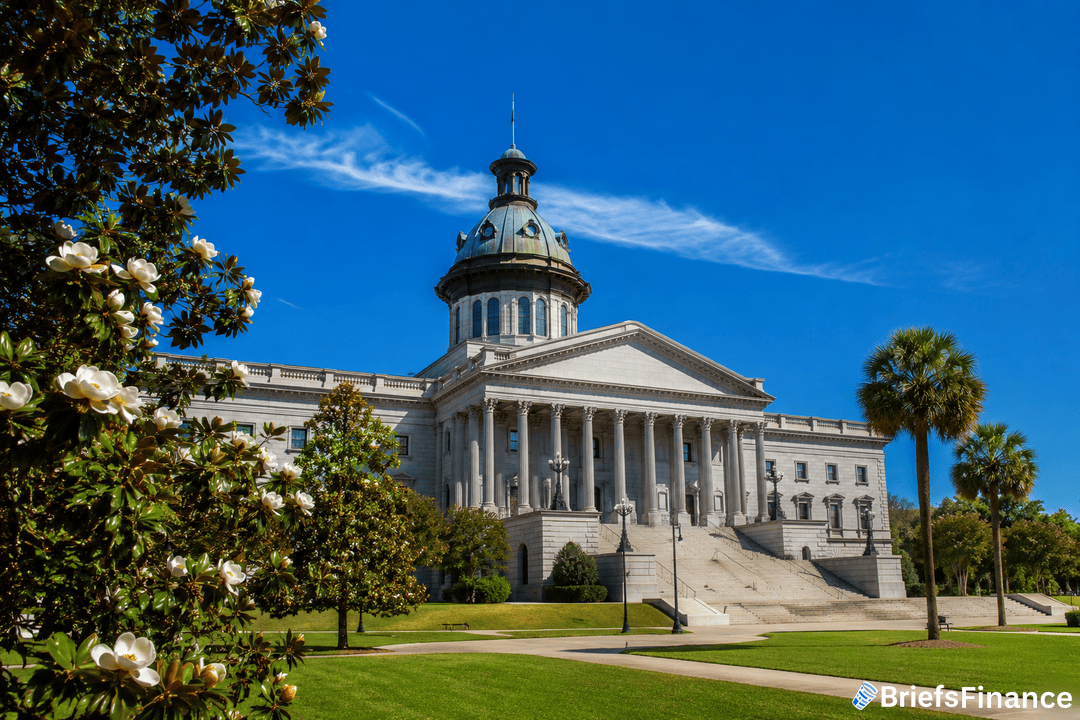
South Carolina Passes Bitcoin Rights Law, Bans State From Federal CBDC

Published May 21, 2026
[tts_player]
Share:
Summary:
  • Governor Henry McMaster signed Senate Bill 163 on May 19. It protects self-custody and crypto payments.
  • The law bans state offices from taking or testing a federal digital dollar.
  • The bill passed the state Senate 38-1 and the House 110-1.

South Carolina just drew two lines in the sand. People can hold Bitcoin in self-custody and use it to pay for things.

The state, though, cannot touch a federal digital dollar.

Governor Henry McMaster signed Senate Bill 163 into law on Tuesday. The bill adds a new chapter to the state code just for crypto rights.

What The Law Says

The bill came from state Senators Daniel Verdin and Matthew Leber. It took 17 months to pass.

The bill cleared the state Senate 38-1 and the House 110-1.

The law protects:

  • The right to use crypto to pay for legal goods and services
  • The right to hold crypto in self-hosted or hardware wallets
  • Crypto mining sites in zones set for industry
  • Node runners, stakers and coders, who do not need money-mover licenses

State and city offices cannot charge extra tax just because a payment was made in crypto.

Local rules that single out miners with strict zoning or noise limits, while other firms get a pass, are blocked too.

That last bit matters for big mining sites. They can now plan builds without fear of one-off rules.

We break down what state crypto policy means for investors in Market Briefs. Five minutes a day, with a free investing masterclass when you join.

The Federal Dollar Ban

The same law bans state offices from taking payments in a federal digital dollar. It also blocks them from joining any Fed test or pilot.

A CBDC, under this law, is a digital coin sent out by the Fed or a federal office.

Private stablecoins backed by treasuries, like USDC, are not part of the ban. They stay legal in the state.

That gap matters. Private stablecoins keep running. A federal digital dollar gets locked out.

The law tells the federal side to stay out. But it leaves the door open for private firms to keep building stablecoin tools.

Why It Matters For Investors

The law keeps the state's top lawyer in charge of fraud cases. That includes fake mining or staking offers.

So buyer guards stay in place.

Large miners may still need to share power deals with the state grid panel. That helps prove they can ease grid stress at peak times.

The rules give crypto firms a clear set of guardrails in a state that has been one of the more careful US states for finance.

Clear rules like these can pull more capital and jobs into the state.

Worth Noting

Nine other states have passed similar "Bitcoin Rights" laws. South Carolina just made it ten.

The Satoshi Action Fund has been pushing model bills like this through state houses.

The 38-1 Senate vote is a bigger sign than just crypto policy. In this state, Bitcoin rights is no longer a left-right fight.

Watch what other states do next. The same model bill keeps moving through statehouses across the country.

For now, the state has set a clear line. Crypto stays.

A federal digital dollar does not.

The lopsided floor votes show how much support the model has built up.

The split makes sense. Voters want cash they hold. They do not want the Fed in their wallet.

That view now cuts across both parties.

If more states pass laws like this, the road to a US CBDC gets longer. Each "no" at the state level raises the bar.

Join Market Briefs for the daily read on crypto, policy and markets. Delivered weekday mornings with a 45-minute investing course thrown in as a bonus.

Disclosure

Recent News

1 2 3 74

Get Market Briefs delivered to your inbox every morning for free!

No fluff. No noise. No politics. Just finance news you can read in 5 minutes.

Blogs

September 11, 2026
How Is the Economy Doing? Washington Says It's Fixed, but the Numbers Don't Agree
  • Treasury Secretary Scott Bessent says the economy is fixed because lower earners' incomes are now rising faster than top earners'.
  • The Atlanta Fed and Bank of America show different numbers, and Hilton, Marriott, and McDonald's can't agree on what they're seeing either.
  • Whichever side is right, the economy is built to make investors rich, and inflation is how it does it.
Read More
September 10, 2026
US National Debt Hits $40 Trillion: Why the Economy Hasn't Collapsed Yet
  • The US national debt crossed $40 trillion in 2026 and is growing faster than the economy. The debt to GDP ratio now sits at 125%, the highest outside the pandemic and higher than World War II.
  • On September 9, 2026, Treasury Secretary Scott Bessent rolled out an emergency plan for the government to lend money to itself. Ray Dalio now says the dollar has roughly three years before real pain.
  • Empires rarely default. They debase. Since 1971, median household income grew about 8x while houses grew 17x and the S&P 500 grew 360x, so investors got richer while workers fell behind.
Read More
September 9, 2026
Your 401k Is Fueling the AI Bubble
  • About $10 trillion of 401k money sits in a $77 trillion stock market, mostly through target date funds and S&P 500 funds. Roughly 30% of every S&P 500 dollar lands in five AI-heavy tech stocks.
  • Four bubble signals run hotter today than before the 2000 crash: top-ten concentration, tech's share of the index, the Buffett Indicator, and how much of the market index funds own.
  • You only lock in an AI bubble loss if you sell. The 2022, 2020, 2008, and 2000 crashes were all buying windows for long-term investors, and the US-China AI race means government money could keep flowing in.
Read More
September 9, 2026
What Is Wealth Preservation? How To Protect Your Money From Anything
  • Wealth preservation is an investing strategy built around keeping the money you've already made instead of chasing growth.
  • It leans on assets that hold steady when markets fall - gold, Treasury bonds, and companies that keep earning through wars, crashes, and pandemics.
  • The tradeoff is real: you give up some upside, and the two key numbers to check are maximum drawdown and correlation to the market.
Read More
September 8, 2026
Why Is Everything So Expensive? Why Prices May Never Come Back Down
  • Official inflation is 3.4% and prices are up 32% since 2020, but rent (41%), gas (47%), car insurance (64%) and ground beef (79%) all outran the 28% median wage.
  • The Federal Reserve targets 2% inflation on purpose. Rising prices push extra dollars to investors and shrink the real cost of a $40 trillion national debt.
  • Investors who simply owned the S&P 500 gained about 150% over the same six years, and the Fed's September 16 decision will show whether it protects the dollar or the economy first.
Read More
September 7, 2026
The U.S. Housing Market Just Flipped: Renting a Home Now Beats Buying One
  • The US is in a buyer's market in 41 of the 50 largest metro areas, but prices sit near record highs and mortgage rates are close to 7%.
  • The same median house costs 27% more than it did in 2021 while the monthly payment costs 90% more, and incomes rose a little more than 10%.
  • A 2008-style crash is not showing up in the data, so the pressure is landing on buyers instead of prices.
Read More
September 4, 2026
An Interest Rate Hike in 2026? The Fed Just Broke Its Own Script
  • The Federal Reserve spent a year signaling cheaper money, and its new chairman just warned that an interest rate hike may be coming instead.
  • The Fed is stuck between high inflation and a weak job market, and fixing one makes the other worse.
  • Higher rates also reprice roughly a third of America's $40 trillion national debt this year, which is why Washington wants cuts so badly.
Read More
September 3, 2026
5 Passive Income Ideas That Pay You Whether You Work or Not
  • School teaches one formula: work, earn, spend. Stop working and the money stops, so the wheel never ends.
  • Five assets pay you without your labor - dividends, rent, interest, royalties, and the things you already own.
  • $80,000 a year of cash flow takes about $1 million invested at 8%, or roughly 20 years of $1,000 a month.
Read More
September 2, 2026
The Best Way to Invest 10k: Three Options To Transform 10K into 10 Million
  • Passive investing in stocks or real estate targets around 10% a year, and time in the market matters more than the price you get in at.
  • Active investing means putting your time in alongside your money, which raises the target to roughly 20% a year and raises the risk of losing it all.
  • Investing in yourself has no ceiling, because a new skill can create a new income that no market return can match.
Read More
September 1, 2026
The Tax Write Offs the Rich Are Using in 2026 While the IRS Shrinks
  • The 2026 tax brackets landed lower than they were headed, and the standard deduction jumped from a planned $8,350 to $16,100 for single filers.
  • New write offs for overtime, tips, seniors and car loan interest are live now, and most of them are written to expire in 2028.
  • About a third of IRS auditors have been fired, and four assets do most of the work for people who want income without a matching tax bill.
Read More
1 2 3 26
Share via
Copy link