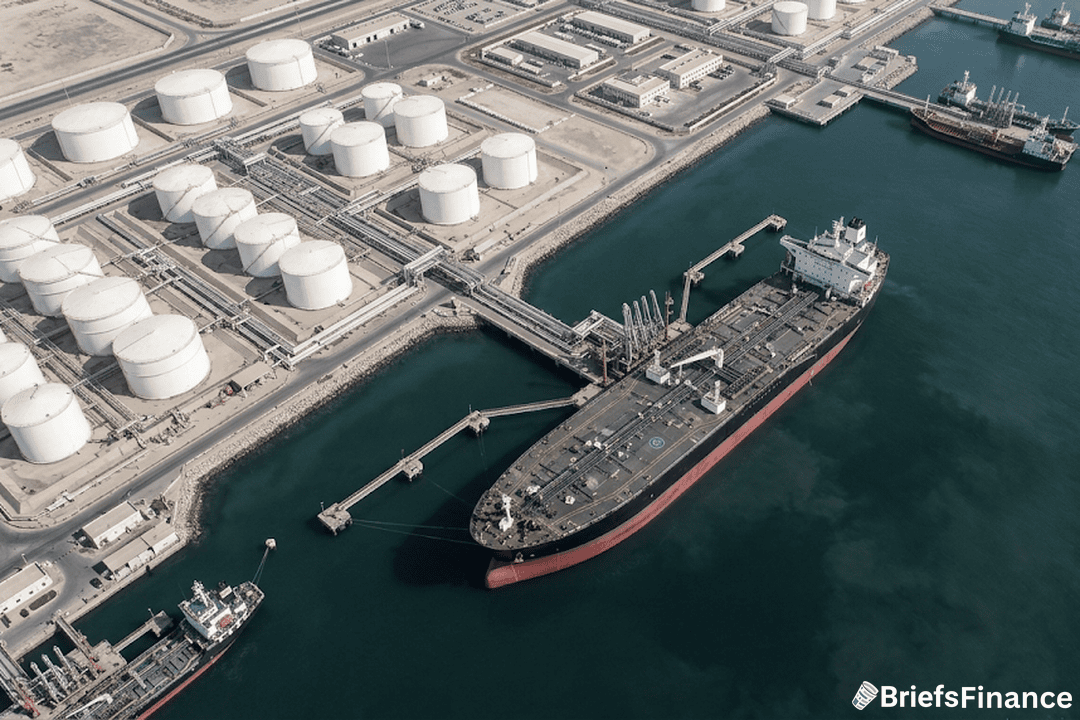
A Big Ship Breaks the Silence at a Quiet Port
Tanker traffic in the Persian Gulf used to be easy to follow. Ships would broadcast their position, and anyone with a screen could watch their slow trips. Most ships in the region have stopped doing that for safety. Sail quietly, and the world can't see you.
That makes satellites important. A satellite image from August 13, 2026 captured a supertanker secured to an offshore loading buoy at Ju'aymah. That loading point sits within the sprawling Ras Tanura export terminal.
The ship can load about 2 million barrels, so it is not a small arrival. The same image showed an empty mooring nearby. That spot held a different tanker on Tuesday. Add it up, and you get a port that may be getting busier.
One tanker alone is not a wave, but the timing stands out. No tanker that large had been spotted at the Ras Tanura complex in nearly a month. When ships stop showing themselves, the ones visible on a satellite photograph become clues.
The Red Sea Route Has a Target on It
Saudi Arabia wanted to keep its oil moving during the Iran war. So it diverted much of its Persian Gulf barrels to terminals on the Red Sea, the country's western edge. That helped keep prices from spiking badly. It was a reroute that kept the market calm.
Get the free Always Be Buying eBook and learn the simple system for building wealth on any income
That backup route is now in the middle of a fight.
The Houthis, who are aligned with Iran, have said they will hit any vessel that calls at Saudi ports. On Thursday, they said they struck a refinery at Jazan on the Red Sea that is owned by Saudi Aramco. That marked the second strike on the same facility within a week. Saudi energy officials did not respond to requests for comment.
Other Gulf producers are changing their moves too. The United Arab Emirates has moved millions of barrels in recent weeks using shuttle runs and quiet, evasive paths. Most ships are not sending the usual location signals, so most of those trips are nearly invisible.
What It Means for Your Money
The week of August 13 brought a concrete number for that unpredictability. On Tuesday, US Energy Secretary Chris Wright said the previous week's outflow was 9 million barrels a day, almost half prewar volumes. That is not just a disruption on the other side of the world; those are barrels that are hard to track.
When oil is hard to track, prices move on whatever someone does catch. A satellite picture of a terminal can move prices. A refinery hit twice within days can do the same. The oil market doesn't like blank spots.
That is why this matters beyond shipping. Oil prices flow into gasoline, energy company costs, and investment portfolios. If the Red Sea route becomes more dangerous, the world could face the supply shock it has been trying to avoid.
For now, Saudi exports are still reaching buyers, but the rerouting adds risk to every barrel. The lack of transparency means a single satellite image can shift sentiment quickly. Analysts watching the region have to piece together clues from moorings, shuttle runs, and occasional statements by officials.
The true volume is impossible to count, but the uncertainty is measurable. Each new attack or sighting changes the calculation, and that complexity is likely to persist.
Download the free Always Be Buying eBook and start putting your money to work today