Free NewsletterPro Login
S&P 500 6,287 +0.42%
DOW 44,521 -0.18%
NASDAQ 21,103 +0.71%
S&P 500 +12.4%
Briefs Finance Fund +24.8%
JOIN THE FUND →

Oil Just Hit $90. Now Wall Street Has Two Problems at Once.

A stylized illustration of a cylindrical cup with blue arrows and lines indicating a swirling or rotational motion inside the cup.
Published Mar 6, 2026
[tts_player]
Share:
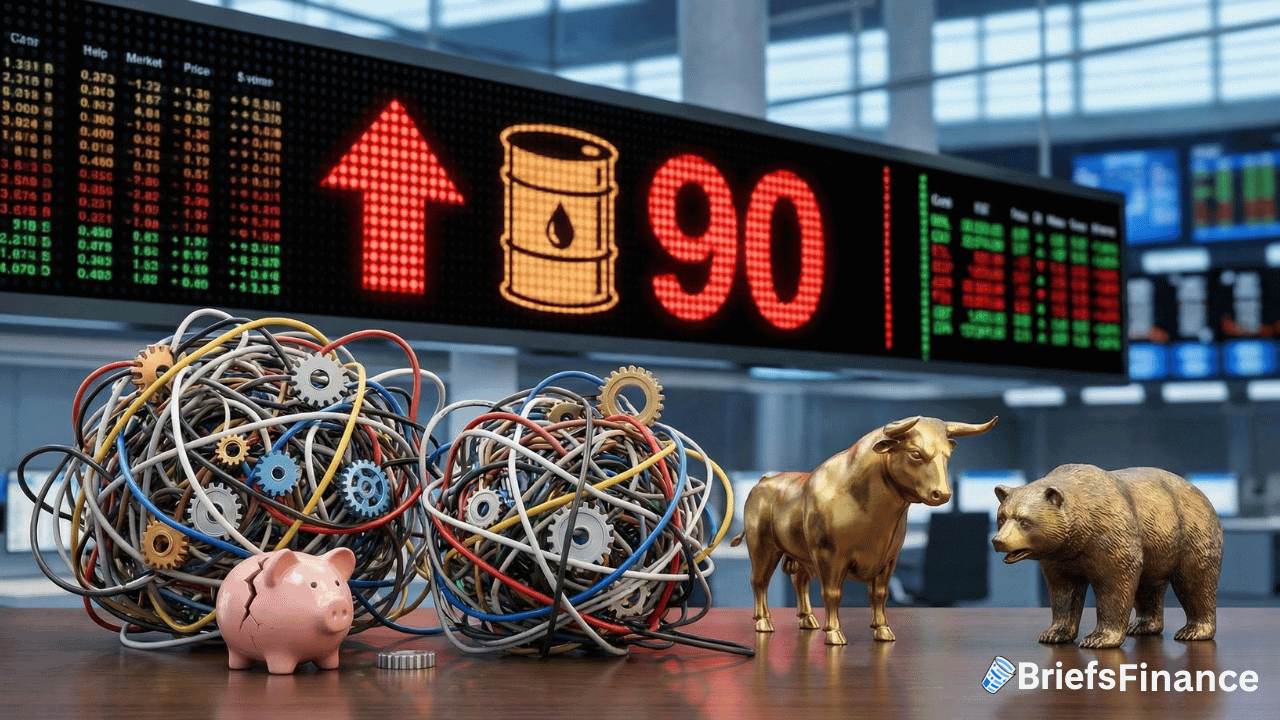
A tangled mess of wires and gears, a piggy bank, a gold bull, and a bear sit in front of a digital stock ticker displaying an oil barrel icon and the number 90.
Summary:

  • U.S. crude surged above $91 Friday — its highest price since 2023 — on week's biggest weekly gain ever.
  • A weak jobs report dropped the same day, raising fears of a slowing economy and rising inflation together.
  • Gas is up 35 cents a gallon in one week. The $100/barrel threshold is now in sight.

Oil crossed $90 a barrel Friday. The jobs report came in ugly the same morning. And suddenly investors are staring at the scenario nobody wants.

The Oil Move

U.S. crude jumped 12.5% on Friday to $91 per barrel — topping $90 for the first time since October 2023. Brent, the international benchmark, briefly touched $94. Bloomberg reported that WTI is on pace for its biggest weekly percentage gain in at least two decades. Since the Iran war started last weekend, U.S. crude has surged 35%.

The driver: the Strait of Hormuz — the narrow waterway off Iran's coast that handles roughly a fifth of the world's traded oil — is at a near-total halt. Kuwait began cutting output after running out of storage for bottled-up crude. Iran said Friday that the European Union is now a "legitimate" target if it joins the conflict, sending oil even higher.

Gas prices hit a national average of $3.32 per gallon Friday morning — up 35 cents in a week.

Two Problems, Zero Good Fixes

The oil spike might have been manageable on its own. But Friday also brought a jobs report showing U.S. employers cut more jobs last month than they created. The S&P 500 fell 1.1%, the Dow dropped 558 points, and the Russell 2000 — small-cap stocks most sensitive to the domestic economy — led losses down 2%.

The AP described the combination as the scenario "investors hate because no one in the world has a good tool to fix both a weak economy and high inflation at the same time." Airlines, cruise lines, and freight companies — all heavy fuel users — took the sharpest hits. Southwest Airlines fell 7.7%. Norwegian Cruise Line dropped 4.4%.

What Comes Next

NBC News reported that some analysts are warning $100 oil, if sustained, could be too much for the global economy to absorb. The Trump administration unveiled a ship insurance program for vessels crossing the Strait of Hormuz on Friday — markets barely flinched.

J.P. Morgan had forecast Brent averaging $60 in 2026 before the war started. That forecast now looks like a different era entirely.

The word no one wants to say out loud is stagflation — a slowing economy with rising prices. This week made it impossible to ignore.

Disclosure

Recent News

1 2 3 39

Get Market Briefs delivered to your inbox every morning for free!

No fluff. No noise. No politics. Just finance news you can read in 5 minutes.

Blogs

June 29, 2026
Portfolio Diversification: Why Putting All Your Eggs in One Basket Destroys Wealth
  • Real diversification means spreading investments across all 11 economic sectors plus bonds, alternatives, and cash so no single bet can sink the portfolio.
  • Different sectors perform at different times, so a diversified portfolio captures upswings while smoothing the brutal drawdowns that wipe out concentrated bets.
  • Total market index funds offer the simplest path to diversification, and annual rebalancing is what keeps the structure working over time.
Read More
June 29, 2026
Non Taxable Income: What It Is and Why It Matters
  • Non taxable income is money you receive that you don't owe income tax on.
  • The tax code treats workers, investors, and business owners very differently, and investors often come out ahead.
  • Learning how income is taxed is a quiet superpower for keeping more of what you earn.
Read More
June 29, 2026
Semiconductor Stocks: A Simple Guide for Investors
  • Semiconductor stocks are companies that design and make computer chips, the brains inside nearly every modern device.
  • The AI boom has turned chips into one of the market's most important and most watched groups.
  • They offer big growth potential, but come with high valuations and a notoriously cyclical history.
Read More
June 25, 2026
How Stocks Work: A Simple Guide for Beginners
  • A stock is a slice of ownership in a company - buy one, and you own a piece of the business.
  • You make money two ways: the share price rising over time, and dividends paid to shareholders.
  • The simplest path for most beginners is buying into the whole market through a low-cost index fund.
Read More
June 25, 2026
Stop Loss vs Stop Limit: What's the Difference?
  • A stop loss order sells your stock once it hits a trigger price, prioritizing getting you out.
  • A stop limit order only sells within a price range you set, prioritizing price over a guaranteed exit.
  • The trade-off: a stop loss almost always executes; a stop limit might not if the price moves too fast.
Read More
June 25, 2026
Energy Stocks: A Simple Guide for Investors
  • Energy stocks are companies that produce and supply the power the world runs on, from oil and gas to newer sources.
  • They make up one of the 11 sectors of the market and tend to move with energy prices and big-picture shifts.
  • Like any sector, the key is diversification and understanding the forces driving demand.
Read More
June 18, 2026
What Is a Stop Loss Order? A Simple Guide
  • A stop loss order automatically sells a stock once it falls to a price you set.
  • It's a tool to cap losses or lock in gains without watching the market all day.
  • It works best for active strategies, and can backfire if used carelessly on long-term holdings.
Read More
June 18, 2026
Best S&P 500 Index Fund: How to Choose One
  • The best S&P 500 index fund for most investors is simply the cheapest, most established one that tracks the index well.
  • Funds like VOO, IVV, and SPY all hold the same 500 companies, so the biggest difference is the fee.
  • Pick one, automate your buys, and let time do the heavy lifting.
Read More
June 17, 2026
What Are Penny Stocks? Risks and Rewards Explained
  • Penny stocks are very low-priced shares of very small companies, often trading for just a few dollars or less.
  • They promise huge gains but carry huge risks: low liquidity, high failure rates, and wild price swings.
  • Most investors are better served by quality companies and funds than by chasing cheap shares.
Read More
June 17, 2026
Best Stocks for Beginners With Little Money
  • The best stocks for beginners with little money usually aren't individual stocks at all - they're low-cost index funds.
  • You can start with $100 or less and use small, regular investments to build wealth over time.
  • Focus on diversification and consistency, not on picking the next big winner.
Read More
1 2 3 24
Share via
Copy link









