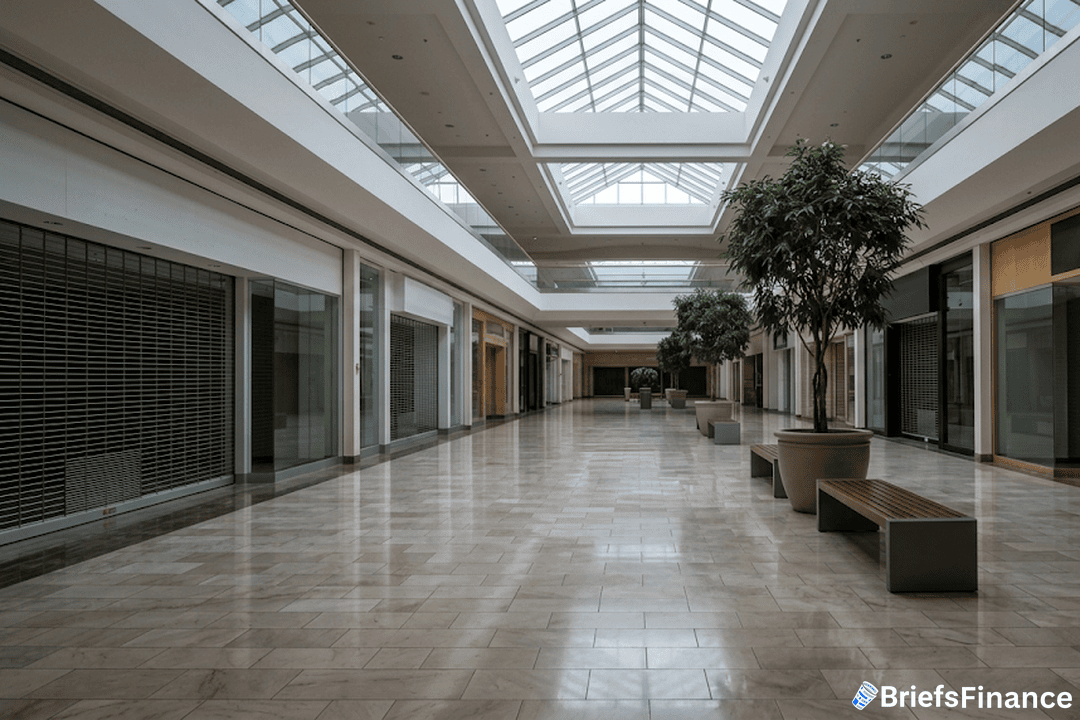
A Big Mall With a Familiar Problem
Destiny USA is the biggest mall in New York. It sits in Syracuse, the state's fifth-largest city.
The property spans 2.4 million square feet.
Inside, you will find stores, a hotel, an indoor ropes course, a go-kart track, and a movie theater with 19 screens. Planners hoped it would pull in visitors from Canada and across the northeastern United States, and Syracuse leaders saw it as a chance to revive a Rust Belt economy that had lost people as manufacturing declined.
The mall never got enough foot traffic.
J.C. Penney and Best Buy closed their stores there. By 2022, Pyramid Management Group, the family-run company that owns the mall, could not keep up with its mortgage and entered forbearance.
Higher interest rates from the Federal Reserve made refinancing more expensive, too.
Pyramid later submitted the winning bid in an open-market sale for the loan.
The loan originally had $430 million in principal.
When a AAA Rating Says the Wrong Thing
Lenders bundled the mall's mortgage with other property loans and sold the result to investors as CMBS, short for commercial mortgage-backed securities.
Some of those bonds earned AAA ratings in 2014, the highest rating available. Asset manager Lord, Abbett & Co. is among the largest holders.
Get the free Always Be Buying eBook and learn the simple system for building wealth on any income
The trouble goes back to 2007, when a Syracuse agency issued municipal bonds to help finance the mall.
The bonds go by the name PILOT, short for payments in lieu of taxes. Pyramid repays them with money it would otherwise owe as property taxes.
About $235 million of those municipal bonds are still outstanding. They stand ahead of the CMBS in the repayment line.
That created a strange mismatch. When the CMBS were issued, $215 million of the lower-priority bonds received AAA ratings, while the municipal debt above them was rated single A.
Daniel McNamara, who founded Polpo Capital Management and serves as its chief investment officer, said the rating setup defied logic.
"The fact that the Destiny Mall municipal bonds, which are structurally senior to the CMBS debt, were originally rated single A, while $215 million of subordinate CMBS bonds were rated AAA, is an insult to common sense," McNamara said.
He also sees the pattern as familiar. "It's the same over-leveraged, bygone-era enclosed mall story that's been playing out across the CMBS market since Covid," he said.
What This Means for Your Portfolio
Pyramid tried this once before. In 2025, it offered about $70 million to buy the debt but could not close the financing.
This year, with investment partners, it made a lower offer during a bidding process run by Newmark Group Inc., and that offer won.
The sale has not closed, so final losses are still unclear.
This is not only a Syracuse problem. New York, San Francisco, and other cities have seen property values drop, and that has hurt CMBS tied to offices, shopping centers, and hotels.
If you own a bond fund, a small piece of that pain can land in your portfolio.
The area around Destiny USA also has a big reason for hope. A few miles away, Micron Technology is building what may become the biggest U.S. chip plant.
The project is part of a government push to spur semiconductor manufacturing. It could be part of up to $100 billion in Micron investment in New York State.
Governor Kathy Hochul's administration says it will create 50,000 jobs. That could bring new shoppers to Destiny USA.
Pyramid, a family-run operator of nine malls in New York State and Massachusetts, has spent years trying to keep its properties afloat. Now it is in expansion mode.
In May, it agreed to buy Providence Place, a mall in Rhode Island.
For your portfolio, the useful lesson is hiding in the same mismatch.
A high rating is an opinion, not a promise. At Destiny USA, that distinction is worth more than $350 million to bondholders.
Download the free Always Be Buying eBook and start putting your money to work today