Free NewsletterPro Login
S&P 500 6,287 +0.42%
DOW 44,521 -0.18%
NASDAQ 21,103 +0.71%

Warning: Undefined variable $funds in /var/www/briefs.co/htdocs/wp-content/plugins/oxygen/component-framework/components/classes/code-block.class.php(133) : eval()'d code on line 491

Warning: foreach() argument must be of type array|object, null given in /var/www/briefs.co/htdocs/wp-content/plugins/oxygen/component-framework/components/classes/code-block.class.php(133) : eval()'d code on line 491
/* the link was here */

Fake IRS Mails Use QR Codes to Empty Crypto Wallets

Published Jul 30, 2026
[tts_player]
Share:
Fake IRS Mails Use QR Codes to Empty Crypto Wallets
Summary:
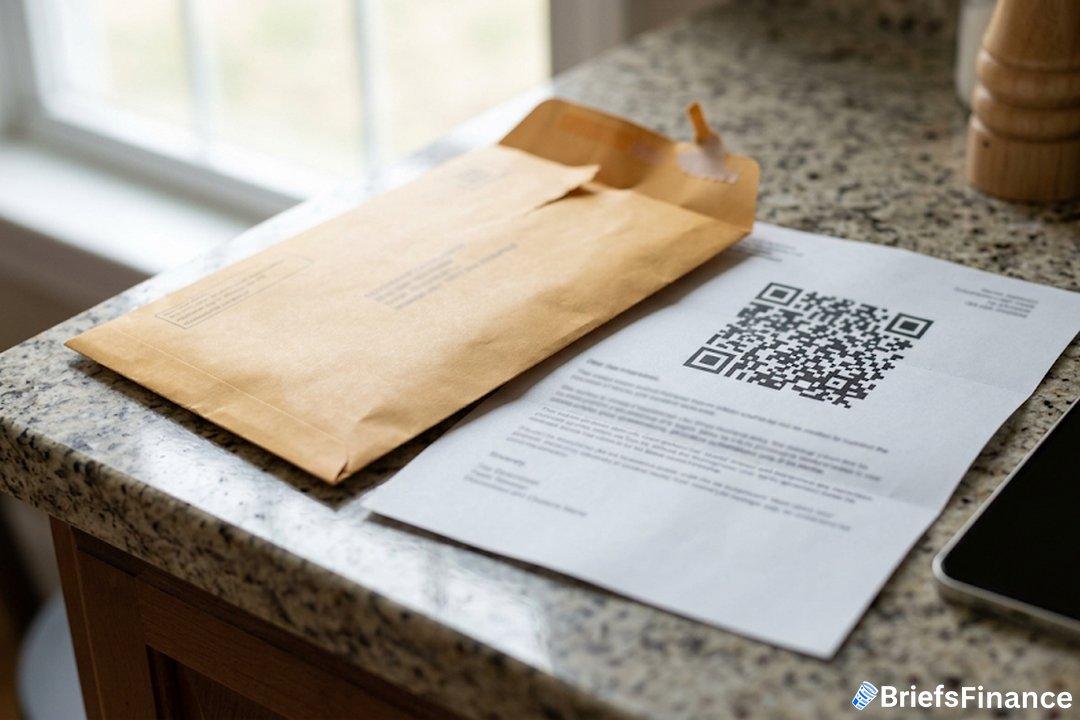
  • Scammers are mailing fake IRS notices that include QR codes leading to a fraudulent website designed to steal cryptocurrency and personal information.
  • In 2025, crypto-related scams led to over $11 billion in losses, a 22% rise compared to the prior year, with the average person losing $62,604.
  • The IRS Criminal Investigation unit issued a warning about this specific scheme on July 30, 2026, as cyber crime keeps climbing.

How the Scam Works

You get an official-looking letter in the mail. It has the IRS logo, a convincing layout, and a QR code. Scan that code, and you land on a website that looks like a real government page. It asks you to enter your crypto wallet details and personal info to enroll in something called the non-existent "Digital Asset Compliance Portal."

There is no such portal. It is a fake, built just days before those letters went out, according to investigators.

Jarod Koopman, chief of IRS Criminal Investigation, put it plainly. "Criminals continue to exploit public trust in government agencies by creating convincing fake websites and official-looking correspondence." The scheme targets cryptocurrency holders specifically, hoping people will trust anything that looks like it came from the taxman.

Coinbase Security, in a blog post detailing the scheme, described it as a "professional, international fraud operation." The letters themselves are physically mailed, which adds a layer of credibility. The fraudulent site was operated from servers in Romania on a network "already known for hosting FedEx and banking phishing pages," according to the Coinbase Security blog post. The campaign's technical framework was established only a few days before the letters went out, and the domain name was registered through a Hong Kong registrar.

Get the market news that matters in a five-minute read with Market Briefs, our free daily newsletter

The Numbers Behind the Crisis

This is not a small or isolated problem. The FBI tracks cyber crime through its Internet Crime Report, and the 2025 numbers are staggering.

The catch: More than 18,000 separate reports came in of crypto thefts over $100,000 in a single incident. That means a lot of people are losing life-changing money. The FBI also noted that cryptocurrency and AI-related complaints are now among the costliest types of cyber crime they track.

The trend is going the wrong way. As more people move digital assets into their own wallets, scammers are getting more creative about how to reach them. A phishing email is easy to spot. A fake IRS letter in the mail is a different story.

What This Means for Your Portfolio

If you hold cryptocurrency, this scam is worth paying attention to. The IRS will never ask you to scan a QR code to verify your wallet or pay a tax bill that way. They will not send you a letter demanding you enroll in a "compliance portal" to unlock your assets.

The real IRS communicates through official channels, and they already have your tax information. Any unsolicited message that asks for your private keys or wallet passwords is a red flag, no matter how official it looks.

The scam infrastructure was set up "just days" before the letters were mailed, which means these operations move fast. By the time the IRS issues a warning, the scammers may already be onto the next variation.

For anyone with crypto, the safest move is to ignore any letter or message that asks for your wallet details or personal information - even if it has a government logo on it. If you are unsure, go directly to the IRS website yourself, not through a link or code someone sent you. One scan of the wrong QR code can drain your wallet before you realize what happened.

Join Market Briefs, our free daily newsletter, for a quick daily rundown of the markets
Disclosure

Recent News

1 2 3 45

Get Market Briefs delivered to your inbox every morning for free!

No fluff. No noise. No politics. Just finance news you can read in 5 minutes.

Blogs

June 29, 2026
Portfolio Diversification: Why Putting All Your Eggs in One Basket Destroys Wealth
  • Real diversification means spreading investments across all 11 economic sectors plus bonds, alternatives, and cash so no single bet can sink the portfolio.
  • Different sectors perform at different times, so a diversified portfolio captures upswings while smoothing the brutal drawdowns that wipe out concentrated bets.
  • Total market index funds offer the simplest path to diversification, and annual rebalancing is what keeps the structure working over time.
Read More
June 29, 2026
Non Taxable Income: What It Is and Why It Matters
  • Non taxable income is money you receive that you don't owe income tax on.
  • The tax code treats workers, investors, and business owners very differently, and investors often come out ahead.
  • Learning how income is taxed is a quiet superpower for keeping more of what you earn.
Read More
June 29, 2026
Semiconductor Stocks: A Simple Guide for Investors
  • Semiconductor stocks are companies that design and make computer chips, the brains inside nearly every modern device.
  • The AI boom has turned chips into one of the market's most important and most watched groups.
  • They offer big growth potential, but come with high valuations and a notoriously cyclical history.
Read More
June 25, 2026
How Stocks Work: A Simple Guide for Beginners
  • A stock is a slice of ownership in a company - buy one, and you own a piece of the business.
  • You make money two ways: the share price rising over time, and dividends paid to shareholders.
  • The simplest path for most beginners is buying into the whole market through a low-cost index fund.
Read More
June 25, 2026
Stop Loss vs Stop Limit: What's the Difference?
  • A stop loss order sells your stock once it hits a trigger price, prioritizing getting you out.
  • A stop limit order only sells within a price range you set, prioritizing price over a guaranteed exit.
  • The trade-off: a stop loss almost always executes; a stop limit might not if the price moves too fast.
Read More
June 25, 2026
Energy Stocks: A Simple Guide for Investors
  • Energy stocks are companies that produce and supply the power the world runs on, from oil and gas to newer sources.
  • They make up one of the 11 sectors of the market and tend to move with energy prices and big-picture shifts.
  • Like any sector, the key is diversification and understanding the forces driving demand.
Read More
June 18, 2026
What Is a Stop Loss Order? A Simple Guide
  • A stop loss order automatically sells a stock once it falls to a price you set.
  • It's a tool to cap losses or lock in gains without watching the market all day.
  • It works best for active strategies, and can backfire if used carelessly on long-term holdings.
Read More
June 18, 2026
Best S&P 500 Index Fund: How to Choose One
  • The best S&P 500 index fund for most investors is simply the cheapest, most established one that tracks the index well.
  • Funds like VOO, IVV, and SPY all hold the same 500 companies, so the biggest difference is the fee.
  • Pick one, automate your buys, and let time do the heavy lifting.
Read More
June 17, 2026
What Are Penny Stocks? Risks and Rewards Explained
  • Penny stocks are very low-priced shares of very small companies, often trading for just a few dollars or less.
  • They promise huge gains but carry huge risks: low liquidity, high failure rates, and wild price swings.
  • Most investors are better served by quality companies and funds than by chasing cheap shares.
Read More
June 17, 2026
Best Stocks for Beginners With Little Money
  • The best stocks for beginners with little money usually aren't individual stocks at all - they're low-cost index funds.
  • You can start with $100 or less and use small, regular investments to build wealth over time.
  • Focus on diversification and consistency, not on picking the next big winner.
Read More
1 2 3 24
Share via
Copy link











