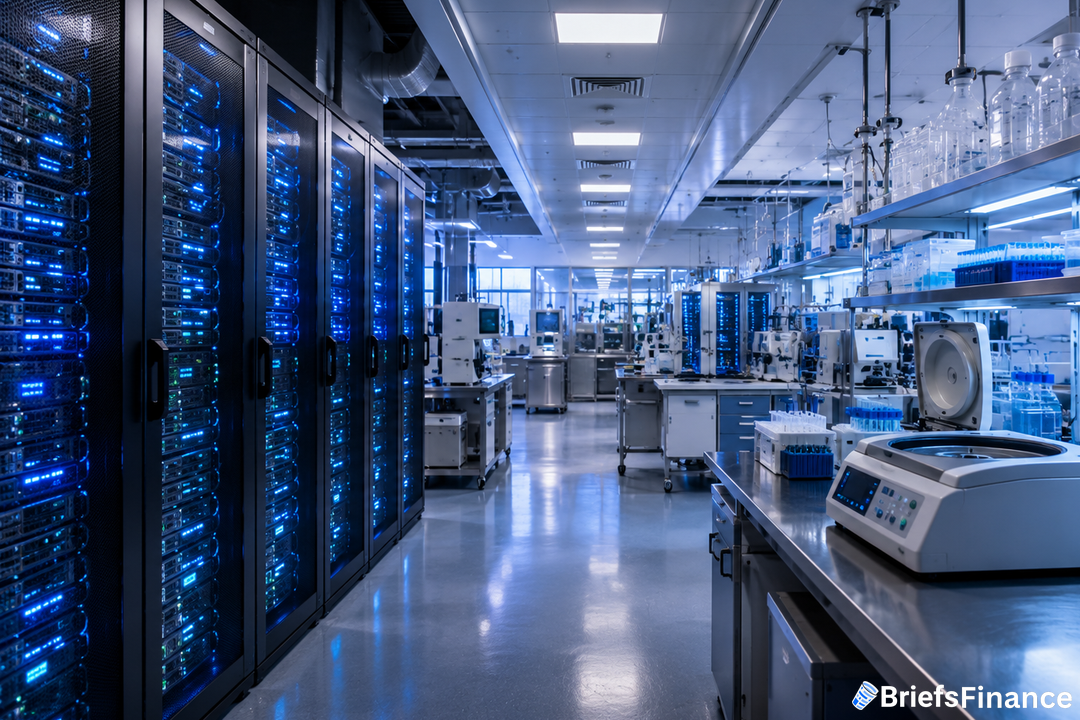
What Bristol Myers and Nvidia Are Building
Bristol Myers Squibb already knows Nvidia's gear. The two companies have already been collaborating for three years. Now they are taking that partnership much further.
Under the terms of the deal, Bristol Myers will install an Nvidia DGX SuperPOD that includes DGX Vera Rubin NVL72 systems. The company stated that this setup would provide it with one of the most formidable AI supercomputers in the life sciences field.
For Bristol Myers, the goal is straightforward. The process of developing new drugs is extremely challenging, and pharmaceutical firms are actively searching for approaches to lower costs and simplify the effort. If the partnership can help speed up that process, the payoff could be huge.
Why Drugmakers Are Flocking to AI
Bristol Myers is not alone in betting big on Nvidia's technology. Nvidia already collaborates with Eli Lilly & Co. Furthermore, Amgen Inc. has constructed an Nvidia supercomputer at a facility in Iceland. The pattern is pretty clear: pharmaceutical companies are increasingly adopting AI to reduce costs and timelines.
Get the market news that matters in a five-minute read with Market Briefs, our free daily newsletter
Nvidia is positioning itself as the go-to supplier for this transformation. The company's chips and supercomputing systems have already made it the backbone of the AI boom in tech. Now it is selling that same power to industries like pharma, where the stakes are high.
The Broader Context of AI in Drug Development
The push for AI in drug discovery reflects a deeper industry struggle. Developing a new medicine typically takes a decade or more and costs billions of dollars, with a high failure rate during clinical trials.
Bristol Myers' investment in Nvidia's latest DGX systems is designed to handle exactly these kinds of computational workloads.
AI systems can rapidly screen millions of chemical compounds, predict their efficacy and safety, and optimize clinical trial designs.
What This Means for Your Portfolio
This announcement is a reminder that the AI boom has not been limited to chatbots and data centers. It is spreading into industries where the technology can solve real, expensive problems.
For investors in Bristol Myers Squibb, the move signals that management is serious about using AI to create new medicines more quickly. For Nvidia shareholders, this is another example of the company expanding beyond its core chip business into partnerships that create stickier, long-term relationships. Drug companies that build entire systems around Nvidia gear are not likely to switch suppliers easily.
And for anyone watching the broader market, the takeaway is that AI adoption is still in its early stages in many industries. Pharma is just one example. The companies that figure out how to use this technology first could have a real advantage.
Join Market Briefs, our free daily newsletter, for a quick daily rundown of the markets