Free NewsletterPro Login
S&P 500 6,287 +0.42%
DOW 44,521 -0.18%
NASDAQ 21,103 +0.71%
S&P 500 +12.4%
Briefs Finance Fund +24.8%
JOIN THE FUND →

Baghdad and Damascus Sign Pact to Reactivate Pipeline Avoiding the Hormuz Strait

Published Jul 17, 2026
[tts_player]
Share:
Summary:
  • Iraq and Syria signed an agreement on July 17, 2026, to restore a pipeline that has been shut since the 2003 U.S. invasion.
  • The route would give Iraq an alternative export corridor around the Strait of Hormuz, which saw major disruption during the U.S.-Iran war.
  • Iraq's oil production dropped from about 4.2 million barrels per day in February to 1.9 million in June.

A Pipeline With a Long History

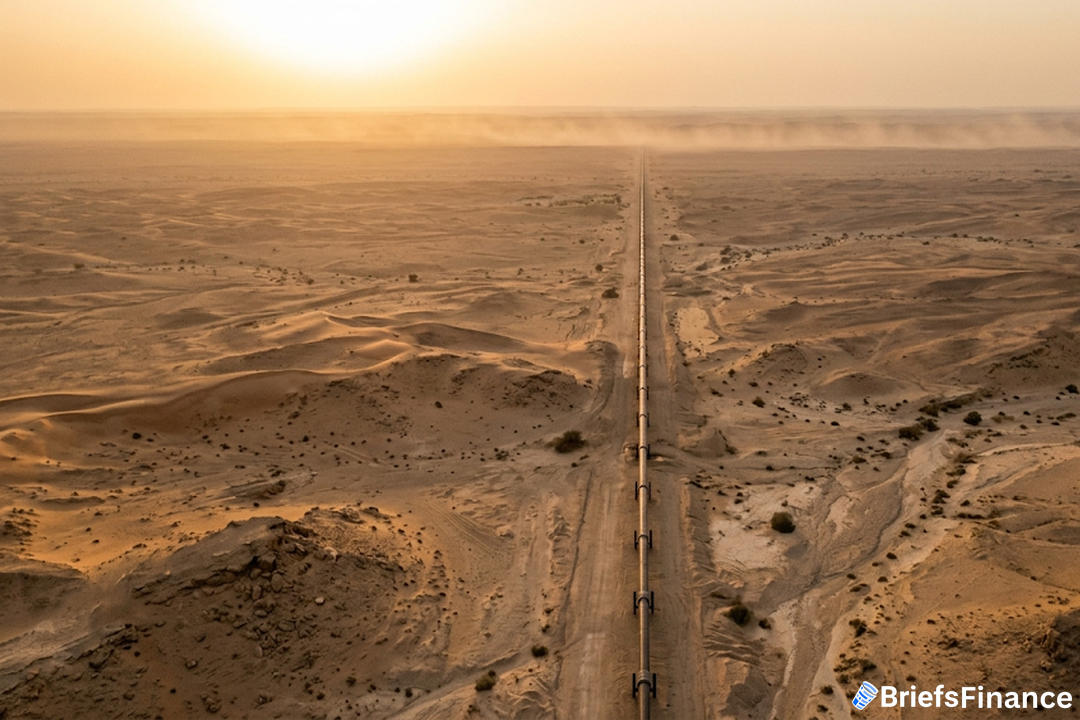
Iraq and Syria signed an agreement on July 17, 2026 to restore an oil pipeline that was damaged during the 2003 U.S. invasion of Iraq and then closed. The U.S. Energy Information Administration states the pipeline's design allows it to move 700,000 barrels daily.

The Strait of Hormuz saw disruption to tanker traffic during the U.S.-Iran war, and Iraq, because it had few pipeline options, depended heavily on its southern port of Basra on the Persian Gulf. When that route was disrupted, it lost its primary export corridor.

The signing ceremony included top energy officials from both countries. U.S. Energy Secretary Chris Wright oversaw the signing ceremony, where Bassem Abdul Karim Nasr, chief executive of Basra Oil Company, and Youssef Qablawi, chief executive of Syrian Petroleum Company, signed the agreement. Iraqi Prime Minister Ali al-Zaidi recently visited the U.S. and met President Donald Trump.

Why Every Gulf State Wants Pipeline Options

Many Gulf nations are seeking to grow their pipeline networks to lessen reliance on the Strait of Hormuz. Saudi Arabia is considering adding 2 million barrels per day of capacity to its Red Sea pipeline, according to a Reuters report from July 7, 2026, citing people close to the matter. The UAE is building an additional pipeline that terminates at Fujairah Port along the Gulf of Oman, thereby doubling its export capacity outside the strait.

Get the market news that matters in a five-minute read with Market Briefs, our free daily newsletter

Iraq's new pipeline with Syria fits the same pattern. It would allow Iraqi oil to reach the Mediterranean coast, bypassing the Strait of Hormuz entirely.

Energy Secretary Chris Wright put a broader spin on it at the signing. "There is so much room to drive improvement in Iraq, to raise oil production, to reduce dependencies on hostile neighbors, to bring freedom, prosperity and abundant energy to the nation of Iraq," he said.

The Catch: Pipelines Are Not a Cure-All

Bob McNally, founder of energy consulting firm Rapidan Energy, points out that the real threat from Iran is not just the waterway. "The problem isn't the waterway. It's that Iran can use weapons to attack loading facilities, pumping stations, the end stations, these terminals, and the storage units of these pipelines," he said.

Historical Context and Strategic Importance

The pipeline's roots trace back to the 1980s, when it was a vital artery for Iraqi crude exports to Europe via Syria. After the 2003 U.S. invasion, damage and subsequent sanctions kept it shuttered. Its revival comes as the recent U.S.-Iran war exposed the fragility of Iraq's export infrastructure.

Missile strikes and naval skirmishes near the Strait of Hormuz crippled tanker traffic, forcing Iraq to scramble for alternatives. Reopening the pipeline not only reduces Baghdad's dependence on a single chokepoint but also strengthens its leverage against future disruptions.

Join Market Briefs, our free daily newsletter, for a quick daily rundown of the markets
Disclosure

Recent News

1 2 3 38

Get Market Briefs delivered to your inbox every morning for free!

No fluff. No noise. No politics. Just finance news you can read in 5 minutes.

Blogs

June 29, 2026
Portfolio Diversification: Why Putting All Your Eggs in One Basket Destroys Wealth
  • Real diversification means spreading investments across all 11 economic sectors plus bonds, alternatives, and cash so no single bet can sink the portfolio.
  • Different sectors perform at different times, so a diversified portfolio captures upswings while smoothing the brutal drawdowns that wipe out concentrated bets.
  • Total market index funds offer the simplest path to diversification, and annual rebalancing is what keeps the structure working over time.
Read More
June 29, 2026
Non Taxable Income: What It Is and Why It Matters
  • Non taxable income is money you receive that you don't owe income tax on.
  • The tax code treats workers, investors, and business owners very differently, and investors often come out ahead.
  • Learning how income is taxed is a quiet superpower for keeping more of what you earn.
Read More
June 29, 2026
Semiconductor Stocks: A Simple Guide for Investors
  • Semiconductor stocks are companies that design and make computer chips, the brains inside nearly every modern device.
  • The AI boom has turned chips into one of the market's most important and most watched groups.
  • They offer big growth potential, but come with high valuations and a notoriously cyclical history.
Read More
June 25, 2026
How Stocks Work: A Simple Guide for Beginners
  • A stock is a slice of ownership in a company - buy one, and you own a piece of the business.
  • You make money two ways: the share price rising over time, and dividends paid to shareholders.
  • The simplest path for most beginners is buying into the whole market through a low-cost index fund.
Read More
June 25, 2026
Stop Loss vs Stop Limit: What's the Difference?
  • A stop loss order sells your stock once it hits a trigger price, prioritizing getting you out.
  • A stop limit order only sells within a price range you set, prioritizing price over a guaranteed exit.
  • The trade-off: a stop loss almost always executes; a stop limit might not if the price moves too fast.
Read More
June 25, 2026
Energy Stocks: A Simple Guide for Investors
  • Energy stocks are companies that produce and supply the power the world runs on, from oil and gas to newer sources.
  • They make up one of the 11 sectors of the market and tend to move with energy prices and big-picture shifts.
  • Like any sector, the key is diversification and understanding the forces driving demand.
Read More
June 18, 2026
What Is a Stop Loss Order? A Simple Guide
  • A stop loss order automatically sells a stock once it falls to a price you set.
  • It's a tool to cap losses or lock in gains without watching the market all day.
  • It works best for active strategies, and can backfire if used carelessly on long-term holdings.
Read More
June 18, 2026
Best S&P 500 Index Fund: How to Choose One
  • The best S&P 500 index fund for most investors is simply the cheapest, most established one that tracks the index well.
  • Funds like VOO, IVV, and SPY all hold the same 500 companies, so the biggest difference is the fee.
  • Pick one, automate your buys, and let time do the heavy lifting.
Read More
June 17, 2026
What Are Penny Stocks? Risks and Rewards Explained
  • Penny stocks are very low-priced shares of very small companies, often trading for just a few dollars or less.
  • They promise huge gains but carry huge risks: low liquidity, high failure rates, and wild price swings.
  • Most investors are better served by quality companies and funds than by chasing cheap shares.
Read More
June 17, 2026
Best Stocks for Beginners With Little Money
  • The best stocks for beginners with little money usually aren't individual stocks at all - they're low-cost index funds.
  • You can start with $100 or less and use small, regular investments to build wealth over time.
  • Focus on diversification and consistency, not on picking the next big winner.
Read More
1 2 3 24
Share via
Copy link











