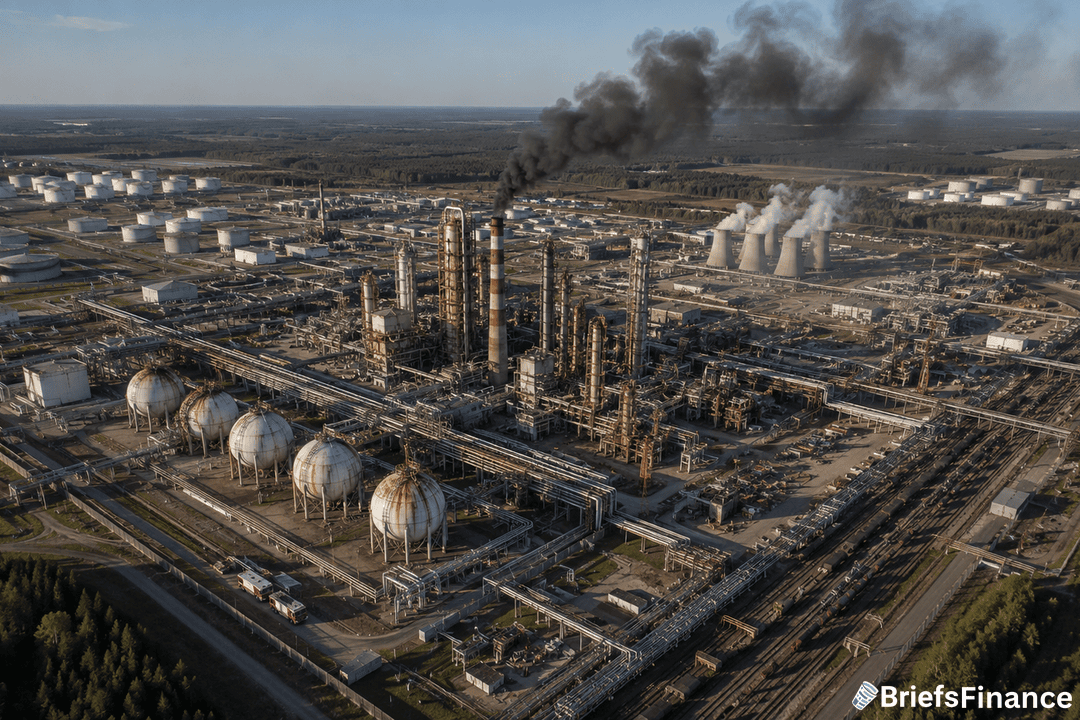
Most attacks on Russian energy infrastructure happen close to the front. This one didn't.
A drone strike on the Tyumen Oil Refinery in western Siberia on Saturday extended Ukraine's reach to roughly 2,000 kilometers from the border, and Russian refining capacity now has nowhere to hide.
The Furthest Hit Yet
Tyumen's regional governor Alexander Moor said air defenses intercepted the drones and the facility wasn't damaged, with employees evacuated and emergency services on site.
The picture on the ground told a different story. Russian social media filled with footage of smoke over the plant, locals reported at least two explosions, and fire trucks streamed toward the industrial zone.
The Russian outlet ASTRA geolocated the footage to the Tyumen refinery, which used to operate as the Antipinsky Refinery. Authorities suspended arrivals and departures at Tyumen's Roshchino Airport while temporary flight restrictions were in place.
You can follow how energy stories like this actually move oil prices in Market Briefs every weekday morning, with a free investing masterclass thrown in when you sign up.
A Big Refinery, Far From The Front
Tyumen isn't a small target. The site can refine up to 9 million tons of crude every year, with a refining depth around 98% - meaning almost every barrel that goes in comes out as something sellable like diesel, fuel oil, petroleum coke, or bitumen.
Strikes on Russian refining capacity have already squeezed fuel supply inside the country and rippled through global crude prices. Hitting Tyumen pushes the conflict into Siberia, where Russia houses much of its oil-processing base.
Ukrainian strikes have already taken meaningful refining capacity offline across European Russia in 2026, pushing the country to import gasoline by sea for the first time in years, and hitting Siberia widens the threat zone in a meaningful way.
Overnight, separate strikes reportedly hit multiple energy sites in occupied Crimea, including the Tavriiska Thermal Power Plant near Simferopol and a gas distribution station tied to the Dzhankoi-Simferopol pipeline. Satellite data from NASA detected thermal anomalies at the sites following the attacks.
What To Watch
Refinery hits matter for investors because they pull diesel and gasoline supply out of the global market, and they put a floor under crude prices when supply tightens elsewhere. Crack spreads - the gap between crude and refined product prices - have widened on every major hit this year.
That math matters for global energy supply, with Russia the world's third-largest oil producer and its refining capacity feeding domestic markets and export buyers across Asia and Latin America.
Russian crude exports actually hit a 2026 high earlier this month, but refined fuel exports are a separate story, and they're under direct pressure.
Two thousand kilometers used to be safe distance. It isn't anymore.
If you want this kind of market read every morning, join Market Briefs here - and you'll also get a 45-minute investing masterclass as a bonus.