Free NewsletterPro Login
S&P 500 6,287 +0.42%
DOW 44,521 -0.18%
NASDAQ 21,103 +0.71%
S&P 500 +12.4%
Briefs Finance Fund +24.8%
JOIN THE FUND →

Chinese Energy Stocks Jump On Clean Energy Boom

A stylized illustration of a cylindrical cup with blue arrows and lines indicating a swirling or rotational motion inside the cup.
Published Feb 12, 2026
[tts_player]
Share:
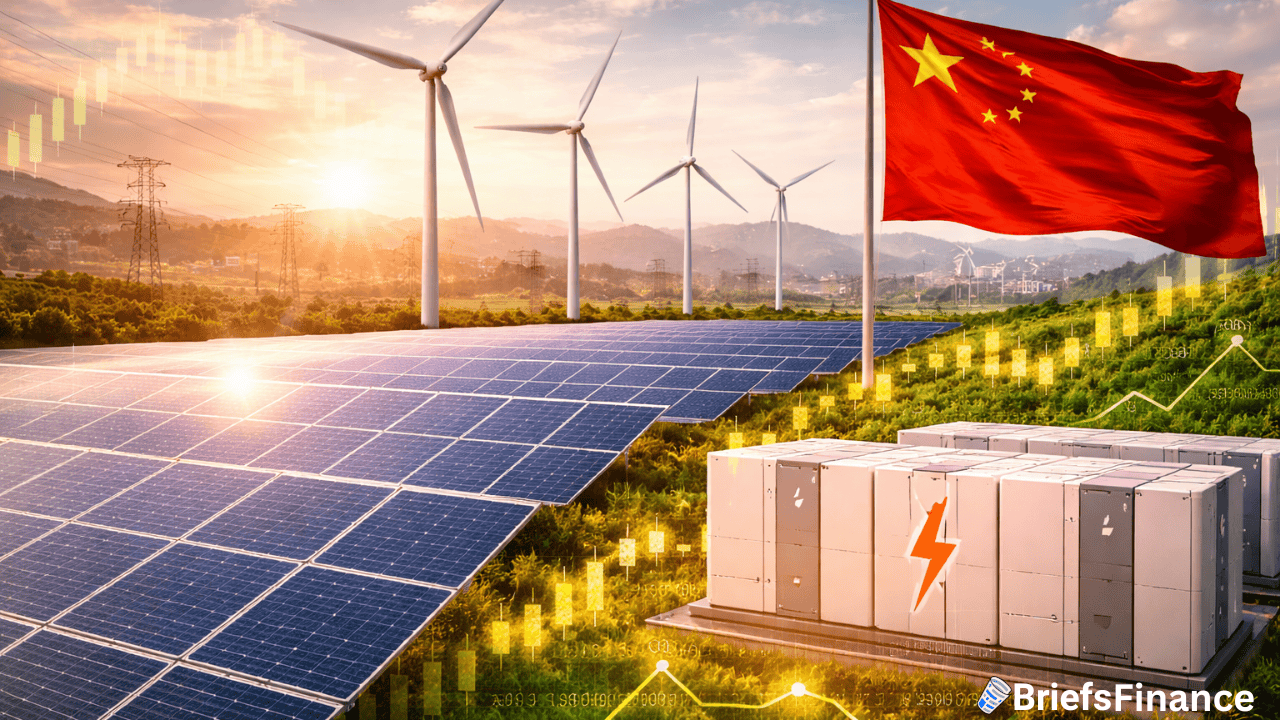
Solar panels, wind turbines, and battery storage set in a green landscape with a Chinese flag, representing clean energy development and the growing impact of Chinese energy stocks in China.
Summary:
  • Historic plateau. China's CO2 emissions have been flat or falling for 21 months, marking the longest decline not driven by economic slowdown.
  • Renewables explosion. Solar output jumped 43% and wind climbed 14% in 2025, meeting all new electricity demand.
  • Storage surge. Energy storage capacity grew by a record 75 gigawatts - roughly equivalent to France's peak winter demand.

Solar power output in China surged 43% year-over-year.

Wind climbed 14%.

Nuclear jumped 8%.

Together, these three sources delivered about 530 terawatt-hours of new clean electricity - enough to cover all of China's 520 TWh growth in electricity demand.

Translation: renewables grew faster than demand. That forced coal generation down 1.9%.

Companies like JinkoSolar - one of China's largest solar manufacturers - are riding this wave.

The country installed 360 gigawatts of wind and solar in 2024 alone, more than half the world's total additions that year.

The Energy Storage Revolution

But solar and wind are unreliable. The sun sets. The wind dies.

That's where storage comes in.

China's energy storage capacity grew by 75 gigawatts in 2025 - a record.

That outpaced the 55 GW rise in peak demand.

Break that down: 75 GW is roughly equivalent to France's peak winter electricity demand of 88-96 GW.

It's a massive amount of capacity that lets China store excess solar and wind power for use when generation drops.

The result? Less need for coal plants to fill the gaps.

Where Emissions Actually Fell

Power sector emissions dropped 1.5% as renewables displaced fossil fuels.

Transport emissions fell 3%, driven by electric vehicle adoption.

Building materials - mainly cement - dropped 7% as construction slowed.

But there's a catch.

The chemicals industry saw emissions jump 12%. That sector is growing fast and could threaten future declines if left unchecked.

Is This Peak Emissions?

China committed to peaking emissions before 2030. Some analysts think they've already hit it.

The 21-month plateau is the longest decline on record not driven by economic slowdown. If it holds, China could beat its 2030 target by years.

But CREA lead analyst Lauri Myllyvirta warns the progress is fragile.

"Because the relative drop is so small, we can't say with certainty yet that it's a fall, therefore the 'flat or falling.'"

A small jump in emissions could push China back above its previous peak. The chemical sector's growth is proof that not every part of the economy is decarbonizing.

What Happens Next

China's next five-year plan drops in March 2026. That document will reveal whether the government plans to keep clean energy additions at current levels—or scale back.

To meet its 2030 climate commitments, China needs to maintain or slightly reduce emissions through the end of the decade.

That requires keeping renewables installations close to 2025 levels.

The trajectory isn't guaranteed.

But right now, the world's biggest polluter is bending its emissions curve downward - and clean energy is doing the heavy lifting.

Disclosure

Recent News

1 2 3 39

Get Market Briefs delivered to your inbox every morning for free!

No fluff. No noise. No politics. Just finance news you can read in 5 minutes.

Blogs

June 29, 2026
Portfolio Diversification: Why Putting All Your Eggs in One Basket Destroys Wealth
  • Real diversification means spreading investments across all 11 economic sectors plus bonds, alternatives, and cash so no single bet can sink the portfolio.
  • Different sectors perform at different times, so a diversified portfolio captures upswings while smoothing the brutal drawdowns that wipe out concentrated bets.
  • Total market index funds offer the simplest path to diversification, and annual rebalancing is what keeps the structure working over time.
Read More
June 29, 2026
Non Taxable Income: What It Is and Why It Matters
  • Non taxable income is money you receive that you don't owe income tax on.
  • The tax code treats workers, investors, and business owners very differently, and investors often come out ahead.
  • Learning how income is taxed is a quiet superpower for keeping more of what you earn.
Read More
June 29, 2026
Semiconductor Stocks: A Simple Guide for Investors
  • Semiconductor stocks are companies that design and make computer chips, the brains inside nearly every modern device.
  • The AI boom has turned chips into one of the market's most important and most watched groups.
  • They offer big growth potential, but come with high valuations and a notoriously cyclical history.
Read More
June 25, 2026
How Stocks Work: A Simple Guide for Beginners
  • A stock is a slice of ownership in a company - buy one, and you own a piece of the business.
  • You make money two ways: the share price rising over time, and dividends paid to shareholders.
  • The simplest path for most beginners is buying into the whole market through a low-cost index fund.
Read More
June 25, 2026
Stop Loss vs Stop Limit: What's the Difference?
  • A stop loss order sells your stock once it hits a trigger price, prioritizing getting you out.
  • A stop limit order only sells within a price range you set, prioritizing price over a guaranteed exit.
  • The trade-off: a stop loss almost always executes; a stop limit might not if the price moves too fast.
Read More
June 25, 2026
Energy Stocks: A Simple Guide for Investors
  • Energy stocks are companies that produce and supply the power the world runs on, from oil and gas to newer sources.
  • They make up one of the 11 sectors of the market and tend to move with energy prices and big-picture shifts.
  • Like any sector, the key is diversification and understanding the forces driving demand.
Read More
June 18, 2026
What Is a Stop Loss Order? A Simple Guide
  • A stop loss order automatically sells a stock once it falls to a price you set.
  • It's a tool to cap losses or lock in gains without watching the market all day.
  • It works best for active strategies, and can backfire if used carelessly on long-term holdings.
Read More
June 18, 2026
Best S&P 500 Index Fund: How to Choose One
  • The best S&P 500 index fund for most investors is simply the cheapest, most established one that tracks the index well.
  • Funds like VOO, IVV, and SPY all hold the same 500 companies, so the biggest difference is the fee.
  • Pick one, automate your buys, and let time do the heavy lifting.
Read More
June 17, 2026
What Are Penny Stocks? Risks and Rewards Explained
  • Penny stocks are very low-priced shares of very small companies, often trading for just a few dollars or less.
  • They promise huge gains but carry huge risks: low liquidity, high failure rates, and wild price swings.
  • Most investors are better served by quality companies and funds than by chasing cheap shares.
Read More
June 17, 2026
Best Stocks for Beginners With Little Money
  • The best stocks for beginners with little money usually aren't individual stocks at all - they're low-cost index funds.
  • You can start with $100 or less and use small, regular investments to build wealth over time.
  • Focus on diversification and consistency, not on picking the next big winner.
Read More
1 2 3 24
Share via
Copy link









