What happened
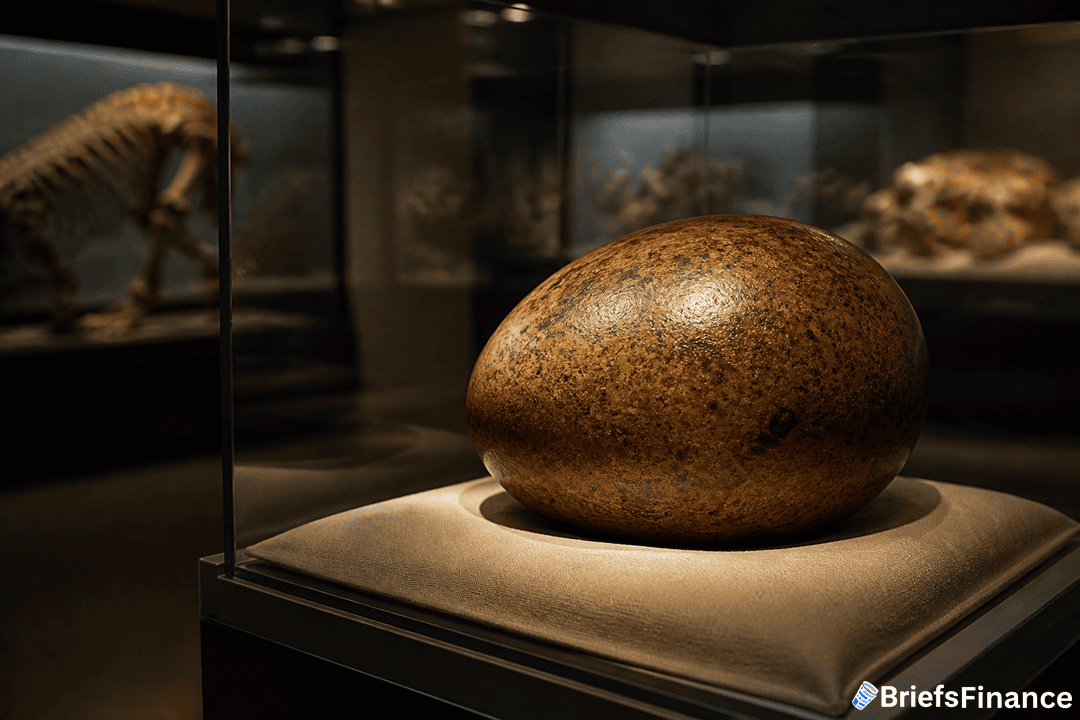
After purchasing a rare moa egg in June at Artemis Gallery in Louisville, Colorado, for around $14,000, Colossal Biosciences says it will transfer the specimen to Professor Te Maire Tau, a Māori scholar who is a tribal leader working from the Canterbury region of New Zealand's South Island. "To quote Indiana Jones, 'It belongs in a museum,' a museum in Aotearoa, under the care of the people whose ancestors lived alongside these extraordinary birds," said Colossal Co-Founder and Chief Executive Officer Ben Lamm.
First found on January 14, 1966, in New Zealand, the egg spent roughly six decades in a private American collection before it was acquired by the Dallas-based company. Assembled so far from numerous shards, the egg will receive additional pieces reaffixed under the direction of researchers from Ngāi Tahu, a South Island Māori tribe.
Why the egg matters
Moa stood as tall as 12 feet, weighed up to 230 kg, and went extinct about 600 years ago. The egg is sizable - nearly twice an ostrich egg's volume and roughly 8.7 by 6.7 inches - and belongs to a very small set of moa shells that are complete or nearly complete. Such eggshells have yielded ancient DNA and, through their structure and thickness, clues to nesting and incubation.
Film director Peter Jackson, an investor in Colossal who is working with the Ngāi Tahu Research Center and Canterbury Museum on the moa initiative, said he contacted the company when the egg came up for sale outside New Zealand. "When we learned that this exceptionally rare moa egg was being sold outside of New Zealand, we spoke to Colossal, who not only offered to rescue it at their own considerable expense - but to also fly it privately to New Zealand, so it returns home safely," he said. "After expert restoration, it will very likely become only the ninth known nearly intact moa egg - probably one of the five best-preserved examples."
When stories touch on culture and conservation, a quick daily update helps you stay grounded, so sign up for Market Briefs
The project and the people involved
Colossal is pursuing de-extinction programs for the moa, woolly mammoth, dodo, dire wolf, and Tasmanian tiger. Lamm said the moa effort was built around indigenous leadership: "When we launched the moa program, we made a clear commitment that indigenous leadership would guide the science and every decision surrounding the project. Securing and transporting this egg back to its rightful home is just part of that commitment."
Lamm told Bloomberg News the team is making "great progress" and may be positioned to bring the bird back by the early 2030s, though the timeline could change. He added that the Ngāi Tahu Research Center would decide when the public gets to see the bird. Work on the dodo is feeding into the moa research, he said: "Some of the editing technologies and delivery mechanisms are ahead of schedule, benefiting from our dodo project. We recently announced a new AI tool focused on the dodo that will also play a pivotal role in the moa de-extinction."
Colossal notes that, historically, moa supplied indigenous communities with meat, feathers, and bones. Bringing them back would require gene editing and surrogate species, with studies targeting close relatives like Australia's emu and Central America's tinamou. Paul Scofield, Canterbury Museum's senior natural history curator and an adviser on the project, called the prospect of returning moa to a New Zealand environment exciting, saying it offers Māori a direct connection and an economic opportunity.
What this could mean for your portfolio
De-extinction might sound cinematic, but the work is concrete: gene editing, surrogate development, and governance in partnership with Māori leaders. According to Colossal, its efforts could establish benchmarks for de-extinction and begin repairing harms tied to Earth's biodiversity loss, and the company has a tentative early 2030s target for moa, though that schedule could change. The bottom line: this egg is both a scientific resource and a signal of how biotech platforms, indigenous partnerships, and museum collaborations could shape timelines, funding, and eventual commercialization paths across conservation tech.
Across unexpected human interest stories, a short clear summary makes meaning easier, so try our free Market Briefs newsletter