Big growth, not big hiring
Applied Materials expects to grow revenue to about twice its current level within the next few years, and management does not see headcount rising in step with that. "As we double the size of the company over the next few years, we're not going to be doubling headcount," Chief Executive Officer Gary Dickerson said ahead of an event marking a new facility. He did not provide a hiring forecast.
The company employed about 38,900 people as of late July. As the largest US maker of chipmaking equipment, Applied is riding a surge in demand for tools that power the artificial intelligence boom.
How AI fits into the plan
Inside Applied, AI is being used to speed up innovation, product development and quality control. With customers, the company is applying AI to push semiconductor yields higher and to move more wafers through fabs each day. "More good chips are worth a lot of money to our customers," Dickerson said, noting the focus on improving both "the number of good chips per wafer, and the number of wafers per day." Applied is still adding talent in select areas where AI is driving major productivity improvements, which in some cases have reached about 50%.
Equipment makers are the clearest read on where chip capacity is heading. Market Briefs covers semiconductors free every morning.
Inside the EPIC Center and the near term speed bumps
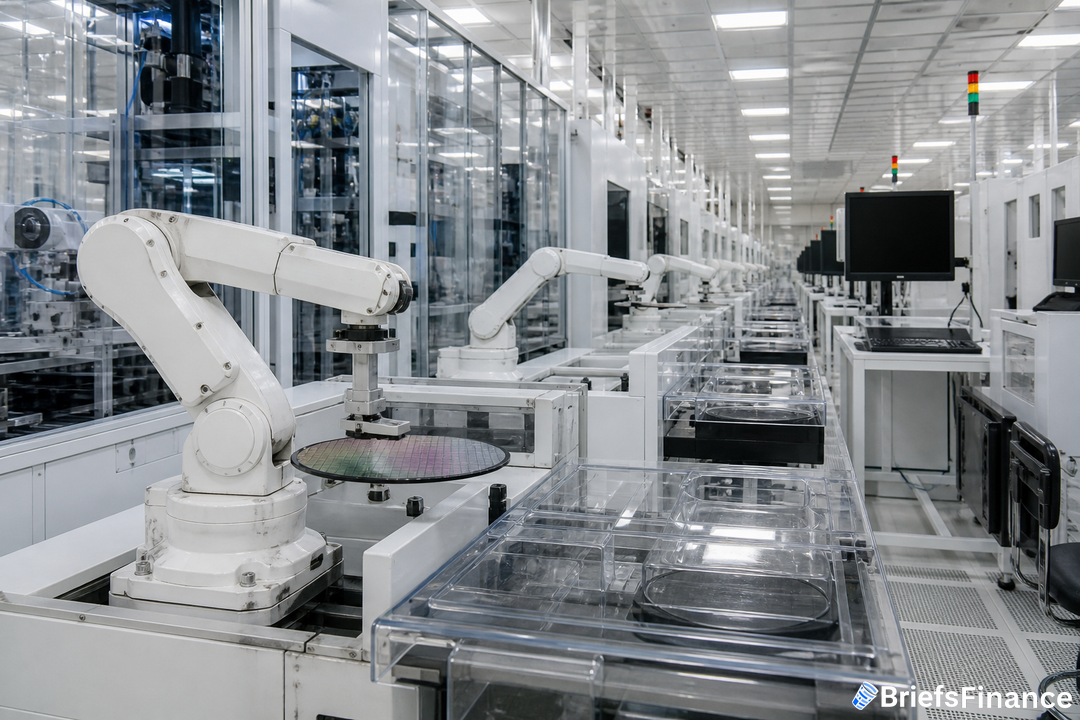
The Sunnyvale, California-based EPIC Center is a hub for equipment work, process innovation and commercialization, intended to bring chipmakers together with researchers and equipment partners to accelerate development. Backed by $5 billion in capital spending, the facility spans 600,000 square feet (56,000 square meters) and sets aside nearly four acres for state-of-the-art clean rooms. By the company's tally, the concrete poured could fill 34 Olympic-sized pools, and the steel used could have built two Eiffel Towers. Partners on the center include Taiwan Semiconductor Manufacturing Co., Intel Corp., Samsung Electronics Co., Micron Technology Inc. and SK Hynix Inc.
Dickerson pointed to immediate bottlenecks that might temper the pace of AI expansion, such as gaps in financing, materials and parts, power availability, and manufacturing capacity. "Are there things that, in the short term, can slow down the rate of growth? Sure," he said. "But the growth is going to be significant in any scenario."
Why it matters for your money
When a top chip-gear supplier expects to scale revenue with fewer new hires, that signals AI is making factories and engineers more productive. If that holds, customers get more usable chips out of each wafer and more wafers through the line, strengthening the backbone of the AI wave even if there are temporary snags in funding or supply.
Doubling revenue implies a very large build-out behind it. Get the free Market Briefs daily newsletter and follow it.