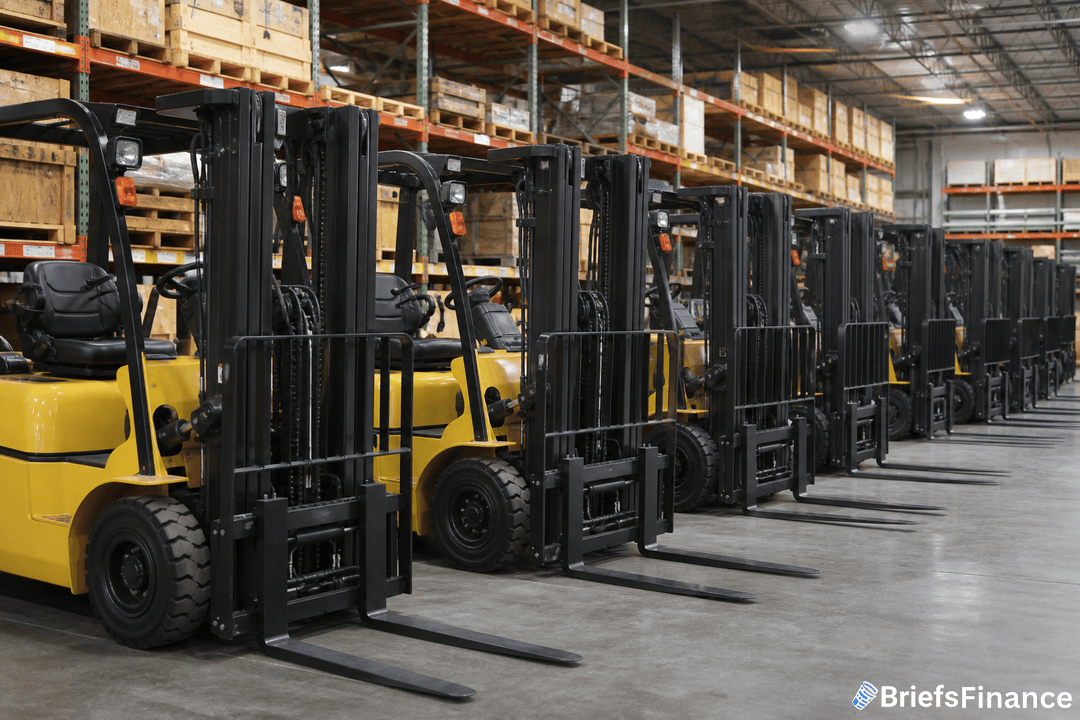
Forklifts Are a Window Into World Trade
Everyone has seen a forklift. Almost nobody stops to think about what it does all day.
That's a mistake, because the beeping yellow machines that stack pallets and unload shipping containers are one of the best signs of how much stuff is moving around the planet. A forklift only gets bought when there is work for it to do, so each sale is basically a small bet on commerce.
China just made a lot of those bets. CCTV reports that from January to July 2026, Chinese forklift sales reached 1.01 million units, up 17.7% compared with the same period last year.
The international side of the business grew even faster than the home market. Overseas shipments grew 22%, topping 380,000 units, which tells you foreign warehouses and ports are hungry for Chinese-made lift trucks.
Domestic buyers are keeping up their end too. Home-market sales hit 629,000 units, a 15.3% year-over-year gain, so this boom is not just about what China sends overseas.
Inside a Factory Running at Full Speed
The demand shows up in real factories, not just spreadsheets. In Zhejiang, several lift-truck makers already have orders booked into Q4, a sign that the current rush has staying power.
Markets move every day, and most of it never reaches you in time. Get the free Market Briefs daily newsletter and stay ahead of it.
One factory in Zhejiang runs a compact electric pallet-truck line that produces a unit every two minutes. That pace is the kind you would expect from a busy kitchen, not a heavy machinery plant, and it helps explain how the industry races past one million units in just seven months.
The machines are not just staying in China. About 90% of that plant's output ships to nearly 100 countries and regions, meaning a forklift built on one factory line can end up moving goods just about anywhere on the map.
That global reach matters for the industry's future. When a country's manufacturers can supply the world, their sales numbers start to look less like a local story and more like a reading on the health of world trade.
Planned demand makes the machine run smoothly, too. With orders booked months in advance, factory managers can line up workers and parts ahead of time instead of scrambling to keep up.
The Warehouse Is Getting Smarter
The machines themselves are also getting a high-tech upgrade. CCTV's report featured autonomous forklifts and warehouse robots fitted with cameras and lidar, a laser-based sensing system that lets a machine "see" the space around it without a human at the wheel.
One Zhejiang factory runs more than 150 autonomous forklifts in coordinated workflows for receiving, storage, picking, and finished-product handling. That means a fleet of driverless machines is running the floor like a relay team.
They handle every step between a truck arriving at the dock and a finished order heading out. The human job shifts from steering to supervising, and that may be the change that reshapes warehouse economics over time.
What This Means for Your Money
Forklift sales could sound like a factory-floor detail. But they are a leading indicator for global commerce, since enterprises only order new lift trucks when they expect more goods to move through warehouses, ports, and distribution centers.
Because that expectation tends to show up later in company earnings and market performance. When the world's biggest manufacturing country is building and exporting forklifts at this pace, it is a sign that global commerce is still humming and that companies tied to shipping and logistics have real momentum behind them.
If the machines are so busy, the money flowing through them probably is too.
When machines like these sell at this pace, the global economy is still in motion, and that motion tends to lift earnings for companies across shipping, manufacturing, and retail.
The money story behind the headlines is usually the part that matters. Join Market Briefs free and get it every morning.