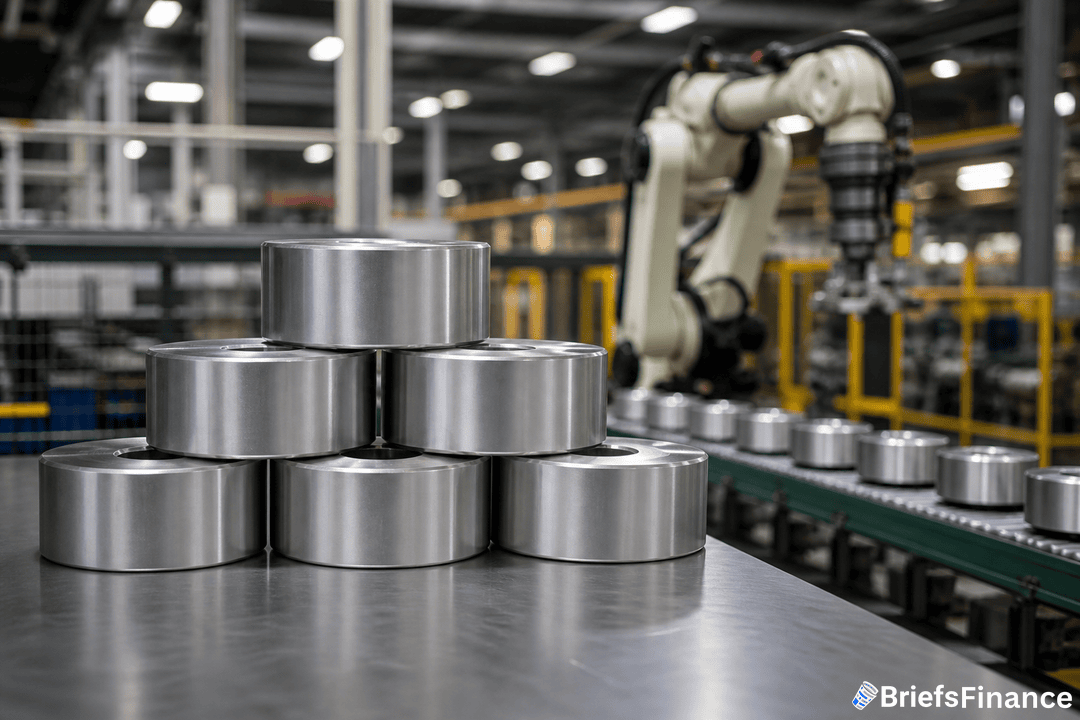
The same magnets that spin inside your car's motor are now quiet workhorses of the robotics boom.
JL Mag Rare Earth, the world's largest maker of rare-earth magnets, just posted its best first half ever. The company says electric vehicles and robots are doing the heavy lifting.
Net income jumped 52% to 462 million yuan, which works out to about $69 million. Revenue climbed a third to a record 4.7 billion yuan, and demand shows no signs of cooling off.
Robots Become a Real Business
Electric vehicles still make up about half of JL Mag's revenue. But the newest growth story is robotics, and it is moving fast.
Robot-related revenue doubled in the first half, turning what was a side note into a meaningful chunk of the business. The company also signed a deal to supply magnets for robots built by an unnamed customer it calls a "world-renowned technology company."
Rates, prices and policy all end up in your budget eventually. Get the free Market Briefs daily newsletter and see it coming.
That name matters less than what it signals. JL Mag says that as the humanoid robot industry scales up, demand for its high-performance magnets and motor rotors should keep expanding. These are the parts that give robots their power, stability, and precise control in their joints.
Chinese investors are betting big on that future. This year alone, they have poured upward of 100 billion yuan, or roughly $14.8 billion, into humanoid-robot ventures.
The Supply Chain Squeeze
Here is the catch. JL Mag is growing fast, but it is also sitting in the middle of a geopolitical fight.
Last year, Beijing imposed export controls on rare earth magnets amid trade tensions with the US. That means JL Mag and similar companies now need official approval to ship many of their products abroad. The move disrupted supplies and raised fears of industrial fallout in countries that depend on these magnets.
China produces more than 90% of the world's rare-earth magnets, so there is no quick replacement. Other countries are trying to build their own supply chains, but that takes years. Rare-earth magnets are central to EV motors, wind turbines, and robot joints, so the impact of export controls ripples through fast.
In the meantime, JL Mag is not waiting around. It currently produces 40,000 tons a year and is aiming for 60,000 tons a year by 2027.
What It Means for Investors
The company's growth over the past decade was built on China's electric vehicle and wind power industries. Now it is betting that robots will carry the next leg, and the numbers suggest the bet is already paying off.
For investors, the story is about more than one company's earnings. It is a window into where global manufacturing is headed. Rare-earth magnets are not flashy, but every EV motor, every turbine, and every humanoid robot needs them. Whoever controls that supply chain holds real leverage.
The question is not whether demand for these magnets will keep growing. It almost certainly will. The real question is how export controls and the race to build alternative supply chains will reshape who gets to sell them, and at what price. For now, JL Mag is in the driver's seat, and its latest results show just how valuable that seat has become.
The best financial decisions come from understanding the whole picture. Join Market Briefs free and get the full brief each morning.