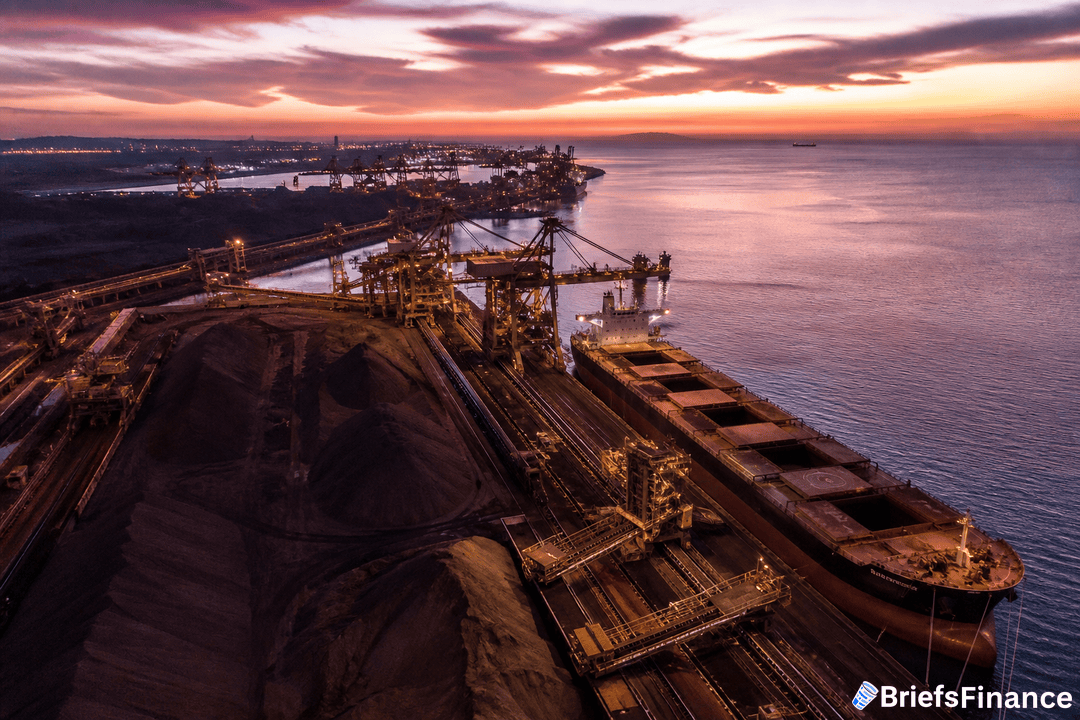
A key Brazilian port that moves iron ore to overseas buyers has drawn two serious offers, with one bid reaching as high as roughly $3.5 billion.
Porto Sudeste, co-owned by commodity trader Trafigura Group and Mubadala Capital, the investment arm of Abu Dhabi's sovereign wealth fund, is now at the center of a sale process that could reshape how Brazilian miners reach global markets.
Why This Port Matters
Porto Sudeste is not just another dock. It is a major logistics link that gives Brazilian miners a direct path to customers in Southeast Asia and beyond, and it has room to expand mineral shipments even further.
Rail connections tie the port to Minas Gerais, the country's key iron-ore producing state. That link matters because getting ore from the mine to the ship is often the hardest part of the business.
If big-money bids for global infrastructure catch your eye, the free Always Be Buying eBook shows a simpler way to build wealth steadily.
The port has been busy.
The Bidding Field
Two offers have landed. The higher-profile group includes BlackRock's Global Infrastructure Partners, iron-ore miner Vale SA, and steelmaker Gerdau SA. That combination is notable because Vale is both a potential customer and a competitor, depending on how you look at it. I Squared Capital submitted the other offer.
According to a Vale representative, the firm assesses investment opportunities "in light of its strategic priorities," "and would keep the market informed of any" "material facts from this exploration or concerning its business."
Two other firms, Stonepeak Partners LP and Brisbane-based logistics company M Resources, decided against bidding as a third group.
What Happens Next
The sale process dates back to 2014, when Trafigura and Mubadala acquired a controlling interest in the port, located in Rio de Janeiro, from MMX Mineracao & Metalicos, a mining venture tied to former billionaire Eike Batista.
Why does it matter? For investors, this is a window into how much value sits in the infrastructure that moves commodities around the world. Ports like this one are the toll roads of global trade, and the bidding war suggests buyers see strong demand ahead for Brazilian iron ore.
If the sale closes near the top of the range, it would mark a significant return on the original investment. It would also signal that large infrastructure funds see long-term value in assets tied to resource exports, even as global commodity prices move up and down.
For anyone watching the iron-ore market, the outcome is worth tracking. A new owner could push the port toward its full capacity, which would mean more supply reaching Southeast Asian buyers. That could put pressure on prices down the line, even if the effect takes time to show up.
When ports and commodities dominate the news, grab the free Always Be Buying eBook to learn consistent investing on any income.