Free NewsletterPro Login
S&P 500 6,287 +0.42%
DOW 44,521 -0.18%
NASDAQ 21,103 +0.71%

Warning: Undefined variable $funds in /var/www/briefs.co/htdocs/wp-content/plugins/oxygen/component-framework/components/classes/code-block.class.php(133) : eval()'d code on line 491

Warning: foreach() argument must be of type array|object, null given in /var/www/briefs.co/htdocs/wp-content/plugins/oxygen/component-framework/components/classes/code-block.class.php(133) : eval()'d code on line 491
/* the link was here */

Flood Costs Leave Spinach Capital Unable to Pay Bond Debt on Time

Published Aug 12, 2026
[tts_player]
Share:
Summary:
  • Crystal City, Texas, missed debt service payments due August 1, blaming flood-related emergency spending and weak tax collections.
  • Officials plan a partial payment of $31,000 on August 15, with all overdue amounts repaid by November 1.
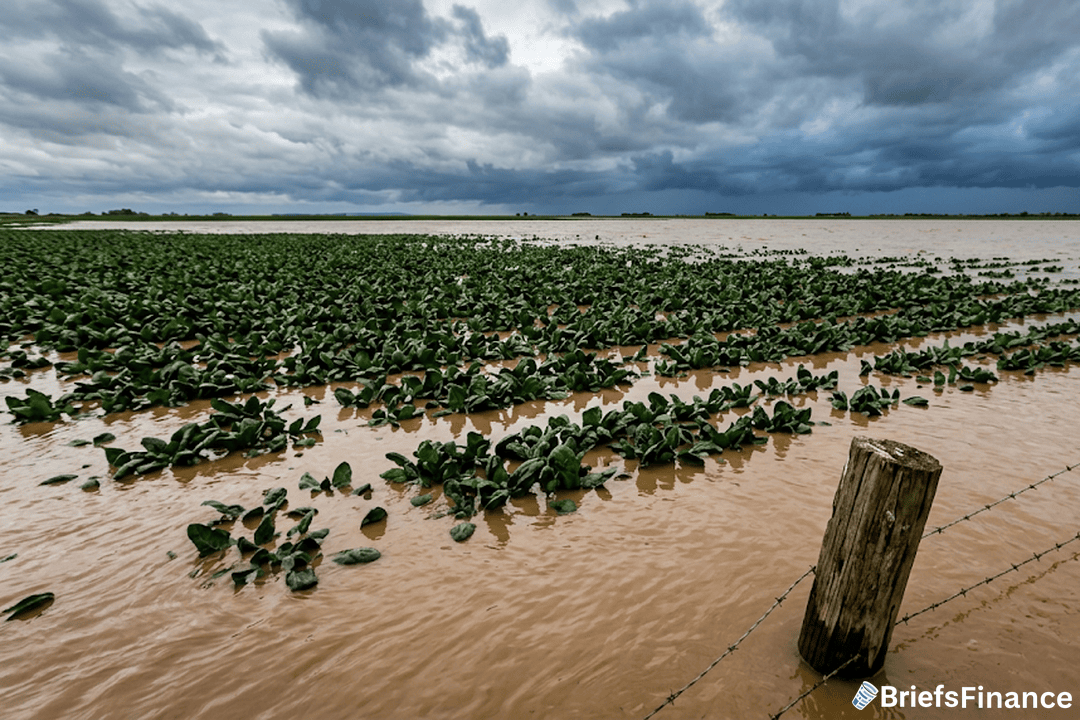
  • July flooding on the Nueces River forced evacuations and damaged 183 homes as water rose from about eight feet to 30 feet overnight.

The Spinach Capital Misses Its August Payment

Crystal City, Texas, has long called itself the "Spinach Capital of the World." It hosts a Spinach Festival every year, and a Popeye statue sits in front of City Hall.

Yet the city is having trouble paying its bills. The town fell behind on debt service payments that were due on August 1.

In a securities filing, city officials pointed to emergency spending caused by floods, lower-than-expected tax collections, and larger upkeep costs as the reasons for the missed payment. They intend to make a partial payment of $31,000 on August 15, allocated on a pro rata basis, with all overdue amounts scheduled to be repaid by November 1.

Bloomberg News did not receive an immediate comment from Crystal City about how much debt service was due on August 1 or what the flood had cost the city.

The Flood That Set Everything Back

The flood added to ongoing financial strains. The Nueces River sent a rush of water downstream, and on July 17 the flood forced evacuations and damaged 183 homes, according to The Texas Tribune. Water levels went from about eight feet to 30 feet in a single night.

Get the free Always Be Buying eBook and learn the simple system for building wealth on any income

Zavala County, which includes Crystal City, was among the counties in Texas that received Federal Emergency Management Agency approval for disaster relief after the flooding.

A Budget Already Under Stress

The flood arrived when the city was already financially stressed. The Crystal City Independent School District eliminated 72 jobs earlier in the year - about a quarter of its staff - as part of an effort to recover financially and stay solvent. That initiative was separate from the city budget, but both signal the strain on the community.

Crystal City's money problems are not new. The earlier school layoffs illustrate the area's economic hardship, and the July flooding made things worse. City officials now have to keep the budget balanced while helping residents whose homes were damaged. The missed August 1 payment reflects these deeper difficulties, and bondholders and residents will be watching whether the city can catch up by November.

In the city's August 12 filing, officials said they are thinking about changing property-tax and utility rates so the budget can be balanced and reserves can be built up. The rain is gone, but the financial damage is still being calculated.

What It Means for Investors

This context matters because the missed payment is not an isolated event. Crystal City has limited financial resources, a struggling school district, and now storm recovery costs. For bondholders, the key risk is whether the city can generate enough revenue to restore its reserves and make future payments on time.

For residents, the risk is that higher taxes or utility rates may be needed to cover the shortfall. The city's November deadline will signal whether its plan is on track. The missed payment has put a spotlight on the financial pressure facing small Texas towns after natural disasters.

Whether it can meet that deadline will be an early test of its recovery plan.

Download the free Always Be Buying eBook and start putting your money to work today
Disclosure

Recent News

1 2 3 53

Get Market Briefs delivered to your inbox every morning for free!

No fluff. No noise. No politics. Just finance news you can read in 5 minutes.

Blogs

June 29, 2026
Portfolio Diversification: Why Putting All Your Eggs in One Basket Destroys Wealth
  • Real diversification means spreading investments across all 11 economic sectors plus bonds, alternatives, and cash so no single bet can sink the portfolio.
  • Different sectors perform at different times, so a diversified portfolio captures upswings while smoothing the brutal drawdowns that wipe out concentrated bets.
  • Total market index funds offer the simplest path to diversification, and annual rebalancing is what keeps the structure working over time.
Read More
June 29, 2026
Non Taxable Income: What It Is and Why It Matters
  • Non taxable income is money you receive that you don't owe income tax on.
  • The tax code treats workers, investors, and business owners very differently, and investors often come out ahead.
  • Learning how income is taxed is a quiet superpower for keeping more of what you earn.
Read More
June 29, 2026
Semiconductor Stocks: A Simple Guide for Investors
  • Semiconductor stocks are companies that design and make computer chips, the brains inside nearly every modern device.
  • The AI boom has turned chips into one of the market's most important and most watched groups.
  • They offer big growth potential, but come with high valuations and a notoriously cyclical history.
Read More
June 25, 2026
How Stocks Work: A Simple Guide for Beginners
  • A stock is a slice of ownership in a company - buy one, and you own a piece of the business.
  • You make money two ways: the share price rising over time, and dividends paid to shareholders.
  • The simplest path for most beginners is buying into the whole market through a low-cost index fund.
Read More
June 25, 2026
Stop Loss vs Stop Limit: What's the Difference?
  • A stop loss order sells your stock once it hits a trigger price, prioritizing getting you out.
  • A stop limit order only sells within a price range you set, prioritizing price over a guaranteed exit.
  • The trade-off: a stop loss almost always executes; a stop limit might not if the price moves too fast.
Read More
June 25, 2026
Energy Stocks: A Simple Guide for Investors
  • Energy stocks are companies that produce and supply the power the world runs on, from oil and gas to newer sources.
  • They make up one of the 11 sectors of the market and tend to move with energy prices and big-picture shifts.
  • Like any sector, the key is diversification and understanding the forces driving demand.
Read More
June 18, 2026
What Is a Stop Loss Order? A Simple Guide
  • A stop loss order automatically sells a stock once it falls to a price you set.
  • It's a tool to cap losses or lock in gains without watching the market all day.
  • It works best for active strategies, and can backfire if used carelessly on long-term holdings.
Read More
June 18, 2026
Best S&P 500 Index Fund: How to Choose One
  • The best S&P 500 index fund for most investors is simply the cheapest, most established one that tracks the index well.
  • Funds like VOO, IVV, and SPY all hold the same 500 companies, so the biggest difference is the fee.
  • Pick one, automate your buys, and let time do the heavy lifting.
Read More
June 17, 2026
What Are Penny Stocks? Risks and Rewards Explained
  • Penny stocks are very low-priced shares of very small companies, often trading for just a few dollars or less.
  • They promise huge gains but carry huge risks: low liquidity, high failure rates, and wild price swings.
  • Most investors are better served by quality companies and funds than by chasing cheap shares.
Read More
June 17, 2026
Best Stocks for Beginners With Little Money
  • The best stocks for beginners with little money usually aren't individual stocks at all - they're low-cost index funds.
  • You can start with $100 or less and use small, regular investments to build wealth over time.
  • Focus on diversification and consistency, not on picking the next big winner.
Read More
1 2 3 24
Share via
Copy link











