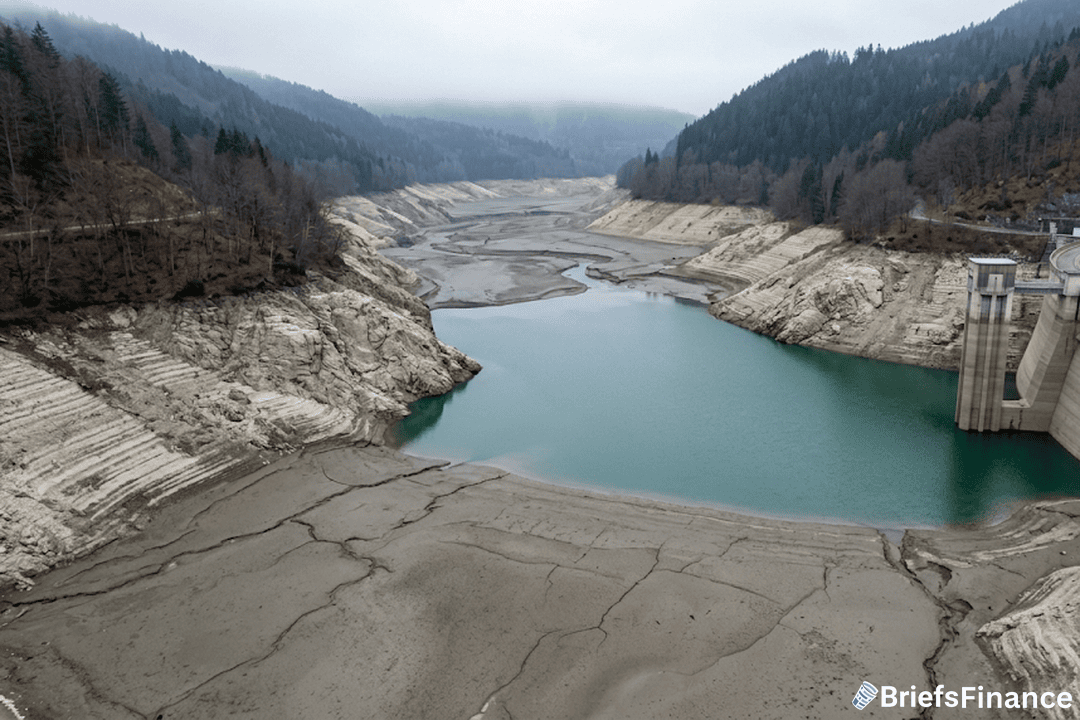
A hot, dry summer is about to become a cold, pricey winter problem.
Reservoir inventories in the NO2 area of southern Norway have fallen to a point not seen in over ten years. Parts of Sweden, France, and northern Italy are not much better off, with reservoirs running at their lowest since 2022, the year a weak hydro season helped make an energy crisis worse.
The worry now is that Europe is heading into the darker months with less water to burn, and electricity prices may feel the squeeze.
Why Low Water Levels Matter for the Grid
Hydropower is easy to take for granted because it is invisible.
But the most recent yearly figures show hydro produced above a tenth of all electricity generated in the EU. That makes it a major player in keeping the lights on.
Its real superpower is speed. A hydro plant can adjust its output within minutes, which makes it the perfect tool for offsetting the ups and downs of wind and solar generation. When the wind stops blowing or the sun goes behind a cloud, hydro is usually the first source that fills the gap.
That flexibility becomes even more valuable as some nuclear reactors shut down due to environmental restrictions. Fewer nuclear plants online means the grid leans harder on whatever else is available.
Europe's power system has become more exposed to weather swings because nuclear capacity is shrinking and gas markets remain sensitive to global supply shocks. When one part of the system is weak, the rest has to compensate, and that often means fossil fuels.
Get the free Always Be Buying eBook and learn the simple system for building wealth on any income
Italy, France, and Switzerland all have hydro levels at multiyear lows right now, according to Florence Schmit, an energy analyst at Rabobank. That points to weaker generation from those countries during the winter months. Austria and Italy, which rely more heavily on hydro, already carry higher power prices than Germany, where hydro plays a smaller role.
A Warning From Norway and a Look at Gas
Norway's energy authority is paying close attention.
On Wednesday, the Norwegian Water Resources and Energy Directorate, known as NVE, warned about winter supply security. The agency said southern Norway's filling rates are low after a dry July.
Kjetil Lund, the agency's director, put the challenge plainly. "We do not know now whether the autumn will be wet or dry," he said. "We must have enough water left to cover the power needs for the winter."
That uncertainty is the whole game. If autumn brings heavy rain, reservoirs can refill and the problem fades. If it stays dry, Europe will need a backup plan, and that backup plan runs on fossil fuels.
Schmit framed it as a delayed problem. "Today's drought problems are tomorrow's gas problems," she said.
Here is why that matters. When hydro and nuclear are limited, power plants start burning more natural gas to keep up. More demand for gas pushes prices higher. Gas prices in Europe are already elevated because of disrupted LNG supplies tied to the Strait of Hormuz closure, even if the pain is nowhere near the levels seen right after Russia's invasion of Ukraine.
Schmit expects that pressure to build. "There will be a lot of gas demand from the power sector in the coming months if hydro and nuclear are curtailed," she said.
What This Means for Your Wallet
The practical takeaway for households is not hard to spot.
If Europe has to burn more gas this winter, the extra cost tends to show up on monthly energy bills. Power prices and gas prices are linked. When one climbs, the other usually follows.
There is also the broader angle. Higher energy costs ripple through the economy, pushing up the price of everything that takes energy to make, ship, or store. That includes groceries, clothes, and basically anything from a factory.
None of this is guaranteed. A wet autumn could ease the pressure quickly, and nations have been building up their gas reserves to handle exactly this kind of situation. But the water levels are the part nobody can control, and right now they are not looking good.
The smart money is on watching the weather. Every week with no real rain brings winter one step closer, and the margin for error gets a little thinner.
Download the free Always Be Buying eBook and start putting your money to work today