First Public Quarter Beats the Numbers
SpaceX published its first-ever quarterly report as a public company on Tuesday, Aug. 4, 2026. It beat the numbers Wall Street had been expecting.
Revenue hit $7.8 billion, easily clearing the $6.81 billion that analysts had penciled in and climbing from $4.7 billion in the first quarter. That is a meaningful jump in one quarter.
The company also posted adjusted profit, known as EBITDA, of $3.5 billion, well above the $2.0 billion forecast.
For a company delivering numbers that strong, the pullback shows that investors are looking past the scoreboard to the cost of the game.
The High Cost of the AI Bet
SpaceX's AI segment posted a loss smaller than the $2.39 billion that analysts projected.
The math that worries investors is the gap between those losses and the sheer size of the checks being written. Overall spending on buildings, equipment, and technology, known in finance as capex, came to $18.37 billion, just below the $18.58 billion forecast.
Get the free Always Be Buying eBook and learn the simple system for building wealth on any income
Wall Street was watching that number closely, since heavy capital spending is where big AI bets usually get tested. The concern, shared across capital-hungry AI companies, is that giant infrastructure outlays will not earn enough relative to the cash they require.
SpaceX is not slowing down. The company said Tuesday it is collaborating with Nvidia to build the Starmind AI-1 payload, which would put data-center-equivalent computing in orbit.
Using Nvidia's Rubin GPU and Vera CPU chips, the project pushes the maximum computing power on SpaceX's satellites to 250 kilowatts. Musk also said on the earnings call that Nvidia will be SpaceX's only AI chip supplier.
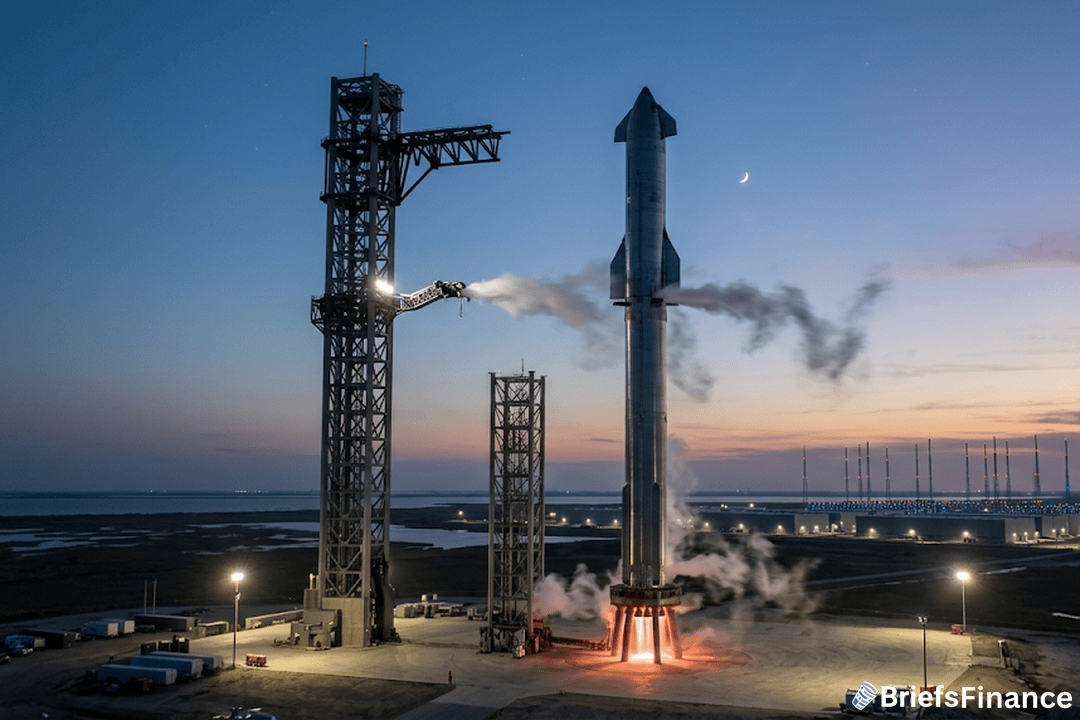
There is also hardware news closer to home. After a weather delay hit the 13th Starship test launch at the Texas Starbase facility on July 23, 2026, Musk said the next step is trying to catch the ship with the launch tower on Flight 14.
A Lockup Looms Over the Stock
The stock also has a supply problem hitting this week. When a company goes public, early insiders usually agree to wait a set period before selling, and that waiting period, called a lockup, ends Aug. 6.
Extra supply like that can put pressure on a stock, even when the business is performing well. Epistrophy Capital's Cory Johnson said in a client note: "The lockup frees hundreds of millions of insider shares, roughly triple the current tradable float."
The timing makes the risk harder to ignore. The first public report lands Aug. 4, and two days later, insiders become eligible to sell.
What It Means for Your Portfolio
SpaceX is now two stories happening at once. The first is a real, growing business, with Starlink ending the quarter at more than 12 million subscribers and posting adjusted EBITDA of $2.60 billion, beating the $2.41 billion estimate.
The second story is a massive bet on the future, one that needs constant cash to fuel it. Musk said on the call that "it is not out of the question that Starlink will one day deliver the majority of the world's internet."
Musk also has a possible SpaceX-Tesla merger on his mind. A Wall Street Journal report from Friday said he continues to push for it, and executives are working out what to do with Tesla's China operations if it happens. SpaceX's close work with the U.S. government and military could make China uneasy about the whole idea.
For investors, the next few quarters will be a live test of how much promise is worth. The earnings are real, the bills are real, and the market now gets to watch whether the AI spending starts to pay off. SpaceX has to show that its huge bills can turn into huge profits, not just huge promises.
Download the free Always Be Buying eBook and start putting your money to work today