Free NewsletterPro Login
S&P 500 6,287 +0.42%
DOW 44,521 -0.18%
NASDAQ 21,103 +0.71%
S&P 500 +12.4%
Briefs Finance Fund +24.8%
JOIN THE FUND →

Trump Is Rewriting Steel and Aluminum Tariffs. Many Importers Will Pay More, Not Less.

Published Apr 2, 2026
[tts_player]
Share:
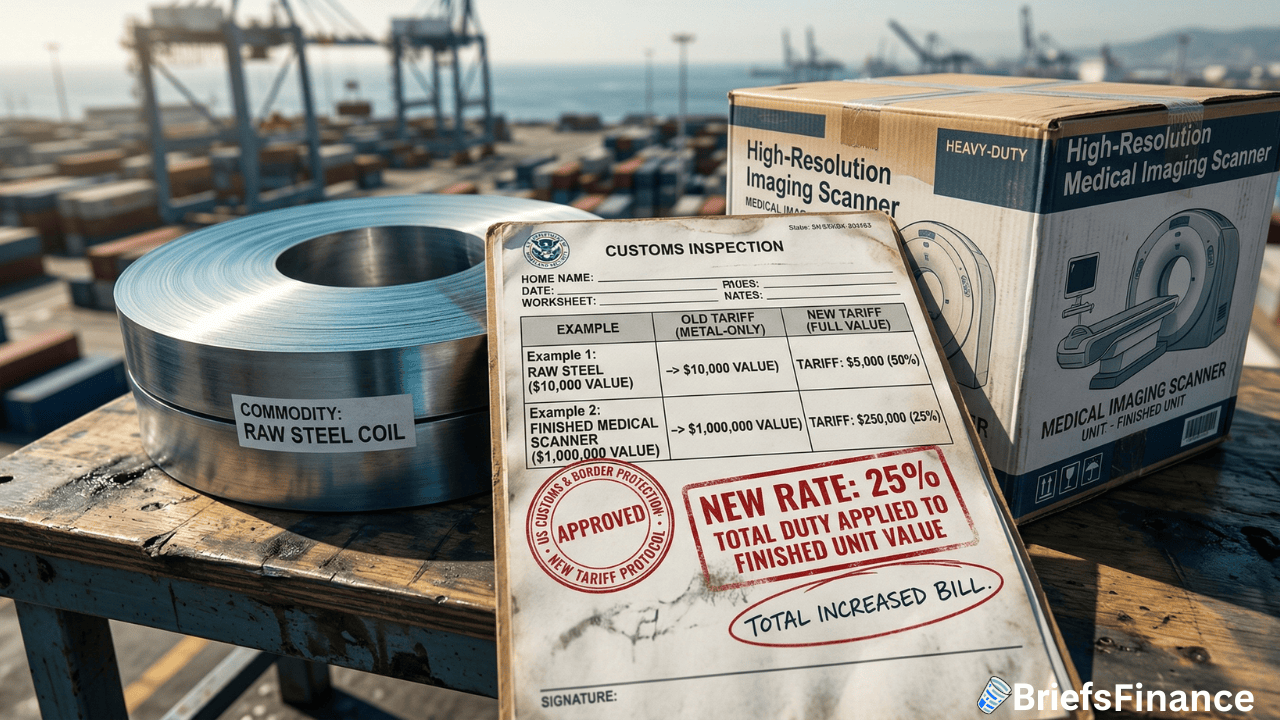
A customs inspection sheet showing a 25% steel tariff rate sits on a table with a raw steel coil and a medical imaging scanner at a shipping port, highlighting challenges faced by importers amid containers in the background.
Summary:
  • The White House is set to cut the tariff rate on finished goods containing steel and aluminum from 50% to 25% - but the tax will now cover the entire product value, not just the metal inside it.
  • Raw steel and aluminum keep their 50% rate, while products with less than 15% metal content could owe nothing at all.
  • Major aluminum stocks fell in after-hours trading after news of the overhaul broke.

A lower tariff rate sounds like relief for importers. For most of them, it won't be.

The White House is getting ready to rewrite the rules on how finished goods made with foreign steel and aluminum get taxed. An announcement could come within days.

The Math That Matters

Right now, a finished product containing imported steel or aluminum gets hit with a 50% duty - but only on the value of the metal itself.

So if you import a $100 piece of equipment with $20 worth of steel inside it, you pay 50% of that $20. That's $10.

Under the new system, that same product would face a 25% tariff on its full $100 price tag. That's $25 - more than double what the old rate cost.

The rate goes down. The bill goes up.

Why the White House Is Doing This

The existing setup has created major problems for companies trying to stay compliant. Pinpointing exactly how much metal sits inside a finished product - anything from car parts to medical equipment - has been a costly guessing game for importers and customs officials.

One case that surfaced in internal discussions: dental floss. There's a tiny metal blade for cutting, but the rest of the product has no steel or aluminum at all.

Trying to calculate a metal-based tariff on something like that was a dead end.

The fix is straightforward - tax the whole product instead of hunting for the metal inside it. Products where steel and aluminum make up less than 15% of the total would owe nothing under the new setup.

Jon Toomey, who leads the Coalition for a Prosperous America - a group representing domestic steel and aluminum producers - said the overhaul should make these tariffs work the way they were designed: backing American manufacturing and its workforce.

What Investors Should Watch

This isn't just a trade policy tweak. It's a revenue play.

The federal government has been pulling in less tariff money since the Supreme Court knocked down several of Trump's country-specific trade penalties earlier this year. Broadening the base for steel and aluminum duties could help plug part of that hole.

Wall Street picked up on the shift fast. Alcoa and Century Aluminum both slid more than 1.5% after the closing bell, and Commercial Metals dropped roughly 1.4%.

Commodity-grade steel and aluminum still carry their 50% rate. Finished goods get a lower percentage on a much bigger number.

The bottom line lower rates = higher rates.
Disclosure

Recent News

1 2 3 39

Get Market Briefs delivered to your inbox every morning for free!

No fluff. No noise. No politics. Just finance news you can read in 5 minutes.

Blogs

June 29, 2026
Portfolio Diversification: Why Putting All Your Eggs in One Basket Destroys Wealth
  • Real diversification means spreading investments across all 11 economic sectors plus bonds, alternatives, and cash so no single bet can sink the portfolio.
  • Different sectors perform at different times, so a diversified portfolio captures upswings while smoothing the brutal drawdowns that wipe out concentrated bets.
  • Total market index funds offer the simplest path to diversification, and annual rebalancing is what keeps the structure working over time.
Read More
June 29, 2026
Non Taxable Income: What It Is and Why It Matters
  • Non taxable income is money you receive that you don't owe income tax on.
  • The tax code treats workers, investors, and business owners very differently, and investors often come out ahead.
  • Learning how income is taxed is a quiet superpower for keeping more of what you earn.
Read More
June 29, 2026
Semiconductor Stocks: A Simple Guide for Investors
  • Semiconductor stocks are companies that design and make computer chips, the brains inside nearly every modern device.
  • The AI boom has turned chips into one of the market's most important and most watched groups.
  • They offer big growth potential, but come with high valuations and a notoriously cyclical history.
Read More
June 25, 2026
How Stocks Work: A Simple Guide for Beginners
  • A stock is a slice of ownership in a company - buy one, and you own a piece of the business.
  • You make money two ways: the share price rising over time, and dividends paid to shareholders.
  • The simplest path for most beginners is buying into the whole market through a low-cost index fund.
Read More
June 25, 2026
Stop Loss vs Stop Limit: What's the Difference?
  • A stop loss order sells your stock once it hits a trigger price, prioritizing getting you out.
  • A stop limit order only sells within a price range you set, prioritizing price over a guaranteed exit.
  • The trade-off: a stop loss almost always executes; a stop limit might not if the price moves too fast.
Read More
June 25, 2026
Energy Stocks: A Simple Guide for Investors
  • Energy stocks are companies that produce and supply the power the world runs on, from oil and gas to newer sources.
  • They make up one of the 11 sectors of the market and tend to move with energy prices and big-picture shifts.
  • Like any sector, the key is diversification and understanding the forces driving demand.
Read More
June 18, 2026
What Is a Stop Loss Order? A Simple Guide
  • A stop loss order automatically sells a stock once it falls to a price you set.
  • It's a tool to cap losses or lock in gains without watching the market all day.
  • It works best for active strategies, and can backfire if used carelessly on long-term holdings.
Read More
June 18, 2026
Best S&P 500 Index Fund: How to Choose One
  • The best S&P 500 index fund for most investors is simply the cheapest, most established one that tracks the index well.
  • Funds like VOO, IVV, and SPY all hold the same 500 companies, so the biggest difference is the fee.
  • Pick one, automate your buys, and let time do the heavy lifting.
Read More
June 17, 2026
What Are Penny Stocks? Risks and Rewards Explained
  • Penny stocks are very low-priced shares of very small companies, often trading for just a few dollars or less.
  • They promise huge gains but carry huge risks: low liquidity, high failure rates, and wild price swings.
  • Most investors are better served by quality companies and funds than by chasing cheap shares.
Read More
June 17, 2026
Best Stocks for Beginners With Little Money
  • The best stocks for beginners with little money usually aren't individual stocks at all - they're low-cost index funds.
  • You can start with $100 or less and use small, regular investments to build wealth over time.
  • Focus on diversification and consistency, not on picking the next big winner.
Read More
1 2 3 24
Share via
Copy link











