Free NewsletterPro Login
S&P 500 6,287 +0.42%
DOW 44,521 -0.18%
NASDAQ 21,103 +0.71%
S&P 500 +12.4%
Briefs Finance Fund +24.8%
JOIN THE FUND →

SpaceX Shares Sink 23% After Starship Engine Issue

Published Jul 17, 2026
[tts_player]
Share:
Summary:
  • SpaceX shares have dropped roughly 23% since being added to the Nasdaq-100 index.
  • A scheduled Starship V3 test flight was aborted Thursday due to defective Raptor engines.
  • The company plans a new launch attempt early next week after engine replacements.

A Bad Week Gets Worse

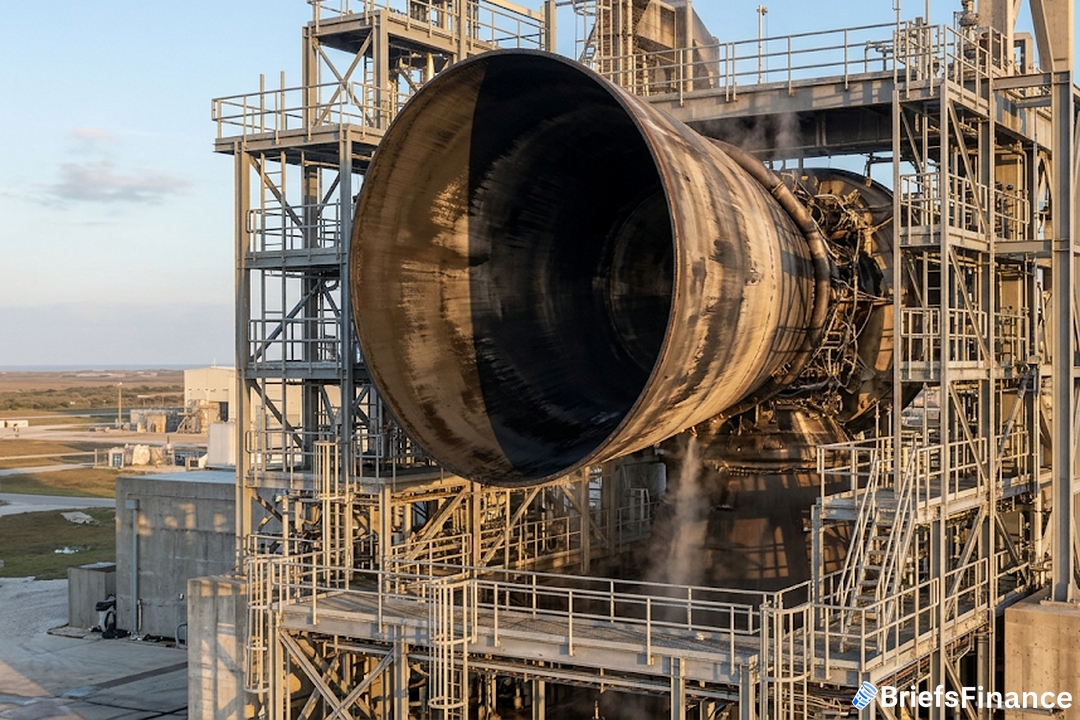
On Thursday, a scheduled test flight of the Starship V3 was called off just before launch. Elon Musk posted on X that "some of the engines didn't start, triggering an automatic launch abort." The company started offloading propellant and announced plans to try again in a few days.

On Friday, July 17, SpaceX stock fell 5.43% in a single day. That marked six straight losing sessions for the aerospace company, which trades under the ticker SPCX.

The steep sell-off highlights the high stakes surrounding SpaceX's Starship program, which is central to its long-term revenue goals. Since its record-breaking IPO and rapid inclusion in the Nasdaq-100, the stock has experienced heightened volatility, and the aborted launch has reinforced investor caution.

Get the market news that matters in a five-minute read with Market Briefs, our free daily newsletter

SpaceX's reliance on Starship for its future ambitions cannot be overstated. The massive rocket is designed to carry payloads to deep space, including NASA's Artemis missions and the company's Starlink satellite deployment plans. With the IPO raising a record $85.7 billion, investors have closely tied the stock's valuation to successful Starship milestones.

The recent aborted launch, combined with previous engine issues, has amplified scrutiny on the Raptor engine's reliability. Markets now await the next test flight, which will serve as a critical indicator of the company's ability to deliver on its ambitious timetable.

This is not the first time the Starship program has hit a snag. In a May test, the Starship's upper stage was sent on a path over the Indian Ocean, and the Super Heavy booster nearly missed its target splashdown in the Gulf of Mexico because only 28 of its 33 Raptor engines relit successfully, with five failing. The FAA launched a probe into the incident and by Monday had given the company permission to resume test flights.

A Record-Setting IPO Under a Microscope

The company raised a record $85.7 billion in its initial public offering back in June 2026, with shares priced at $135 each. Just 15 trading days after its IPO, SpaceX was fast-tracked onto the Nasdaq-100 index.

The Thursday launch window was scheduled as SpaceX's inaugural Starship V3 test flight following its massive IPO.

The next launch attempt is expected early next week.

Investor confidence in SpaceX remains closely tied to successful Starship milestones because the vehicle is designed for deep-space missions and satellite deployment contracts that underpin future revenue. Any delay or failure in the testing schedule can trigger sharp sell-offs, as seen this week. The aborted launch also rekindles concerns about the reliability of the Raptor engine, a critical component that has experienced issues in previous test flights. With the company now replacing two faulty engines, markets will monitor the upcoming attempt for signs of progress.

Join Market Briefs, our free daily newsletter, for a quick daily rundown of the markets
Disclosure

Recent News

1 2 3 38

Get Market Briefs delivered to your inbox every morning for free!

No fluff. No noise. No politics. Just finance news you can read in 5 minutes.

Blogs

June 29, 2026
Portfolio Diversification: Why Putting All Your Eggs in One Basket Destroys Wealth
  • Real diversification means spreading investments across all 11 economic sectors plus bonds, alternatives, and cash so no single bet can sink the portfolio.
  • Different sectors perform at different times, so a diversified portfolio captures upswings while smoothing the brutal drawdowns that wipe out concentrated bets.
  • Total market index funds offer the simplest path to diversification, and annual rebalancing is what keeps the structure working over time.
Read More
June 29, 2026
Non Taxable Income: What It Is and Why It Matters
  • Non taxable income is money you receive that you don't owe income tax on.
  • The tax code treats workers, investors, and business owners very differently, and investors often come out ahead.
  • Learning how income is taxed is a quiet superpower for keeping more of what you earn.
Read More
June 29, 2026
Semiconductor Stocks: A Simple Guide for Investors
  • Semiconductor stocks are companies that design and make computer chips, the brains inside nearly every modern device.
  • The AI boom has turned chips into one of the market's most important and most watched groups.
  • They offer big growth potential, but come with high valuations and a notoriously cyclical history.
Read More
June 25, 2026
How Stocks Work: A Simple Guide for Beginners
  • A stock is a slice of ownership in a company - buy one, and you own a piece of the business.
  • You make money two ways: the share price rising over time, and dividends paid to shareholders.
  • The simplest path for most beginners is buying into the whole market through a low-cost index fund.
Read More
June 25, 2026
Stop Loss vs Stop Limit: What's the Difference?
  • A stop loss order sells your stock once it hits a trigger price, prioritizing getting you out.
  • A stop limit order only sells within a price range you set, prioritizing price over a guaranteed exit.
  • The trade-off: a stop loss almost always executes; a stop limit might not if the price moves too fast.
Read More
June 25, 2026
Energy Stocks: A Simple Guide for Investors
  • Energy stocks are companies that produce and supply the power the world runs on, from oil and gas to newer sources.
  • They make up one of the 11 sectors of the market and tend to move with energy prices and big-picture shifts.
  • Like any sector, the key is diversification and understanding the forces driving demand.
Read More
June 18, 2026
What Is a Stop Loss Order? A Simple Guide
  • A stop loss order automatically sells a stock once it falls to a price you set.
  • It's a tool to cap losses or lock in gains without watching the market all day.
  • It works best for active strategies, and can backfire if used carelessly on long-term holdings.
Read More
June 18, 2026
Best S&P 500 Index Fund: How to Choose One
  • The best S&P 500 index fund for most investors is simply the cheapest, most established one that tracks the index well.
  • Funds like VOO, IVV, and SPY all hold the same 500 companies, so the biggest difference is the fee.
  • Pick one, automate your buys, and let time do the heavy lifting.
Read More
June 17, 2026
What Are Penny Stocks? Risks and Rewards Explained
  • Penny stocks are very low-priced shares of very small companies, often trading for just a few dollars or less.
  • They promise huge gains but carry huge risks: low liquidity, high failure rates, and wild price swings.
  • Most investors are better served by quality companies and funds than by chasing cheap shares.
Read More
June 17, 2026
Best Stocks for Beginners With Little Money
  • The best stocks for beginners with little money usually aren't individual stocks at all - they're low-cost index funds.
  • You can start with $100 or less and use small, regular investments to build wealth over time.
  • Focus on diversification and consistency, not on picking the next big winner.
Read More
1 2 3 24
Share via
Copy link











