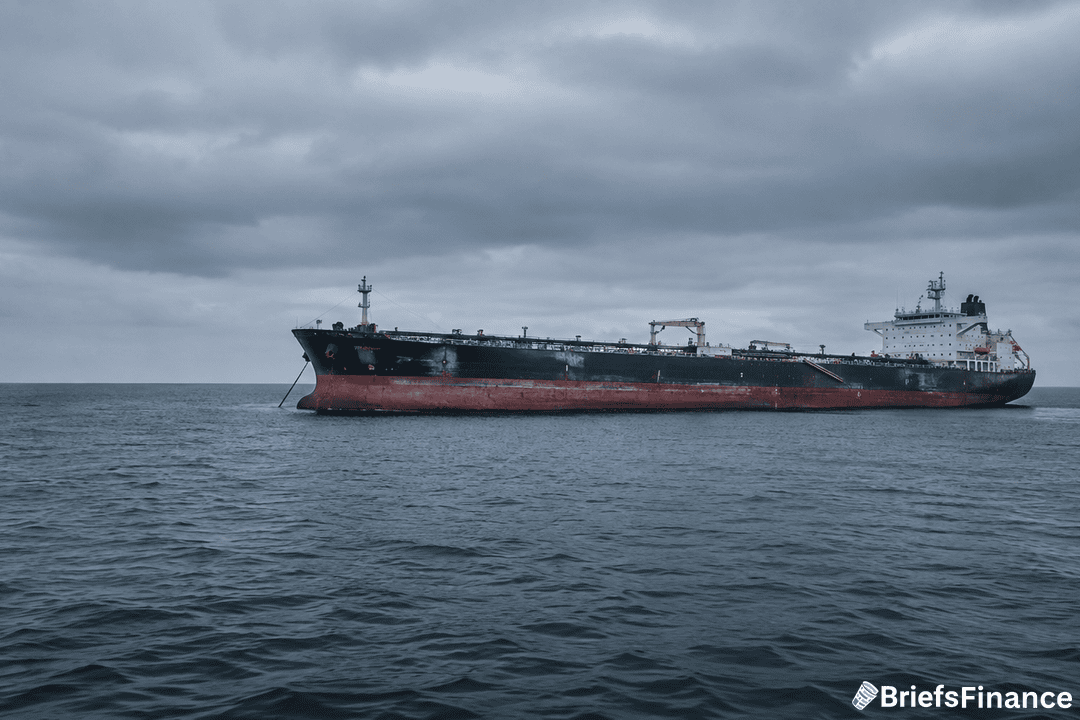
Where the Oil Stopped
Russia ships most of its crude by sea, and those routes have become a target. During the first week of August, Ukrainian strikes damaged five Russian refineries, and they hit two additional ones the next week. That matters because refineries turn crude into fuel, and when they get knocked offline, the crude that would have fed them has nowhere to go.
That crude is not piling up in storage. Instead, it is being pushed toward export terminals, but those ports are struggling too. The Baltic and Black Sea ports are running well below capacity.
Attacks on ships cut loading near Novorossiysk to about half of its peak level, even after Ukraine agreed to avoid some non-Russian tankers and Black Sea infrastructure. Turkey briefly paused transits through the Turkish Straits for vessels heading to Russian and Ukrainian ports. Ust-Luga, another major export hub, is also running below normal, and the reason is not clear.
With drone attacks paused briefly, refiners were able to run more crude, reducing the volume available for export.
What the Numbers Show
That week, 32 vessels took on Russia's crude, moving 22.78 million barrels in total, compared with the prior week's revised figure of 24.49 million barrels across 35 ships. That works out to a daily average of 3.25 million barrels per day, down from 3.5 million.
Get the free Always Be Buying eBook and learn the simple system for building wealth on any income
But this is not a collapse in Russian production. Year-to-date flows still average 3.62 million barrels per day, which is up 280,000 from last year's average and above any annual average since the February 2022 invasion. The country is still exporting a lot of oil, just less of it right now.
Urals crude from the Baltic rose about $4.30 to $63.80 per barrel. Black Sea Urals climbed $4.10 to $62.70. ESPO crude, which goes to Asia, rose $1.40 to $69.63. And the price of delivered crude in India jumped $6.10 to $83.33.
Even with fewer barrels moving, the four-week average gross export value stayed nearly flat at $1.7 billion per week, up just $10 million from the prior period. Higher prices are making up for lower volumes. The weekly export value, however, fell about $170 million to $1.49 billion in the week to Aug. 9.
What It Means for Your Money
Russia's invasion in February 2022 is the backdrop for those flows. The country's heavy reliance on seaborne routes means that attacks on ports and refineries create delays that show up in global benchmarks.
Some of the slowdown is already baked into the numbers. Crude at sea fell to about 107 million barrels, partly because deliveries to India stayed strong at roughly 2.4 million barrels per day, near June's record. But there are bottlenecks forming.
Four Urals cargoes are waiting at anchor off Egypt's Mersa el-Hamra, with offloading delays stretched to roughly six weeks, versus less than seven days early in the year. About 30 cargoes of Arctic crude have stalled in the Riau archipelago this year, often getting transferred to other ships with hidden positions. Sokol, Sakhalin Blend, and ESPO cargoes are also facing weeks of delays near Pacific ports.
Russian exports are down but not out. The attacks are creating friction, delays, and rerouting, and that friction has a price. Oil is a commodity, and commodities respond to supply hiccups.
When a major exporter ships less, the market feels it, and your portfolio can feel it too, whether you own energy stocks, hold funds with oil exposure, or just pay for gas. Meanwhile, the rerouting of cargoes around Africa and longer waiting times at transshipment hubs add significant costs that eventually show up in global price benchmarks.
Download the free Always Be Buying eBook and start putting your money to work today