Free NewsletterPro Login
S&P 500 6,287 +0.42%
DOW 44,521 -0.18%
NASDAQ 21,103 +0.71%
S&P 500 +12.4%
Briefs Finance Fund +24.8%
JOIN THE FUND →

India Pours Billions into Smartphone Production to Challenge China's Lead

Published Jul 15, 2026
[tts_player]
Share:
Summary:
  • India is pouring billions into smartphone manufacturing to challenge China's lead.
  • It handles about 18% of global production versus China's 63%.
  • A new incentive scheme offers up to 5% on eligible sales plus component bonuses.

What India Is Doing

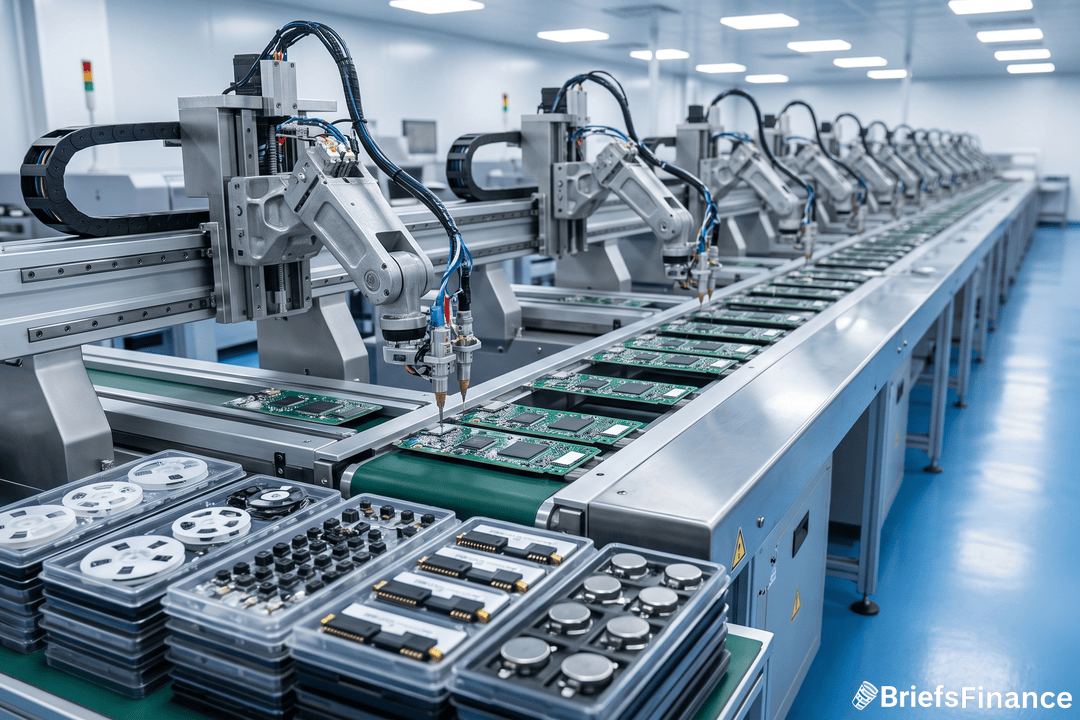
India wants to become a bigger part of the world's phone manufacturing. It already handles about 18% of global smartphone production, but China still dominates with 63%. That gap is exactly what the government is trying to close.

The new Mobile Phone Manufacturing Scheme is the centerpiece. It offers cash incentives of 2.25% to 5% on eligible sales, with an extra 1.5% for companies that source key components and sub-assemblies inside India.

Indian IT Minister Ashwini Vaishnaw announced the program alongside a bigger commitment to semiconductors. The government is pouring an additional ₹1.28 trillion (around $13.3 billion) into chip manufacturing. This adds to a previously established $10 billion chip incentive program that started in 2021.

This latest push comes as global electronics firms seek alternatives to China, driven by trade tensions and a desire for more resilient supply chains. India has already run production-linked incentive schemes for electronics, but the new mobile program explicitly aims to nurture a domestic supply chain rather than just final assembly.

Get the market news that matters in a five-minute read with Market Briefs, our free daily newsletter

Why It Matters

Right now, India is great at putting phones together. Apple has shifted a quarter of its iPhone production there, and companies like Samsung, Xiaomi, Oppo, and Vivo all have assembly plants. But India remains reliant on imported components.

Research firm IDC associate vice president Navkendar Singh noted that the new program represents a move away from simply assembling more devices toward deeper R&D and local value creation.

The timing is not an accident. Counterpoint Research research director Tarun Pathak commented that phone brands are striving to reduce costs on parts. The depreciation of the Indian rupee makes imported components more expensive, thereby incentivizing local procurement.

Who the Winners Are

Apple is the most obvious beneficiary. It already has a deep relationship with Indian contract manufacturers Foxconn and Tata Group. Singh put it bluntly: "Apple stands to benefit directly."

Samsung also manufactures phones in India and can tap the incentives. Among Chinese brands, Vivo recently got clearance for a joint venture with Indian electronics maker Dixon Technologies.

For the broader economy, the government anticipates that the phone scheme will generate roughly 60,000 direct employment opportunities over five years and drive total mobile-phone production worth about ₹39 trillion (around $405 billion).

Pankaj Mohindroo, who leads the India Cellular and Electronics Association, argued that India ought to aim for 35% to 40% of global mobile phone production.

India's concurrent investments in both mobile phones and semiconductors demonstrate its intent to create a comprehensive electronics manufacturing ecosystem like China's. India's achievements in iPhone assembly have demonstrated its ability to secure a larger share of worldwide manufacturing. The true challenge lies in whether the necessary suppliers, technology, and high-value production will follow.

Join Market Briefs, our free daily newsletter, for a quick daily rundown of the markets
Disclosure

Recent News

1 2 3 36

Get Market Briefs delivered to your inbox every morning for free!

No fluff. No noise. No politics. Just finance news you can read in 5 minutes.

Blogs

June 29, 2026
Portfolio Diversification: Why Putting All Your Eggs in One Basket Destroys Wealth
  • Real diversification means spreading investments across all 11 economic sectors plus bonds, alternatives, and cash so no single bet can sink the portfolio.
  • Different sectors perform at different times, so a diversified portfolio captures upswings while smoothing the brutal drawdowns that wipe out concentrated bets.
  • Total market index funds offer the simplest path to diversification, and annual rebalancing is what keeps the structure working over time.
Read More
June 29, 2026
Non Taxable Income: What It Is and Why It Matters
  • Non taxable income is money you receive that you don't owe income tax on.
  • The tax code treats workers, investors, and business owners very differently, and investors often come out ahead.
  • Learning how income is taxed is a quiet superpower for keeping more of what you earn.
Read More
June 29, 2026
Semiconductor Stocks: A Simple Guide for Investors
  • Semiconductor stocks are companies that design and make computer chips, the brains inside nearly every modern device.
  • The AI boom has turned chips into one of the market's most important and most watched groups.
  • They offer big growth potential, but come with high valuations and a notoriously cyclical history.
Read More
June 25, 2026
How Stocks Work: A Simple Guide for Beginners
  • A stock is a slice of ownership in a company - buy one, and you own a piece of the business.
  • You make money two ways: the share price rising over time, and dividends paid to shareholders.
  • The simplest path for most beginners is buying into the whole market through a low-cost index fund.
Read More
June 25, 2026
Stop Loss vs Stop Limit: What's the Difference?
  • A stop loss order sells your stock once it hits a trigger price, prioritizing getting you out.
  • A stop limit order only sells within a price range you set, prioritizing price over a guaranteed exit.
  • The trade-off: a stop loss almost always executes; a stop limit might not if the price moves too fast.
Read More
June 25, 2026
Energy Stocks: A Simple Guide for Investors
  • Energy stocks are companies that produce and supply the power the world runs on, from oil and gas to newer sources.
  • They make up one of the 11 sectors of the market and tend to move with energy prices and big-picture shifts.
  • Like any sector, the key is diversification and understanding the forces driving demand.
Read More
June 18, 2026
What Is a Stop Loss Order? A Simple Guide
  • A stop loss order automatically sells a stock once it falls to a price you set.
  • It's a tool to cap losses or lock in gains without watching the market all day.
  • It works best for active strategies, and can backfire if used carelessly on long-term holdings.
Read More
June 18, 2026
Best S&P 500 Index Fund: How to Choose One
  • The best S&P 500 index fund for most investors is simply the cheapest, most established one that tracks the index well.
  • Funds like VOO, IVV, and SPY all hold the same 500 companies, so the biggest difference is the fee.
  • Pick one, automate your buys, and let time do the heavy lifting.
Read More
June 17, 2026
What Are Penny Stocks? Risks and Rewards Explained
  • Penny stocks are very low-priced shares of very small companies, often trading for just a few dollars or less.
  • They promise huge gains but carry huge risks: low liquidity, high failure rates, and wild price swings.
  • Most investors are better served by quality companies and funds than by chasing cheap shares.
Read More
June 17, 2026
Best Stocks for Beginners With Little Money
  • The best stocks for beginners with little money usually aren't individual stocks at all - they're low-cost index funds.
  • You can start with $100 or less and use small, regular investments to build wealth over time.
  • Focus on diversification and consistency, not on picking the next big winner.
Read More
1 2 3 24
Share via
Copy link











