Free NewsletterPro Login
S&P 500 6,287 +0.42%
DOW 44,521 -0.18%
NASDAQ 21,103 +0.71%
S&P 500 +12.4%
Briefs Finance Fund +24.8%
JOIN THE FUND →

Farmers Return to Fertilizer Purchases After Price Decline

Published Jul 17, 2026
[tts_player]
Share:
Summary:
  • Farmers paused fertilizer buying after US-Iran tensions sent prices sharply higher.
  • Many had already stocked up before the conflict, giving them room to wait.
  • With prices easing, growers are returning to the market, a shift watched closely by commodities traders.

Why Farmers Put the Brakes On

When the US‑Iran conflict flared up, fertilizer prices shot higher almost overnight. That gave farmers a strong reason to pause.

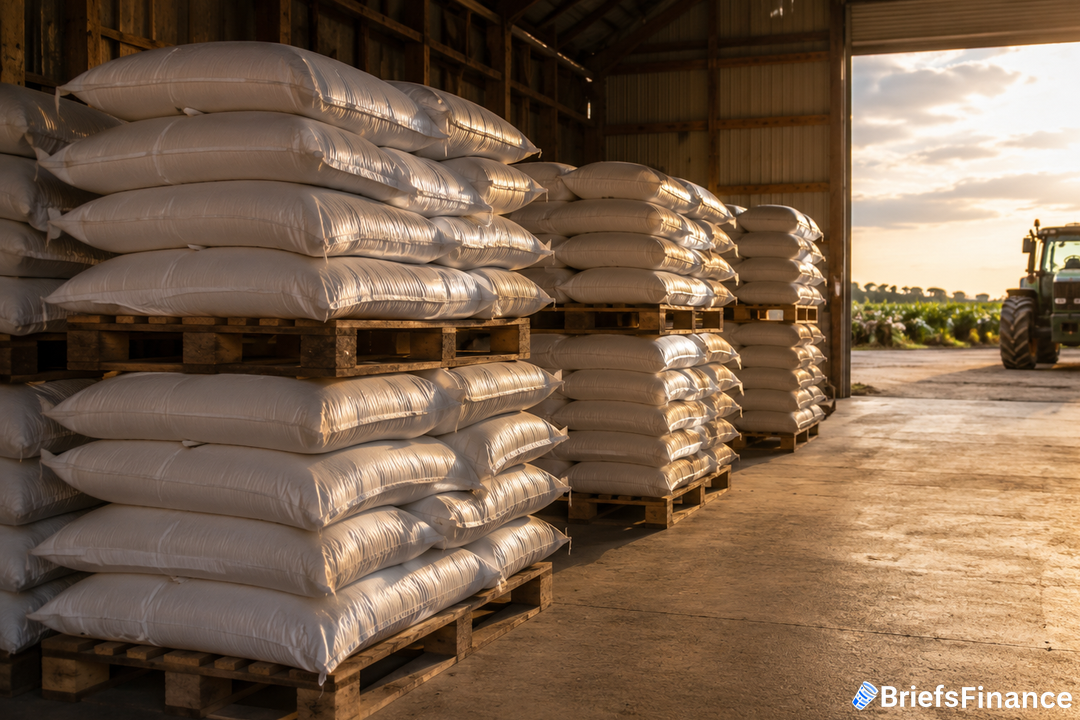
They had already stocked up on fertilizer before the tensions started. So instead of buying more at expensive prices, they decided to wait. "If farmers don't need fertilizer in the field immediately, they wait," said Svein Tore Holsether, chief executive at Yara International ASA, a major fertilizer producer.

Fertilizer prices are closely watched by global commodities markets because they directly influence crop yields and food costs. Yara, headquartered in Norway, is one of the world's largest fertilizer companies and often acts as an industry bellwether.

According to Holsether, the main cause of low European imports was farmers' pre-conflict stockpiling. With no urgent need, farmers held off through the end of the Northern Hemisphere growing season. By mid‑June, urea prices had dropped back to pre‑conflict levels.

Get the market news that matters in a five-minute read with Market Briefs, our free daily newsletter

Still, farmers stayed on the sidelines. "As prices started falling, they waited until they stabilized and until they were closer to actually needing the product," Holsether said.

On top of the price shock, shipping disruptions in the Strait of Hormuz made it harder to load cargoes and move product from the Persian Gulf. Major producers such as Saudi Basic Industries Corp, Fertiglobe Plc, and Qatar Fertiliser Co. operate in that area, meaning shipping disruptions there affect worldwide fertilizer availability.

The Rebound Has Begun

Now the waiting game is ending. The Southern Hemisphere growing season is kicking off, especially in Brazil and Argentina, and farmers need fertilizer again. Holsether put it plainly: "There's a volume and price rebound right now."

The numbers back that up. European nitrogen imports were at historically low levels.

The growing season in the Southern Hemisphere, particularly in major agricultural exporters like Brazil and Argentina, significantly influences global fertilizer demand. As farmers in these regions prepare for planting, their purchasing decisions can shift global prices. Yara's CEO indicated that the company has observed a clear uptick in orders, signaling that the pause has ended.

The Strait of Hormuz Factor

"The next test is when and how do vessels come back into the Strait of Hormuz," Holsether said. That narrow waterway is a chokepoint for Persian Gulf fertilizer exports. Until shipping companies feel confident it is safe to transit, production from countries like Saudi Arabia, Qatar, and Bahrain faces uncertainty.

Holsether also noted the difficulty of seeing clearly right now. "It's very difficult to have a clear view of what is happening in terms of production in Iran, as one example," he said. There is also significant production from Qatar, Saudi Arabia, and Bahrain, but the lack of transparency makes it hard to gauge how much supply is actually reaching the market.

Join Market Briefs, our free daily newsletter, for a quick daily rundown of the markets
Disclosure

Recent News

1 2 3 38

Get Market Briefs delivered to your inbox every morning for free!

No fluff. No noise. No politics. Just finance news you can read in 5 minutes.

Blogs

June 29, 2026
Portfolio Diversification: Why Putting All Your Eggs in One Basket Destroys Wealth
  • Real diversification means spreading investments across all 11 economic sectors plus bonds, alternatives, and cash so no single bet can sink the portfolio.
  • Different sectors perform at different times, so a diversified portfolio captures upswings while smoothing the brutal drawdowns that wipe out concentrated bets.
  • Total market index funds offer the simplest path to diversification, and annual rebalancing is what keeps the structure working over time.
Read More
June 29, 2026
Non Taxable Income: What It Is and Why It Matters
  • Non taxable income is money you receive that you don't owe income tax on.
  • The tax code treats workers, investors, and business owners very differently, and investors often come out ahead.
  • Learning how income is taxed is a quiet superpower for keeping more of what you earn.
Read More
June 29, 2026
Semiconductor Stocks: A Simple Guide for Investors
  • Semiconductor stocks are companies that design and make computer chips, the brains inside nearly every modern device.
  • The AI boom has turned chips into one of the market's most important and most watched groups.
  • They offer big growth potential, but come with high valuations and a notoriously cyclical history.
Read More
June 25, 2026
How Stocks Work: A Simple Guide for Beginners
  • A stock is a slice of ownership in a company - buy one, and you own a piece of the business.
  • You make money two ways: the share price rising over time, and dividends paid to shareholders.
  • The simplest path for most beginners is buying into the whole market through a low-cost index fund.
Read More
June 25, 2026
Stop Loss vs Stop Limit: What's the Difference?
  • A stop loss order sells your stock once it hits a trigger price, prioritizing getting you out.
  • A stop limit order only sells within a price range you set, prioritizing price over a guaranteed exit.
  • The trade-off: a stop loss almost always executes; a stop limit might not if the price moves too fast.
Read More
June 25, 2026
Energy Stocks: A Simple Guide for Investors
  • Energy stocks are companies that produce and supply the power the world runs on, from oil and gas to newer sources.
  • They make up one of the 11 sectors of the market and tend to move with energy prices and big-picture shifts.
  • Like any sector, the key is diversification and understanding the forces driving demand.
Read More
June 18, 2026
What Is a Stop Loss Order? A Simple Guide
  • A stop loss order automatically sells a stock once it falls to a price you set.
  • It's a tool to cap losses or lock in gains without watching the market all day.
  • It works best for active strategies, and can backfire if used carelessly on long-term holdings.
Read More
June 18, 2026
Best S&P 500 Index Fund: How to Choose One
  • The best S&P 500 index fund for most investors is simply the cheapest, most established one that tracks the index well.
  • Funds like VOO, IVV, and SPY all hold the same 500 companies, so the biggest difference is the fee.
  • Pick one, automate your buys, and let time do the heavy lifting.
Read More
June 17, 2026
What Are Penny Stocks? Risks and Rewards Explained
  • Penny stocks are very low-priced shares of very small companies, often trading for just a few dollars or less.
  • They promise huge gains but carry huge risks: low liquidity, high failure rates, and wild price swings.
  • Most investors are better served by quality companies and funds than by chasing cheap shares.
Read More
June 17, 2026
Best Stocks for Beginners With Little Money
  • The best stocks for beginners with little money usually aren't individual stocks at all - they're low-cost index funds.
  • You can start with $100 or less and use small, regular investments to build wealth over time.
  • Focus on diversification and consistency, not on picking the next big winner.
Read More
1 2 3 24
Share via
Copy link











