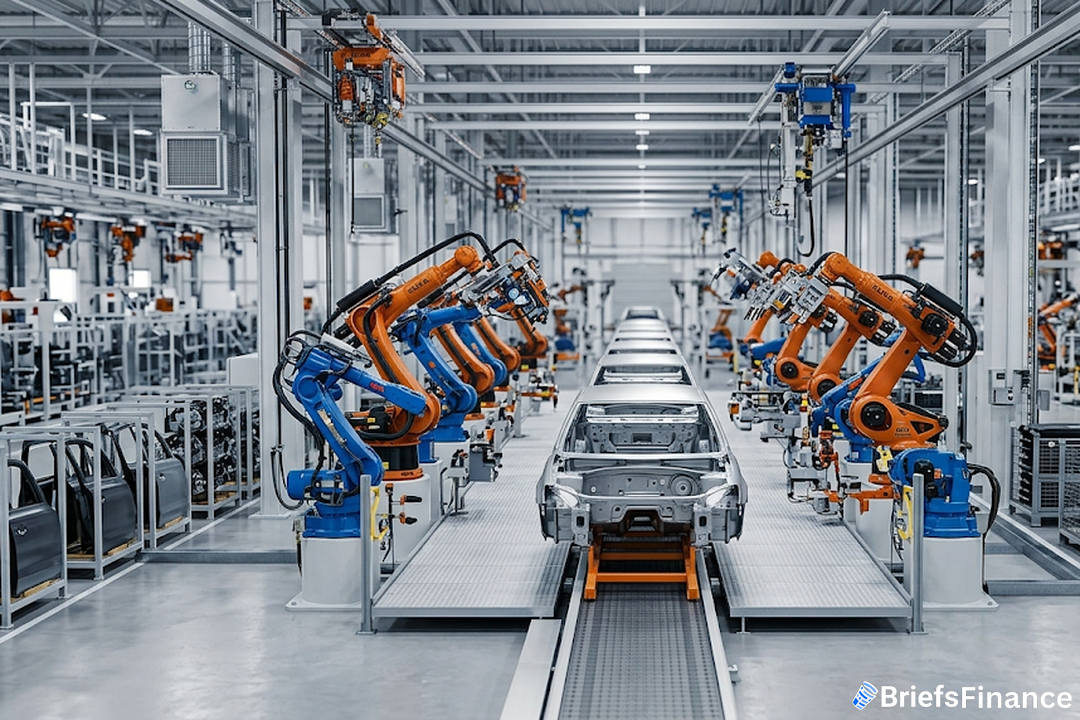
Factory Output Hits a Wall
Economists had predicted a rebound in American factory activity. But the June numbers from the Federal Reserve tell a different story.
Factory output did not change from May to June, missing the 0.1% rise that economists anticipated. May's increase was upwardly revised to 0.1%.
For now, the rebound seems to have stalled.
Factory capacity utilization edged down to 75.7%. The broader industrial utilization rate held steady.
Get the market news that matters in a five-minute read with Market Briefs, our free daily newsletter
The flat reading gains added significance when viewed against the AI-driven surge in computer and electronics output that lifted factory numbers in April and May. That momentum, however, proved short-lived, and the June report suggests the manufacturing recovery remains fragile. Since factory production accounts for roughly three-quarters of total industrial output, the stagnation ripples through the broader economy.
The June data follows a period where AI-related demand boosted computer and electronics output significantly in April and May, raising hopes of a broader manufacturing revival. Yet the flat reading indicates that the rebound remains narrowly concentrated in tech sectors, while traditional manufacturing continues to struggle with weak business investment and elevated costs.
The lack of momentum in manufacturing, especially in durables, highlights the uneven nature of the current economic expansion. While technology-driven segments surged earlier, traditional sectors continue to face headwinds from elevated borrowing costs and sluggish business investment. The Federal Reserve's next interest rate decision will be closely scrutinized for clues on whether policy will shift to support industrial growth.
What Dragged the Numbers Down
The culprit was durable goods - the kind of big-ticket items that last at least three years.
In contrast, output of computers, electronics, defense and space gear - all of which had risen sharply in the prior two months - decelerated in June. That combination left total factory output unchanged.
Other parts of the economy did a little better. Both utility and mining production rose by 0.4% in June. That helped push overall industrial production - which includes factories, utilities, and mines - up 0.1% for the second month in a row.
Rising energy prices are also creating new headaches. A recent spike in oil prices, linked to escalating tensions between the United States and Iran, threatens to raise expenses and weaken demand.
Stuart Paul, an economist at Bloomberg Economics, put it this way: "June's industrial production report is inconsistent with what we're seeing across a host of other datasets. While we've long been skeptical that the US is in the middle of a manufacturing renaissance, we do think there is space for output of durable goods to improve in the months ahead."
The Federal Reserve's upcoming interest rate decision will be closely watched by manufacturers. Higher borrowing costs have already dampened business investment, and a rate cut could provide relief. However, rising energy prices complicate the outlook, potentially stoking inflation and limiting the central bank's ability to ease policy. This tension between supporting growth and controlling prices adds further uncertainty to the industrial sector's near-term trajectory.
Join Market Briefs, our free daily newsletter, for a quick daily rundown of the markets