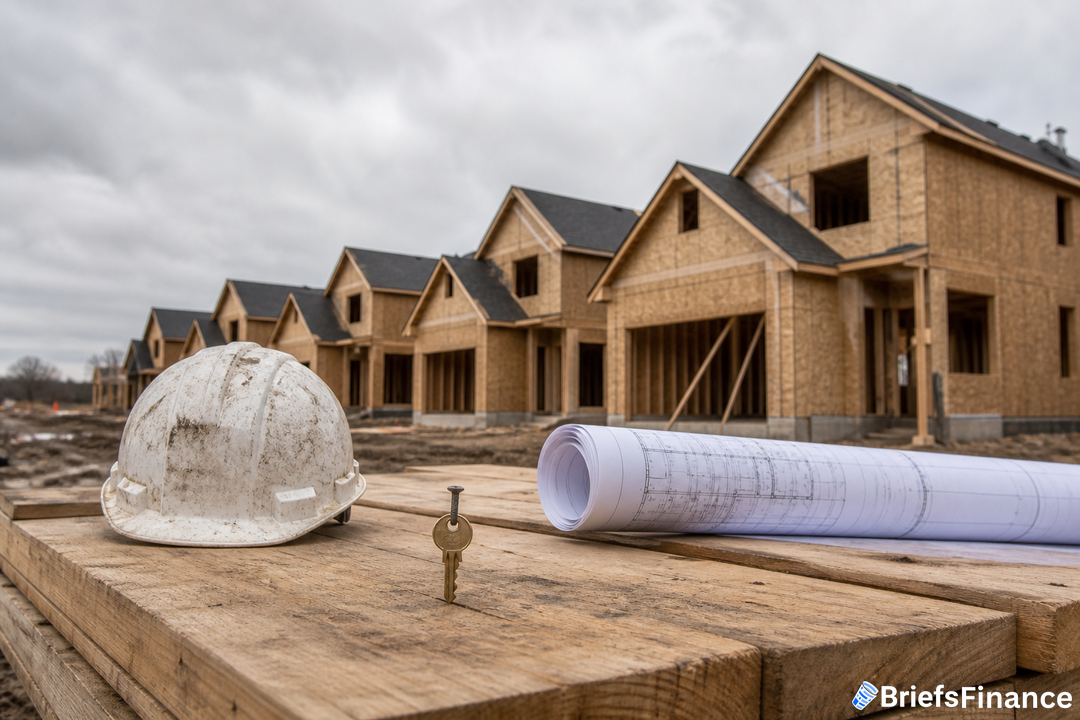
How FHA became a bigger lever for new-home sales
When the frenzy cooled in mid-2022, more new-home closings at the biggest builders started coming with FHA financing. That made sense alongside a broader cooldown, with parts of Texas, Florida, and the Mountain West seeing outright price corrections.
Some of this looks like a return to normal after an unusual boom-era buyer mix. Back then, ultra-cheap conventional financing, metered sales amid capacity constraints, and equity-rich movers from places like New York, Seattle, and San Francisco into markets such as Boise, Austin, and Tampa meant builders did not need to reach deep for entry-level demand.
Affordability strains filled in the rest. After the price run-up and the 2022 rate shock, more shoppers had to stretch. For a sizable slice of shoppers carrying weaker credit scores or heavier debt burdens, a reasonably priced conventional loan wasn't feasible, pushing them toward FHA instead.
Why builders and buyers are turning to FHA now
FHA mortgages, insured by the Federal Housing Administration, are common among first-time buyers and those with weaker credit. The program allows 3.5% minimum down payments and will approve applicants with shakier credit and debt-to-income ratios that exceed what most conventional products allow.
Large builders such as D.R. Horton run captive mortgage units that finance most of their buyers and have been the primary vehicle for mortgage-rate buydowns since 2022. Many of those operations lean into FHA because the deal structure is friendlier. Sellers are allowed to contribute as much as 6% of the home's sale price toward a buyer's expenses, but if you're using a conventional mortgage with under 10% down, the usual cap on concessions is 3%. Builders can also sidestep that conventional cap if permanent buydowns are funded via bulk forward commitments, which are not counted as seller concessions.
The math adds up too. FHA's pricing does not worsen as sharply for lower credit scores as conventional loans do, and in 2023 HUD cut the annual FHA mortgage insurance premium to 0.55% from 0.85%. Stack a small down payment, looser qualifying, a bought-down rate, and cheaper insurance, and a buyer who would miss on a conventional underwrite can become a closed sale.
Many builders had tilted more toward entry-level product, where FHA is more prevalent. That push has plateaued recently, since entry-level spec homes are also where several of the biggest builders have run into issues in the weakest Sun Belt markets over the past couple of years.
When housing choices shift, keeping a steady plan helps protect and grow your savings. Join Briefs Finance CEO Jaspreet Singh on September 29th for a FREE live investor workshop, How to Profit From A Dollar That's Losing its Value, where he shows how we're spotting investment opportunities as the dollar falls. Save your spot.
Where the exposure lives - and what the numbers say
ResiClub's read of builder exposure counts FHA loans as a share of all sales, including all-cash transactions. Some builders disclose FHA as a percentage of financed transactions only, not of all closings. To map the range across major builders, ResiClub worked with the AEI Housing Center and found a wide split.
In 2025, just 3% of Toll Brothers' homebuyers used FHA financing, compared with 53% at LGI Homes. That lines up with price points: Toll Brothers reported an average selling price of $996,400, while LGI Homes came in at $367,407. High-FHA builders are not necessarily in trouble, but they are more tied to the health of FHA borrowers and the lower end of the for-sale market.
From a performance standpoint, overall mortgage delinquencies remain historically low. Even so, strain has risen most within FHA. Since 2022, FHA 30 plus day delinquency transition rates have moved up meaningfully, while GSE loans backed by Fannie Mae and Freddie Mac have been comparatively subdued.
VA loans have ticked higher too, but FHA stands out. That lines up with borrower profiles: FHA borrowers often come to the table with weaker credit scores and less of a financial buffer, which makes them more vulnerable when prices and interest costs climb.
FHA's footprint is not even across the map. The U.S. South, the hub of single-family homebuilding, has higher FHA concentrations. States including Mississippi, Louisiana, Alabama, and Texas post higher proportions than many areas in the Northeast and on the West Coast. Because many top production builders are concentrated in the Southeast and Texas, any outsized stress among FHA borrowers could show up more in those markets.
Policy shifts, market share, and what to watch
The impact was immediate. Optimal Blue data provided to ResiClub show that the share of FHA mortgage locks by non-permanent residents fell from 3.8% in September 2024 to 0.2% in September 2025. To ResiClub's knowledge, no similar change has occurred within the conventional GSE channel so far. That concentrated the shock in the FHA channel.
Keep the scale in perspective. For 2025, the New York Fed estimates FHA's portion at roughly 12% of the U.S. mortgage balance, which totals $12.94 trillion. Look at loan counts rather than dollars and that share goes up, but FHA is still a minority slice overall.
Bottom line for your wallet: since the boom ended, builders have held sales volumes together by tapping more FHA buyers. Part of that is a normal reset after a weird era, and a lot of it is affordability math paired with in-house lending, seller-paid buydowns, and FHA's looser standards. It works, but it also ties results more closely to the segment showing the most stress. If that stress builds, the earliest cracks likely appear at the entry level, especially in the South and Texas where many big builders operate.
A thoughtful approach to buying and investing can keep your nest egg strong. Our CEO Jaspreet Singh is hosting a FREE live investor workshop, How to Profit From A Dollar That's Losing its Value, on September 29th. Sign up free to join him live.