Free NewsletterPro Login

Free Live Investors Workshop

Seats limited

Tue, Sep 29.

The dollar is losing value.

Here’s how investors can still profit.

Hosted By

Jaspreet Singh

Founder, Briefs Finance

X

Warning: Undefined variable $stocks in /var/www/briefs.co/htdocs/wp-content/plugins/oxygen/component-framework/components/classes/code-block.class.php(133) : eval()'d code on line 448

Warning: foreach() argument must be of type array|object, null given in /var/www/briefs.co/htdocs/wp-content/plugins/oxygen/component-framework/components/classes/code-block.class.php(133) : eval()'d code on line 448

Warning: Undefined variable $funds in /var/www/briefs.co/htdocs/wp-content/plugins/oxygen/component-framework/components/classes/code-block.class.php(133) : eval()'d code on line 472

Warning: foreach() argument must be of type array|object, null given in /var/www/briefs.co/htdocs/wp-content/plugins/oxygen/component-framework/components/classes/code-block.class.php(133) : eval()'d code on line 472
/* the link was here */

BP's North Sea Exit Presents an Immediate Energy Challenge for Britain's New Prime Minister

Published Jul 31, 2026
Share:
Summary:
  • BP is preparing to sell its entire offshore portfolio in British waters, exiting the North Sea completely.
  • The sale lands as new Prime Minister Andy Burnham weighs whether to approve fresh exploration.
  • BP is the last oil major running a separately managed North Sea unit, making the exit politically charged.

A Defining Week for Energy Policy

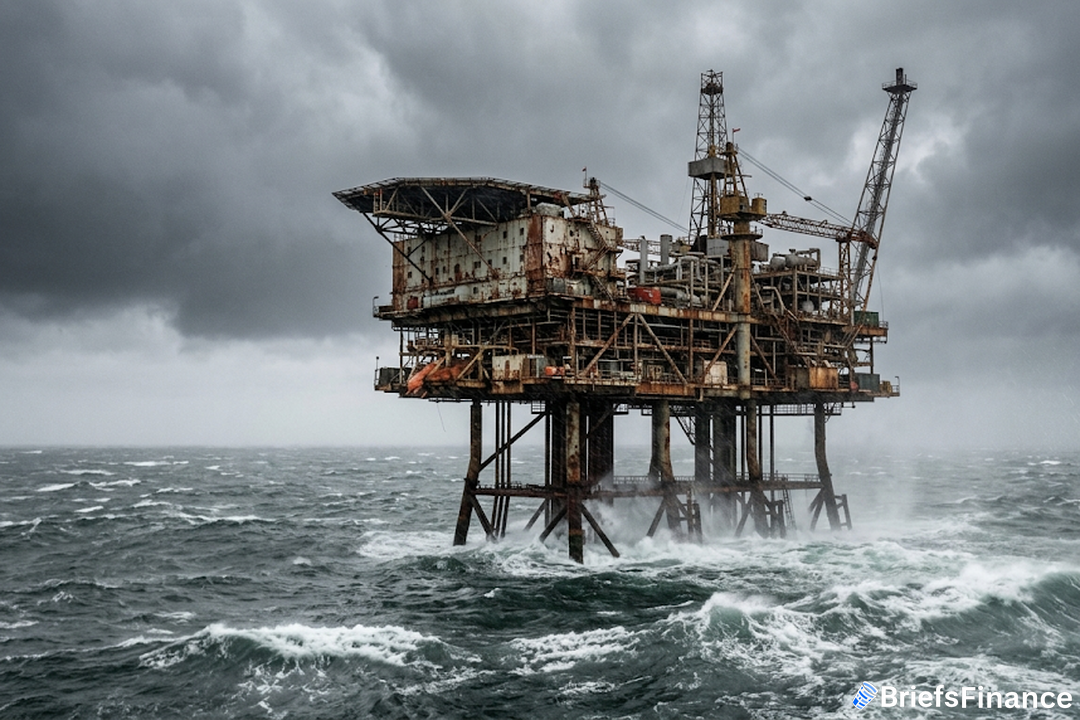
BP Plc is preparing to sell its entire offshore portfolio in British waters, a pivotal moment for the country's shrinking hydrocarbon sector just as Prime Minister Andy Burnham weighs new exploration approvals. As one of the country's largest companies and the last oil major with a separately run North Sea unit, BP is exiting in a move that carries political weight as well as financial consequences.

After replacing Keir Starmer as the country's leader last week, Burnham has indicated he might take a softer line on hydrocarbon exploration in the seas around Scotland. That places him between environmentalists and trade unions, two groups crucial to his Labour Party. Rival parties contend that additional drilling could lower household bills.

BP's move comes after years of friction between North Sea producers and successive governments. In 2022, the Conservatives slapped a windfall levy on North Sea oil and gas output, and producers responded that the tax made investment unviable. The Labour administration, in power for two years, extended that levy and stopped issuing new exploration licences.

BP's departure "should be a defining moment for the new prime minister," said Russell Borthwick, who heads Aberdeen and Grampian Chamber of Commerce. He added that the decision was "another stark reminder that confidence in the UK continental shelf has been badly shaken" after policy instability, high taxes and conflicting signals.

Investors and Activists Watch Closely

Investors and energy executives are waiting to see whether Burnham changes course. President Donald Trump has taken a close interest. During their first call, Burnham told Trump that his approach to drilling would be "pragmatic." Trump welcomed that and said the prime minister had "pledged to open up the North Sea."

Get the market news that matters in a five-minute read with Market Briefs, our free daily newsletter

On Thursday, Burnham defended his position: "There is a resource there. When people are struggling - you can't ignore that."

Trump regularly criticised Starmer for refusing to back new North Sea projects. His decision to attack Iran has also unsettled global oil and gas markets, making the choice between renewables and fossil fuels more politically charged. Wildfires across Europe, including one in Suffolk, have kept climate change high on the agenda.

Whether to approve the Jackdaw and Rosebank fields is the most pressing choice facing Burnham's government. Adura, a joint venture between Shell and Norway's Equinor, operates both. Rosebank, the biggest untapped field in UK waters, is thought to hold between 300 million and 500 million barrels of oil equivalent.

The two projects are now in the public comment phase. Anonymous administration sources said Burnham would probably approve Jackdaw at minimum, while maintaining the freeze on new exploration licences inherited from Starmer.

Andrew Griffith, the Conservative shadow business secretary, said: "This is one of those 'moments' that should serve as a deadly serious wake up call. Britain needs to compete - for energy, capital and talent - but the government carries on putting up taxes and piling on red tape."

A Long Retreat From the Basin

BP's decision is part of a wider exodus. Shell and TotalEnergies have folded their North Sea operations into independent units, while Chevron and ConocoPhillips have already sold out. BP had already been retreating for several years, offloading part of the Shearwater field to Shell and handing the Forties pipeline system to Ineos. It retains a 45% interest in Clair, the UK's largest oilfield, and turns out roughly 100,000 barrels of oil equivalent per day from five hubs, a small portion of its total daily output of 2.3 million barrels.

BP chief executive Meg O'Neill said the UK remained important to the company, but "as we focus our portfolio and direct capital to our highest-value opportunities, we believe our North Sea business will be better positioned as part of another company."

Greenpeace UK political campaigner Angharad Hopkinson cautioned against clinging to a declining basin. "Pragmatism means facing reality, not clinging to a dying basin while communities, the economy and the climate all demand a more secure future," she said.

Join Market Briefs, our free daily newsletter, for a quick daily rundown of the markets
Disclosure

Recent News

1 2 3 80

Get Market Briefs delivered to your inbox every morning for free!

No fluff. No noise. No politics. Just finance news you can read in 5 minutes.

Blogs

September 17, 2026
Why America Bailed Out the Yen: The Japan Carry Trade, the Dollar and Your Mortgage Rate
  • In July 2026 the US sent money to steady the yen because Japan is the largest foreign owner of US debt, and Washington needs Japan to keep lending.
  • For decades the Japan carry trade let Wall Street borrow yen at essentially 0% and pour it into US stocks, real estate and Treasuries, and rising Japanese rates are shutting that off.
  • A weaker yen means fewer buyers for the dollar and for US debt, which pushes Treasury rates up and drags mortgage, car loan and credit card rates up with them.
Read More
September 16, 2026
Treasury Yields Are Spiking Because Lenders Are Backing Away From U.S. Debt
  • The U.S. is paying its highest 30-year borrowing rate in about two decades because its biggest lenders, the Fed, foreign governments, and banks, are all pulling back from Treasuries.
  • Every mortgage, car loan, credit card, and business loan is priced off the 10-year Treasury yield, so when Washington pays more to borrow, so do you.
  • With about $40 trillion of debt against a $32 trillion economy, the country either outgrows its debt or slides into a doom loop, and investors need a plan for both.
Read More
September 15, 2026
Fiat Currency Runs on Trust, and the World Just Stopped Trusting the Dollar
  • Gold has overtaken US treasuries as the world's top reserve asset, and central banks are now buying less US debt and more gold.
  • The US dollar is a fiat currency, meaning it's backed by a promise rather than gold, so it loses value when fewer countries want to hold it.
  • Whether the US economy or its national debt grows faster from here decides which assets stand to benefit next.
Read More
September 14, 2026
Why RAM Prices Are Soaring - and Where the Money Is Moving
  • Memory chips - the RAM inside phones, laptops, fridges, and trucks - are in a shortage Tim Cook called a 100-year flood, and some memory prices have climbed about 90% in a single quarter.
  • Four forces hit at once: AI demand, a production shutdown in 2023, build times that push any fix to 2028 at the earliest, and a bombed helium plant in Qatar.
  • The last two supply shocks ended in aggressive Fed rate hikes and market drops of around 45% and 20%, and this time Washington is spending heavily to bring memory production home.
Read More
September 11, 2026
How Is the Economy Doing? Washington Says It's Fixed, but the Numbers Don't Agree
  • Treasury Secretary Scott Bessent says the economy is fixed because lower earners' incomes are now rising faster than top earners'.
  • The Atlanta Fed and Bank of America show different numbers, and Hilton, Marriott, and McDonald's can't agree on what they're seeing either.
  • Whichever side is right, the economy is built to make investors rich, and inflation is how it does it.
Read More
September 10, 2026
US National Debt Hits $40 Trillion: Why the Economy Hasn't Collapsed Yet
  • The US national debt crossed $40 trillion in 2026 and is growing faster than the economy. The debt to GDP ratio now sits at 125%, the highest outside the pandemic and higher than World War II.
  • On September 9, 2026, Treasury Secretary Scott Bessent rolled out an emergency plan for the government to lend money to itself. Ray Dalio now says the dollar has roughly three years before real pain.
  • Empires rarely default. They debase. Since 1971, median household income grew about 8x while houses grew 17x and the S&P 500 grew 360x, so investors got richer while workers fell behind.
Read More
September 9, 2026
Your 401k Is Fueling the AI Bubble
  • About $10 trillion of 401k money sits in a $77 trillion stock market, mostly through target date funds and S&P 500 funds. Roughly 30% of every S&P 500 dollar lands in five AI-heavy tech stocks.
  • Four bubble signals run hotter today than before the 2000 crash: top-ten concentration, tech's share of the index, the Buffett Indicator, and how much of the market index funds own.
  • You only lock in an AI bubble loss if you sell. The 2022, 2020, 2008, and 2000 crashes were all buying windows for long-term investors, and the US-China AI race means government money could keep flowing in.
Read More
September 9, 2026
What Is Wealth Preservation? How To Protect Your Money From Anything
  • Wealth preservation is an investing strategy built around keeping the money you've already made instead of chasing growth.
  • It leans on assets that hold steady when markets fall - gold, Treasury bonds, and companies that keep earning through wars, crashes, and pandemics.
  • The tradeoff is real: you give up some upside, and the two key numbers to check are maximum drawdown and correlation to the market.
Read More
September 8, 2026
Why Is Everything So Expensive? Why Prices May Never Come Back Down
  • Official inflation is 3.4% and prices are up 32% since 2020, but rent (41%), gas (47%), car insurance (64%) and ground beef (79%) all outran the 28% median wage.
  • The Federal Reserve targets 2% inflation on purpose. Rising prices push extra dollars to investors and shrink the real cost of a $40 trillion national debt.
  • Investors who simply owned the S&P 500 gained about 150% over the same six years, and the Fed's September 16 decision will show whether it protects the dollar or the economy first.
Read More
September 7, 2026
The U.S. Housing Market Just Flipped: Renting a Home Now Beats Buying One
  • The US is in a buyer's market in 41 of the 50 largest metro areas, but prices sit near record highs and mortgage rates are close to 7%.
  • The same median house costs 27% more than it did in 2021 while the monthly payment costs 90% more, and incomes rose a little more than 10%.
  • A 2008-style crash is not showing up in the data, so the pressure is landing on buyers instead of prices.
Read More
1 2 3 27
Share via
Copy link












