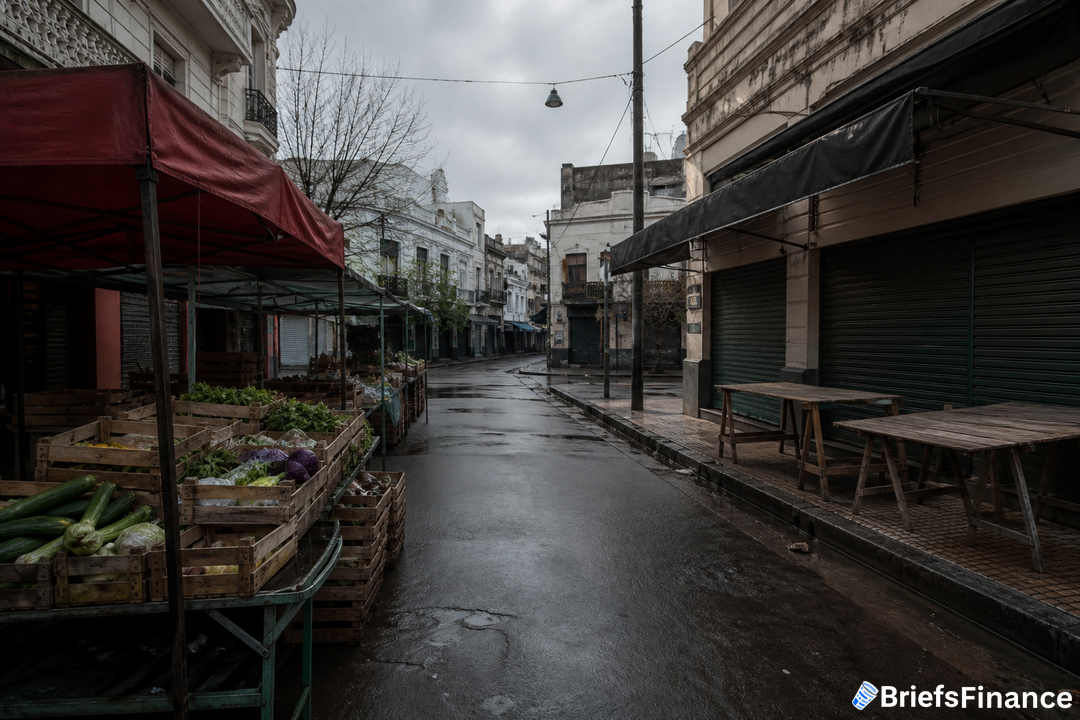
Small uptick, big miss
Argentina's monthly activity index barely grew in August, rising 0.1% from July and coming in well under the 1.5% gain economists expected. Compared with August last year, it contracted 1.7% against a flat 0.0% forecast, according to data released Wednesday.
Wage growth offered one bright spot. Pay in the formal private sector outpaced inflation for the third month in a row, a sign that household demand could get some support.
Exports prop up growth as domestic sectors lag
Energy and farm shipments are doing the heavy lifting on exports, but manufacturing, construction and retail remain in a slump that is diluting those gains. The weakness was stark in July, when the monthly index fell 2.8% from June, the worst single-month drop since the pandemic.
Bloomberg Economics summed up where that leaves things: "August activity figures failed to deliver relief from July's plunge, leaving Argentina's economy almost 3% below its second-quarter level with two months' of 3Q data in hand. This puts it on track for a quarterly contraction, consistent with a technical recession. Still, we don't think the economy has taken an irreversible turn for the worse." The assessment came from Jimena Zúñiga, a Latin America geoeconomics analyst.
When economic signals can be noisy, get a clear free daily read by signing up for Market Briefs
Politics, polls and what is next
The cooling economy and formal job losses are eroding the political lift Milei hoped to get from lower inflation, which has been his standout achievement. With one year to go before the next presidential vote, his approval rating sits at 39% and has stabilized in recent months after a sharp early-year drop, per LatAm Pulse polling by Atlas Intel for Bloomberg News.
After a drop in the second quarter, GDP is projected to contract again in the third on a quarter-over-quarter basis, satisfying the common rule-of-thumb for a recession. Looking further out, analysts in the central bank's latest survey see 2026 growth at 1.5%, cut from 3.2% at the year's start.
Why investors should care
For portfolios with Argentina exposure, the picture is an export-led economy fighting domestic drag. If quarterly output contracts again, that recession tag could keep pressure on local cyclicals while favoring names tied to energy and agriculture. Polls and monthly activity prints now double as a read on both growth and Milei's political runway.
If you prefer a five-minute morning update, subscribe to the free Market Briefs newsletter to stay informed