GM's new playbook: AI, software, and speed
On Oct. 21, 2026, at the GM Forward gathering in downtown Manhattan, General Motors made software and artificial intelligence the focal point of its future design and manufacturing strategy. "All of these developments are building us the car of the future," CEO Mary Barra said.
The pitch is simple: make the company nimbler while packing more capability into vehicles. "Over the last 12 months, we've evolved how we design, engineer and build our vehicles," said Chief Product Officer Sterling Anderson, who led the event and is overseeing GM's latest tech shift.
Cutting the clock to two years
GM now aims to compress the stretch from concept to production to roughly two years, instead of the usual four to five years, but it did not specify when that cadence would become standard. "There's inherent virtue to speed," Anderson told CNBC. "Not just in being able to get a car out faster, it's being able to develop a system that's far more performant that you could have otherwise."
The urgency has a global backdrop. AlixPartners estimates China is getting vehicles to market about twice as fast, with 40 percent to 50 percent less investment and a 30 percent cost advantage. GM said it is building a revamped development playbook for vehicles, anchored in enterprise AI and virtualization. "This concurrent engineering model allows us to innovate faster, improve continuously, and scale new technologies across our lineup with incredible agility," the company said.
The new vehicle brain and 2028 autonomy targets
GM continues to play catch-up to Tesla on delivering tech through over-the-air updates and automated driving. Anderson, previously an executive at Tesla, declined to make a direct comparison of GM's systems, but said using multiple types of sensors allows GM's vehicles to perceive more than a camera-only setup. He also said faster development and new software architecture should help the company compete with Chinese automakers abroad.
That architecture centers on a new electronics platform that GM says will reach both EVs and gas models. The company says it will deliver 40 times the computing capability and as much as 50 percent quicker cellular connectivity than prior systems, enabling richer over-the-air updates, onboard diagnostics, AI features, and automated driving. GM says this vehicle brain will debut on the $130,000 Cadillac Escalade IQ EV in 2028, then spread to other models, including the next generation of its EVs.
Technology keeps reshaping transportation and investing, so stay ahead with the free Market Briefs newsletter delivered in minutes each morning
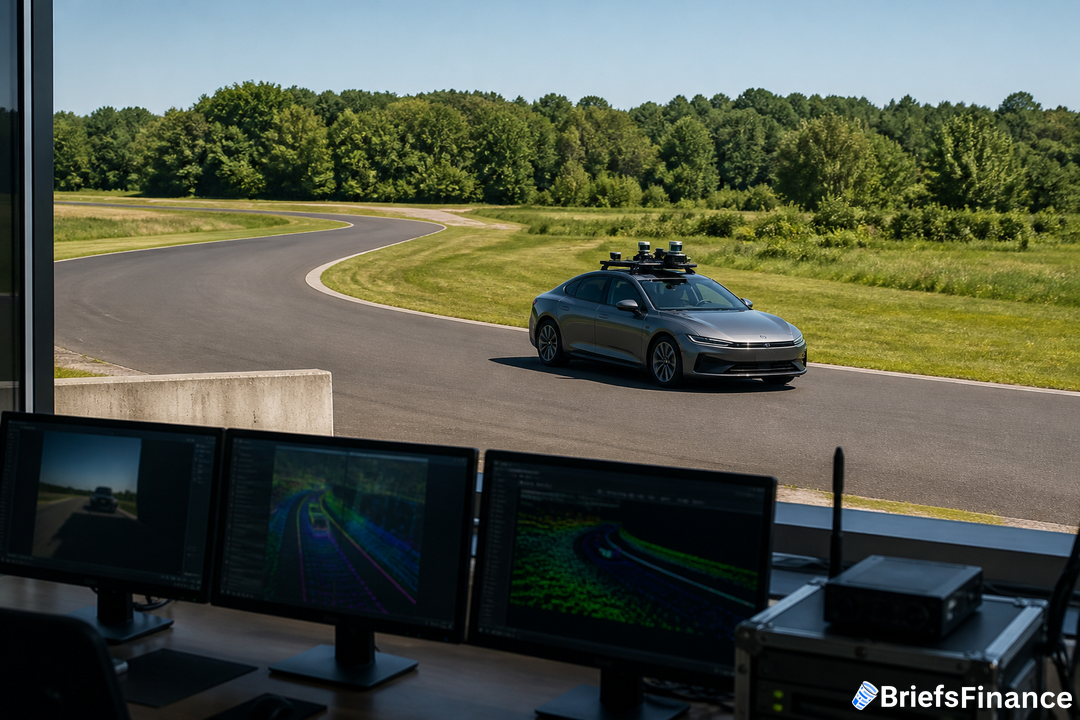
GM also reconfirmed a 2028 goal for eyes-off highway driving that will allow drivers to look away from the road, starting on the Escalade IQ EV before moving into higher volume models. "Our vision is that eventually every vehicle should drive itself or its occupants anywhere, and we're investing across the self-driving stack to make that real," Anderson said.
Batteries, fourth gen EVs, and OnStar AI
GM says future EVs and gas models will share efficiency-minded upgrades. The coming EVs are expected to be 25 percent more aerodynamic and 15 percent lighter, with more compact motors and battery packs. To reach those goals, GM ran virtual evaluations on over 300,000 battery designs using its lithium manganese-rich chemistry before constructing even one prototype.
Anderson said LMR will be the exclusive battery technology for GM's fourth generation EVs. GM had previously stated it intended to deploy those batteries in full-size EVs like the Chevrolet Silverado and Escalade IQ starting in 2028.
Despite slower U.S. EV adoption and GM pulling back billions of dollars in EV investment, President Mark Reuss said the company remains committed. "We continue to develop our future EVs and work to reduce battery costs," Reuss said. "And when the U.S. market is ready for EVs in large numbers, we will be there for them."
GM also intends to roll out a proprietary in-vehicle AI assistant under its OnStar brand. The assistant is expected to launch within the next few months on the 2027 Cadillac Lyriq EV via an over-the-air software update, then expand to additional models, and it will be available via subscription. GM currently uses Google's Gemini for in-vehicle AI and has said its in-house version will tie in more deeply with the vehicle.
Anderson argued GM has the data to build strong AI tools, pointing to more than a century of manufacturing history and 30 years of OnStar. "In the age of AI, data is currency," he said.
The bottom line: if GM hits its own marks - a two year development cycle, the new electronics launch in 2028, and eyes-off highway driving in 2028 - it narrows the gap with faster, cheaper rivals. That trajectory shapes how often your car gets smarter and how the company earns software revenue, both key drivers for your portfolio.
When headlines blur together, get clear, concise context by joining Market Briefs, our free daily newsletter that respects your time